





 Portuguese
  English
  Spanish
  6 min of reading
  2 comments


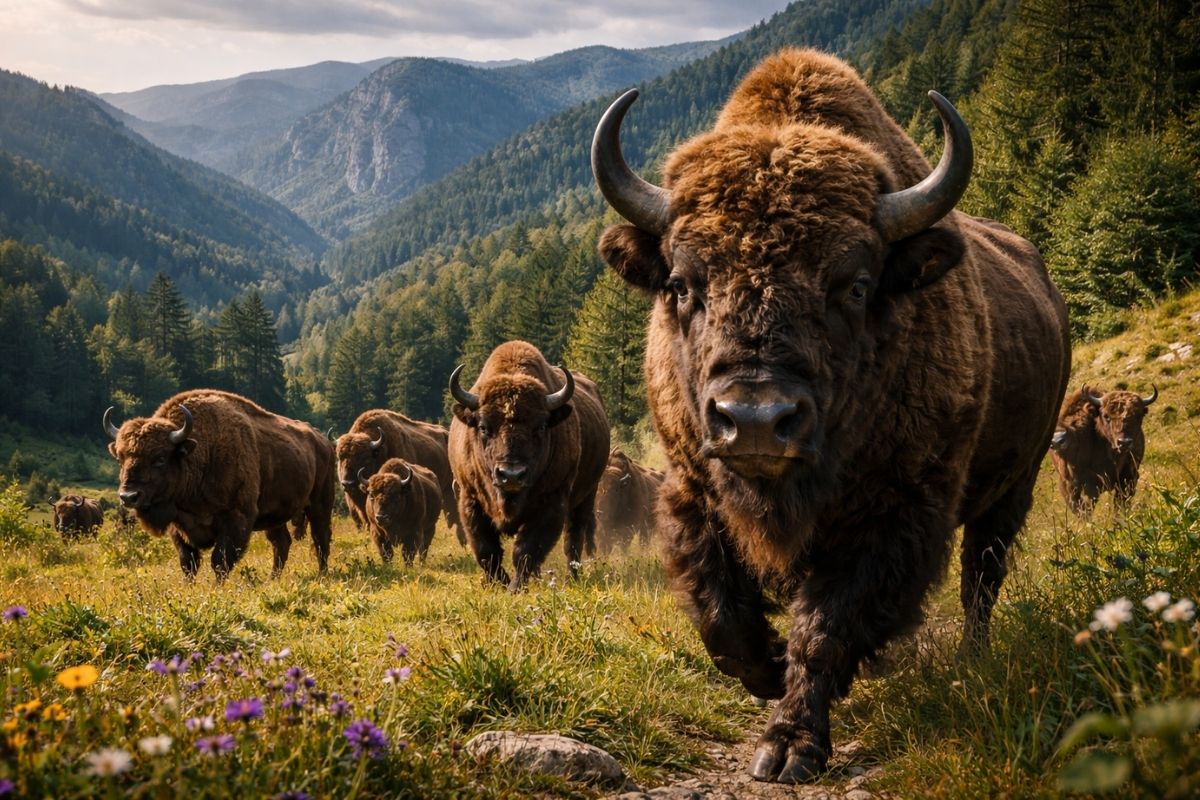


Recently Released European Bison in Zhenda, Bulgaria, Reinforce Rewilding in the Rhodope Mountains After a Journey of Over 1,000 Kilometers, Elevating the Group to 24 Animals and Expanding Grazing, Fertilization, and Habitat Opening Effects, with Gains in Biodiversity, Carbon Sequestration, and Nature Tourism in the Region
On December 10, 2024, the landscape of the Rhodope Mountains in Bulgaria received a symbolic and operational boost for rewilding: five European bison were transferred to the Zhenda nature reserve and placed in an acclimatization enclosure. With the arrival of the group, the regional population reaches 24 European bison, consolidating a stage of expansion that has been built since the reintroduction that began in 2013.
The return of European bison carries a double promise. Ecologically, the species is seen as crucial for enhancing biodiversity and supporting processes linked to carbon sequestration, by maintaining a mosaic of forests, pastures, and scrublands. In territorial terms, the presence of European bison is associated with nature tourism and the need to prepare for gradual human coexistence as rewilding increases the number of animals roaming free.
Release in Zhenda and the Acclimatization Phase

The operation began in late November when four females and one male calf were released into an acclimatization enclosure in Zhenda, a priority area for rewilding in the Rhodope Mountains.
-
The winter of 2026 in Brazil will not be what you expect: meteorologists warn that the season will be warm and rainy at the same time due to the advance of El Niño, which is already warming the Pacific and changing the climate of the entire country.
-
For the first time, humanoid robots will compete in a full half-marathon without any human assistance in Beijing, with over 100 teams from China registering machines that need to complete the course with autonomous navigation on two legs.

-
Submarine cables installed to transmit the internet now also help scientists detect earthquakes.

-
After so many blackouts, a family transforms an electric truck into a power source for their home and shows how a 100 kWh battery can keep everything running for days.


The purpose of the enclosure is to allow the European bison to undergo a period of adaptation to the local environment before being released into the wild.
The acclimatization phase was planned to last several months.
Experts from the Rewilding Rhodopes project team closely monitor the health and well-being of the European bison during this period, with constant observation of the group’s behavior and assessment of signs of complete adaptation to the location.
Only after this stability diagnosis is a full release into the Zhenda landscape anticipated.
A Two-Day Journey and Over 1,000 Kilometers

The five European bison did not come from a local herd.
They were transferred from the Zubria Zvernica Breeding Center, a wildlife sanctuary dedicated to the conservation and education about bison, located in a state forest in the heart of Slovakia.
The journey to Bulgaria was described as a two-day trip, surpassing the mark of 1,000 kilometers.
The long-distance movement highlights the effort behind rewilding.
In addition to moving animals, the transfer connects to a European strategy for population reconstruction: breeding centers and sanctuaries supplying individuals to areas seeking to reestablish wild populations, as seen in the Rhodope Mountains.
3,800 Hectares of Habitats and a Mosaic with Large Predators
The rewilding site in Zhenda has a clear territorial scope: 3,800 hectares.
Efforts to restore wildlife on-site began in early 2024 and combine forest and open habitats, a landscape design that supports the reintroduction proposal of European bison.
When they leave the enclosure and begin to roam free, the European bison will share the area with wolves, brown bears, jackals, red deer, and chamois.
Coexistence with this set of species is treated as part of the ecological revitalization of the Rhodope Mountains, as it enhances interactions among predators, herbivores, and other species, creating space for greater biodiversity on different scales.
Why European Bison Are Considered Ecosystem Engineers
The impact of European bison is attributed to four mechanisms cited as the basis for the animal’s effect on the landscape: grazing, feeding, trampling, and fertilization.
These processes help maintain the region’s mosaic rich in biodiversity, with forests, scrublands, and pastures, in addition to countless micro-habitats that house a wide range of plant and animal species.
This logic is central to rewilding in the Rhodope Mountains.
The presence of European bison helps maintain a mosaic of forests, scrublands, and pastures, which fosters biodiversity by increasing the variety of micro-habitats.
At the same time, European bison function as an emblematic species, as their return also signals a recovery of the wildlife that had historically been interrupted in Bulgaria.
Biodiversity, Carbon Sequestration, and Nature Tourism in the Same Equation
The project’s argument in Bulgaria combines three fronts: biodiversity, carbon sequestration, and nature tourism.
Biodiversity appears as a result of the habitat mosaic and the formation of micro-habitats. Carbon sequestration arises as a climate benefit associated with the functioning of pastures and large connected landscapes.
Nature tourism enters as a vector for development linked to the presence of an iconic animal and the expansion of observation opportunities.
In the specific case of carbon sequestration, a modeling study released by the Yale School of the Environment, still not peer-reviewed, estimated that the population of European bison in the wild in the Southern Carpathians rewilding landscape in Romania could help pastures capture around 10 times more carbon than before the reintroduction.
The practical message associated with carbon sequestration is straightforward: to maximize capture and storage, European bison need to be able to roam freely across large, naturally well-connected landscapes, a condition considered essential for sustaining the effect over time.
In the Rhodope Mountains, rewilding treats biodiversity and carbon sequestration as scale- and time-dependent effects.
Thus, increasing the population to 24 European bison is seen as a relevant step, but within a long-term trajectory, where nature tourism tends to grow in parallel with the consolidation of a sustainable population.
From Extinction in the 20th Century to the Leap from 2,500 to 9,000 in the Last Decade
The European bison once existed in large numbers across much of Europe.
In Bulgaria, the species disappeared from the wild during the Middle Ages, and a combination of hunting and habitat loss led to extinction as a wild species in the early 20th century.
By 1927, fewer than 60 individuals remained in zoos and private parks, a low point that required population rebuilding from a few animals.
Since then, reintroduction programs have restored significant wild populations in Central and Eastern Europe, particularly in Poland and Belarus.
Bulgaria had a small reintroduced herd in the northeastern part of the country in the 1960s, and a more recent return occurred in 2013, when European bison returned to the Rhodope Mountains.
In the last decade, the total number of European bison increased from just over 2,500 to around 9,000 individuals, described as a significant recovery on a continental scale.
Rewilding in Network: Rhodope, Southern Carpathians, and Oder Delta
The movement in Zhenda is not happening in isolation.
Complementing efforts in the Rhodope Mountains, the restoration landscape of the Southern Carpathians, from Rewilding Europe, hosts a population of over 200 European bison in the wild, the result of a reintroduction program that began in 2014.
On another front, there is support for the return of bison in the Oder Delta, a landscape shared by Germany and Poland.
This connection helps explain why rewilding treats European bison as a central piece. Projects in different regions work to expand populations, consolidate connectivity, and thus sustain biodiversity and benefits such as carbon sequestration.
In the Rhodope Mountains, the expansion to Zhenda in 2024 adds a new point to this network, with the explicit goal of establishing a sustainable population in Bulgarian territory.
Local Partnerships and the Challenge of Coexistence as the Population Grows
The reintroduction in Zhenda is part of a partnership between the Rewilding Rhodopes Foundation and the South Central State Forest Enterprise in Smolyan, aimed at restoring wildlife in the Rhodope Mountains.
The release of the bison has also been described as a result of collaboration between the Rewilding Rhodopes project, the Zubria Zvernica Breeding Center, and other partners.
Planning for the future includes new releases. At the same time, rewilding asserts that measures will be taken to encourage and enable people to live alongside European bison as the population grows.
In this scenario, nature tourism emerges as part of the package of benefits associated with the presence of the animals, alongside biodiversity and carbon sequestration.
The release in Zhenda, in the Rhodope Mountains, places Bulgaria at a more concrete stage of rewilding: evident numbers, with 24 European bison in the region, 3,800 hectares of territory under restoration, and a strategy that connects biodiversity, carbon sequestration, and nature tourism.
The next step is the acclimatization period, which precedes the full release and tests the territory’s ability to sustain a sustainable population.
If this topic interests you, it’s worth following the upcoming releases and how coexistence will be built in Bulgaria. Would you choose to expand rewilding with European bison in the Rhodope Mountains first or prioritize immediate actions for nature tourism and human coexistence?








Que se hagan millones
Importantíssimo essa reportagem sobre essa **** selvagens, era alimentos dos índios americanos, conseguiam empurrá-los em desfiladeiros para se alimentar, alguns não eram aproveitados, com a implantação ferrovia, os milionários matam por esporte, atiravam dos vagões adaptados para esse fim, era uma matança descivernada.Com esse novo método, vao recuperar essa especie considerada que em instincao para voltar aos olhos dos turistas.Muito bia reportagem.