





 Portuguese
  English
  Spanish
 6 min of reading
  50 comments


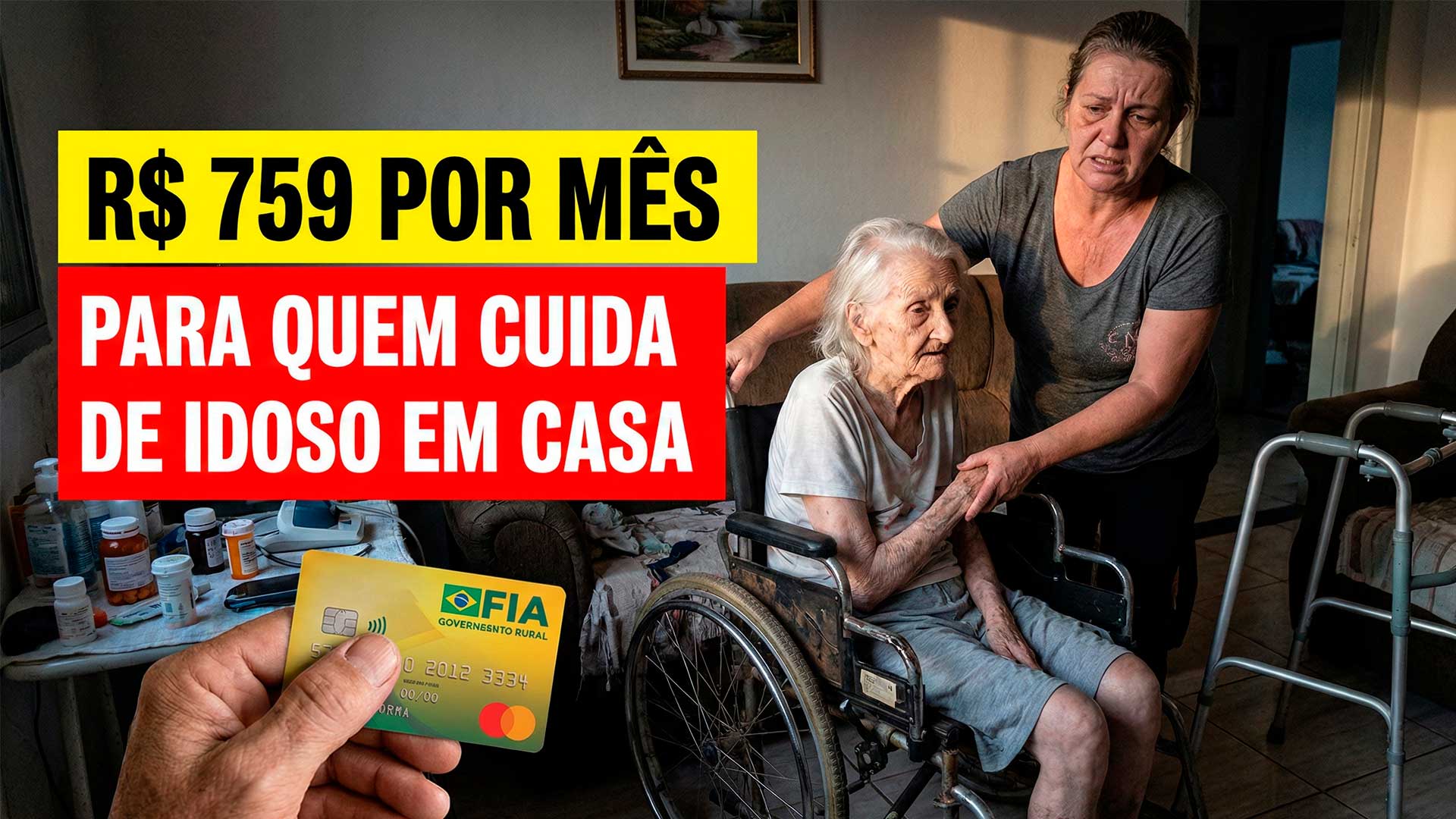


State Program That Integrates Paraná Friend of the Elderly Offers Half a Minimum Wage to Family Caregivers, Begins in Pilot Phase in 20 Cities and Reignites the Debate on Aging, Support Networks and Professionalization of Home Care in Brazil.
The Government of Paraná began, in December 2025, to pay the Family Caregiver Grant to families caring for elderly individuals in situations of dependence at home. The monthly benefit of R$ 759, equivalent to half the national minimum wage in 2025, is aimed at caregivers who have already been performing this work for years, often invisibly.
The program integrates the Paraná Friend of the Elderly, a state policy created by Law 22,189/2024 and regulated by Decree 11,588/2025, which organizes a specific care network for the elderly population.
The initiative was officially structured throughout 2025 and includes, in addition to the financial grant, tools to support municipalities, qualify services, and monitor results.
-
The Senate approves a bill that criminalizes misogyny, hatred, or aversion towards women, and includes the crime in the Racism Law with a penalty of up to 5 years.

-
Chamber Approves Bill That Allows Pepper Spray for Women Over 16 and Imposes Strict Rules for Purchase, Possession, and Use as Self-Defense

-
Chamber Approves Law to Combat Leucaena, Fast-Growing Plant That Dominates Land and Threatens Native Species in Various Regions of the Country

-
Asset Division: Know What Cannot Be Divided in Case of Divorce


In practice, the proposal recognizes that home care for the elderly is no longer just a private family matter. The rapid aging of the population, the increase in chronic diseases, and functional dependence have made caregiving routines more complex and risky when there is no technical guidance.
At the same time, the new benefit also exposes well-known dilemmas for specialists. On one hand, it represents financial relief and symbolic recognition of an intense and undervalued job. On the other hand, it raises questions about the value paid, the limited coverage, and the risk of shifting responsibilities that should be shared with the State and structured health and social assistance services back onto families.
Family Caregiver Grant in Paraná: Value, Criteria and Pilot Phase
The Family Caregiver Grant is anchored in its own legal framework. The state law that established the Paraná Friend of the Elderly program defined general lines of support for the elderly population, and the decree from October 2025 regulated the grant as one of the main tools to strengthen home care. According to the government, the benefit is ongoing, but will depend on periodic evaluation and budget availability.
The amount is half the national minimum wage, currently R$ 759, paid monthly to family members who care for elderly individuals with clinical functional frailty and in situations of dependence. To be eligible, the caregiver must be at least 18 years old, live with the elderly person, be registered in CadÚnico, and have a family per capita income of up to one minimum wage, among other criteria defined in state regulations.
Implementation began in a pilot phase, with 300 benefits distributed in 20 municipalities in Paraná, such as Londrina, Cascavel, Guarapuava, and Ponta Grossa, averaging 15 grants per city.
The government states that expansion to other locations will be gradual, as municipalities join the program and establish local committees and registries. However, specialists point out that the number of spots remains small compared to the number of dependent elderly individuals across the state.
Accelerated Aging Pressures Families and Public Policies
Demographic data helps explain the urgency of the measure. Projections from IBGE show that the proportion of people aged 60 and older nearly doubled between 2000 and 2023, rising from 8.7 percent to 15.6 percent of the Brazilian population. By 2070, around 37.8 percent of the country’s inhabitants will be elderly, amounting to over 75 million people.
This change has a direct impact within households. Studies from the Institute for Applied Economic Research (Ipea) indicate that the number of elderly individuals needing assistance with basic activities such as hygiene, feeding, and mobility has been increasing year after year, which characterizes a situation of functional dependence.
Research shows that millions of elderly Brazilians already report needing this assistance daily, which pressures families and social protection systems for more sustainable and organized solutions.
Caring for the Elderly at Home Requires Technique, Organization, and Safety
Care for dependent elderly individuals involves much more than affectionate companionship. Gerontologist Ana Paula Simões, a researcher affiliated with UFPR, reminds us that administering medications at the correct times, organizing hygiene, preventing falls, and observing changes in behavior are tasks that require specific knowledge. Small errors in these routines can trigger clinical decompensations, severe falls, or preventable hospitalizations.
The Brazilian Society of Geriatrics and Gerontology (SBGG) emphasizes, in its technical materials, that the increase in chronic diseases, frailty syndromes, and dementia conditions makes care increasingly complex. For the organization, ensuring quality of life involves preserving the functionality of the elderly, which includes well-planned routines, adapted environments, and trained caregivers, whether formal or family members.
Publications from the Ministry of Health on patient safety at home point to recurring risks in the houses of elderly individuals. These include errors in medication dosing or timing, insufficient water supply, lack of supervision during critical moments, and inadequate adaptation of environments, such as bathrooms without grab bars and stairs without handrails. These flaws, seen as minor details by many families, are among the factors that most lead to preventable hospitalizations.
For this reason, specialists argue that cash transfer programs, like the Family Caregiver Grant, need to be accompanied by structured guidance, simple training, and periodic follow-up by health and social assistance teams. Home visits, educational materials, and remote support channels can help family caregivers make safer decisions in their daily routines, reducing the feeling of isolation that often accompanies this role.
In the case of Paraná, the policy design includes the use of a State Caregivers Registry, as well as in-person evaluations in partnership with local health and social assistance networks. The government’s stated intention is to strengthen community support networks, ensuring that the elderly can remain at home with dignity, but within a system that monitors criteria, outcomes, and potential risk situations.
Professionalization of Care and Growth of Specialized Services
The creation of the Family Caregiver Grant also engages with a broader movement toward professionalization of elderly care. Recent reports show that specialized caregiver companies, such as the Paraná-based Geração de Saúde, have seen an increase in demand for technical guidance, nursing supervision, and structured routines for families already caring for their relatives at home.
In this context, state financial support is likely to coexist with the pursuit of private or community services that complement family care. Instead of replacing the presence of children and grandchildren, professional teams can organize shifts, standardize procedures, and provide support in more severe situations. The combination of family care and specialized support is seen by many geriatricians as one of the most realistic solutions to address the mass aging of the Brazilian population.
Studies from Ipea on caregiving work remind us, however, that this is predominantly a female activity that is still little recognized as formal employment, which can lead to precariousness if expansion is not accompanied by labor rights and appropriate regulation.
In this scenario, programs like the Family Caregiver Grant can serve as an important entry point to shed light on the issue, but they also challenge managers and society to think about how to distribute the costs and responsibilities of long-term care more fairly.
Do you think that half a minimum wage is an adequate amount to recognize those who care for a dependent elderly person at home, or should the benefit be larger and accompanied by more public services? In your view, does the Family Caregiver Grant strengthen the elderly’s ability to stay at home, or does it shift a task that the State is unable to fully assume onto families? Leave your comment and share how the debate on elderly care appears in your reality.










Qualquer ajuda de custo-benefício é bem vinda.Porém deveria ser um Salário mínimo, cuido à anos da minha irmã que já é idosa e eu também sou, ela têm problemas psiquiátrico e não está fácil, tanto emocional como financeiro. Além do desgaste emocional o financeiro também interfere no dia a dia.
Acho que poderia ser um salário minimo, porque é bastante responsabilidade cuidar do idoso,
Eu acho que poderia ser um salario minimo porque a responsabilidade é grande, cuidar de um idoso, eu cuido de minha mãe, ela não dá trabalho, mais tem idoso que é difícil cuidar !!