





 Portuguese
  English
  Spanish
  4 min of reading
  0 comments


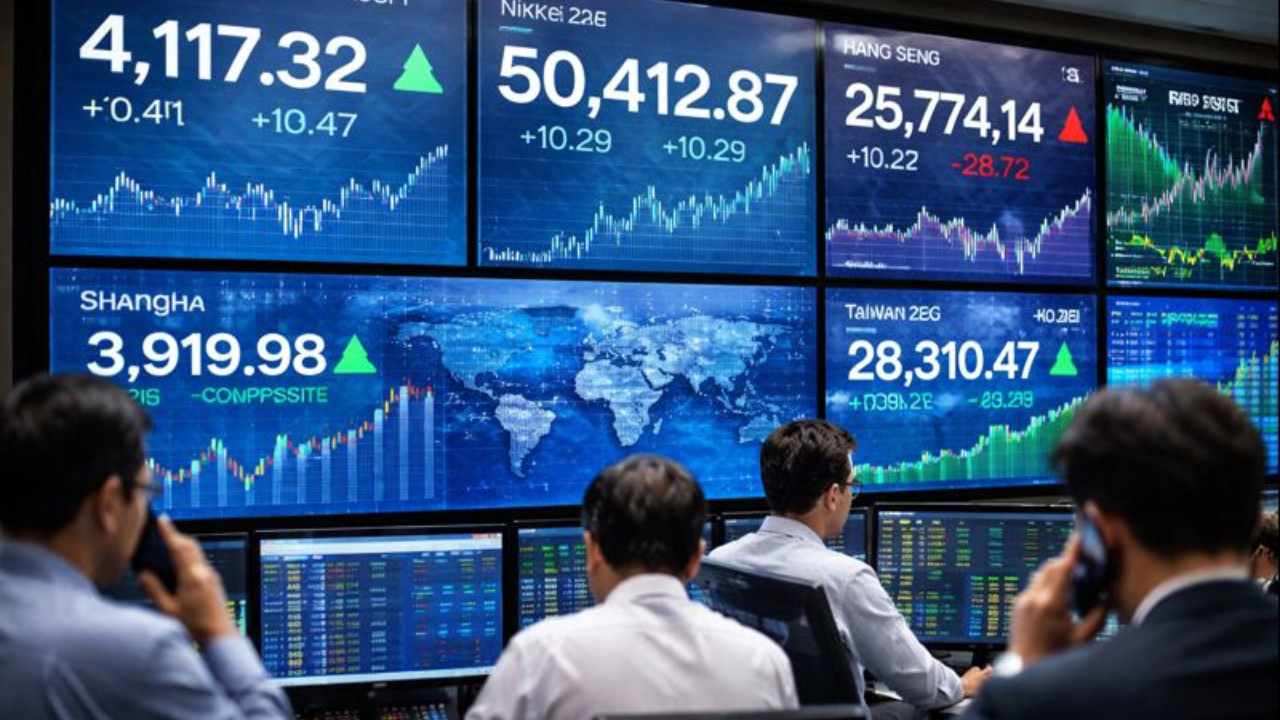
Asian Markets Close Mixed As Investors Watch U.S. Economy And Next Steps Of The Federal Reserve.
The Asian stock exchanges ended the session on Tuesday (23) close to stability, as investors in Asian markets await new indicators from the U.S. economy, which could influence the Federal Reserve’s next decisions and the direction of the global financial market.
The movement came after two consecutive sessions of gains in most of the region, in a scenario marked by caution and selectivity.
Since the early hours of the day, the focus has been on U.S. data regarding economic growth, inflation, and consumer confidence, released throughout the morning.
-
50 viaducts, 4 tunnels, 28 bridges, and 40 kilometers of bike paths: BR-262 in Espírito Santo will receive 8.6 billion reais for the largest engineering project in the state’s history, inspired by the Immigrant Highway in São Paulo.

-
Brazil produces too much clean energy and doesn’t know what to do with it: over 20% of solar and wind capacity was wasted in 2025 while investors flee and 509 renewable generation projects were abandoned in the last year.

-
Piauí will produce a new fuel that replaces diesel without needing to change anything in the truck’s engine and reduces pollutant gas emissions by half: truck drivers from all over the Northeast are already celebrating the news that will arrive later this decade.

-
A new Brazilian shopping center worth R$ 400 million will be built in an area equivalent to more than 4 football fields, featuring 90 stores, 5 cinemas, a supermarket, a college, and parking for 1,700 cars, potentially generating 3,000 jobs.


These indicators are considered crucial for the United States’ monetary policy, especially regarding the pace of interest rates.
Therefore, even with some markets recording slight gains, the overall performance was contained, reflecting the defensive stance of global investors.
South Korea Stands Out With Naval Sector Growth
In South Korea, the stock market showed positive performance.
The Kospi index, the main benchmark of the local stock exchange, closed up for the third consecutive session, rising 0.28% to 4,117.32 points, mainly driven by the shipbuilding sector.
Among the highlights, Hanwha Ocean recorded a strong increase of 12.5%.
This movement occurred after U.S. President Donald Trump announced plans to renew the Navy’s fleet of warships, which boosted expectations for new contracts in the sector.
Additionally, rival companies also followed the positive trend.
HD Korea Shipbuilding & Offshore Engineering rose 3.2%, while Samsung Heavy Industries had a more moderate gain of 1.2%.
Thus, South Korea’s performance stood out among Asian stock exchanges, even in a regional cautious environment.
Japan Edges Higher, But Yen Pressures Exporters
In Japan, the Nikkei index showed a marginal increase of 0.02%, ending the day at 50,412.87 points.
Despite the positive result, the Japanese market faced pressure in the automotive sector, which led the session’s losses.
The strengthening of the yen in the currency market was one of the main concerns.
The appreciation of the currency tends to reduce the competitiveness of Japanese exporters, directly impacting companies focused on international trade.
Meanwhile, Finance Minister Satsuki Katayama reiterated the government’s concern about excessive movements in the currency, signaling possible intervention to contain abrupt fluctuations.
China Has Mixed Performance With Technology And Metals Up
In mainland China, the indices showed mixed behavior.
The Shanghai Composite rose 0.07% to 3,919.98 points, while the Shenzhen Composite ended stable at 2,492.11 points.
Among the positive highlights, mining company Shandong Gold-Mining surged 6.9%, following the global appreciation of precious metals, which remain near historic highs.
Additionally, technology companies also gained momentum. Cambricon and Foxconn Industrial Internet recorded gains close to 4% each.
On the other hand, not all stocks had favorable performance. MetaX Integrated Circuits fell 5.1%, reflecting targeted adjustments in the semiconductor sector.
Hong Kong And Taiwan Follow Distinct Trends
In Hong Kong, the Hang Seng index closed down slightly by 0.11% at 25,774.14 points.
The movement reflected investors’ caution in light of the external scenario and uncertainties related to global economic performance.
Meanwhile, in Taiwan, the Taiex rose 0.57%, reaching 28,310.47 points.
The positive result was mainly supported by stocks linked to the technology sector, which continue to benefit from global demand for chips and digital solutions.
Oceania Maintains Positive Trend Despite Global Scenario
In Oceania, the Australian market showed firmer performance.
The S&P/ASX 200 index closed up 1.1% in Sydney, at 8,795.70 points, marking gains for the fourth consecutive session.
This movement occurred even amid the caution observed in Asian stock exchanges, indicating a greater risk appetite among local investors, supported by internal data and commodity performance.
Global Expectations Remain Focused On The Federal Reserve
Overall, Asian markets remain focused on the upcoming developments in the U.S. economy and signals from the Federal Reserve.
The decisions of the American monetary authority have a direct impact on the global financial market, influencing capital flows, exchange rates, and the performance of stock exchanges around the world.
Thus, as new data does not bring greater clarity on the direction of interest rates in the United States, the trend is for sessions marked by moderate volatility and targeted movements, with investors prioritizing caution and selectivity in investment decisions.








Seja o primeiro a reagir!