






 Portuguese
  Spanish
  4 min of reading
  0 comments


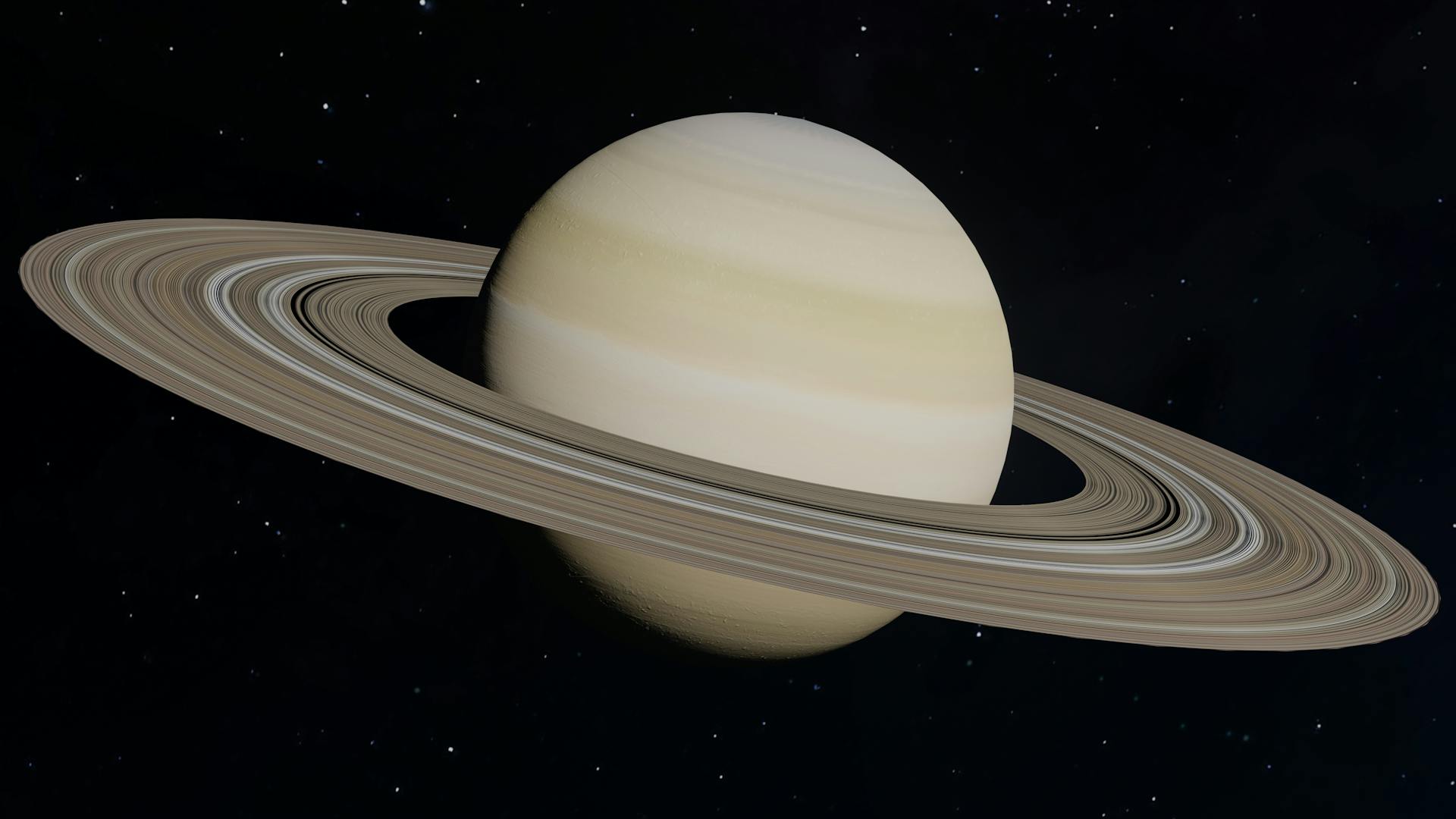
After decades of contradictory measurements, scientists discovered that the planet Saturn does not challenge the laws of physics: the effect is caused by a cycle between auroras, atmospheric warming, intense winds, and electric currents revealed with unprecedented precision by the James Webb telescope
Saturn has returned to the center of attention with an answer to a riddle that has puzzled science for decades: the apparent variation in the planet’s rotation, something incompatible with the expected behavior of a rotating body. New observations indicate that the phenomenon does not represent a real break in the laws of physics, but rather the effect of a self-sustaining cycle linked to the planet’s auroras.
The difficulty arose because, depending on the method of measurement, Saturn appeared to rotate at different speeds over time.
This inconsistency led to doubts about the interpretation of the signals emitted by the planet and kept the origin of this unusual behavior open.
-
Oil Company Robots Discover 3,300-Year-Old Canaanite Shipwreck in the Mediterranean, Proving Ancient Mariners Navigated Open Seas Using Stars Long Before Historians Thought

-
Helicopter Drops 180 Tons of Sand and Gravel on Swedish River to Revive Ecosystem Damaged by Decades of Exploitation

-
Brazilian Company Launches Retro Smartphone with 48 MP Camera, T9 Keyboard, and Privacy Features for Social Media-Free Use

-
Self-Taught Chinese Farmer Builds 5-Ton Submarine from Scrap, Launches It in Anhui River




Now, observations made with the James Webb Space Telescope have allowed scientists to associate the effect with processes in the upper atmosphere of the gas giant.
Tom Stallard, the lead author of the study and a professor at Northumbria University, stated that scientists had known for decades that something strange was happening with Saturn’s apparent rotation rate. He said that previous work had shown that the phenomenon was driven by atmospheric winds, but the origin of those winds still needed to be explained.
Mystery about Saturn’s rotation
The problem dates back to observations made by NASA’s Cassini probe in 2004. At the time, the data suggested that Saturn’s rotation rate was changing, something that did not make sense, as planets do not accelerate or decelerate without the action of an external force.
Later, scientists began to consider that the signal used to measure this rotation did not come from the planet’s core, but from the upper atmosphere. At high altitudes, intense winds would generate electric currents capable of producing a misleading auroral signal, mimicking changes in Saturn’s rotation.
How the Webb investigated the phenomenon
To understand what produced these winds, the team turned its attention to Saturn’s aurora borealis, the planetary equivalent of the northern lights. The James Webb observed this region continuously for a full day of the planet, a period of 10 hours and 33 minutes.
This monitoring allowed for detailed changes to be recorded over time across the auroral area. The advancement was made possible by analyzing the trihydrogen ion, H₃⁺, a molecule that shines in the infrared and acts as a natural thermometer of the upper atmosphere.
By tracking this brightness, researchers created high-resolution maps of temperature and particle density at Saturn’s poles. Previous measurements had error margins of around 50°C, making it difficult to identify more delicate patterns, but Webb’s data achieved accuracy about ten times greater.
The cycle that links auroras, winds, and currents
With this precision, researchers identified detailed structures of heating and cooling for the first time. The hottest regions coincided exactly with the points where auroral energy penetrated Saturn’s atmosphere.
From there, the picture became clearer. The auroras heat the atmosphere, this heating drives winds, the winds generate electric currents, and these currents help to fuel the auroras themselves, forming a self-sustaining system.
Stallard described this mechanism as a kind of planetary heat pump. In practice, the behavior that seemed to put Saturn at odds with the laws of physics came to be understood as the result of a continuous atmospheric and magnetic process.
Impact beyond Saturn
The discovery is not limited to explaining Saturn’s apparent rotation. It also shows a deep and bidirectional link between a planet’s atmosphere and its magnetosphere, the magnetic bubble that surrounds it.
In this scenario, energy does not flow only from space to the atmosphere. The atmosphere itself also participates in controlling what happens around the planet in the space environment, which can alter how signals from other gas giants are interpreted, both in the Solar System and beyond.
The result may also influence studies on exoplanets, where similar auroral processes may affect atmospheric behavior. The study was published in the journal JGR Space Physics.





Be the first to react!