





 Portuguese
  English
  Spanish
  3 min of reading
  1 comment


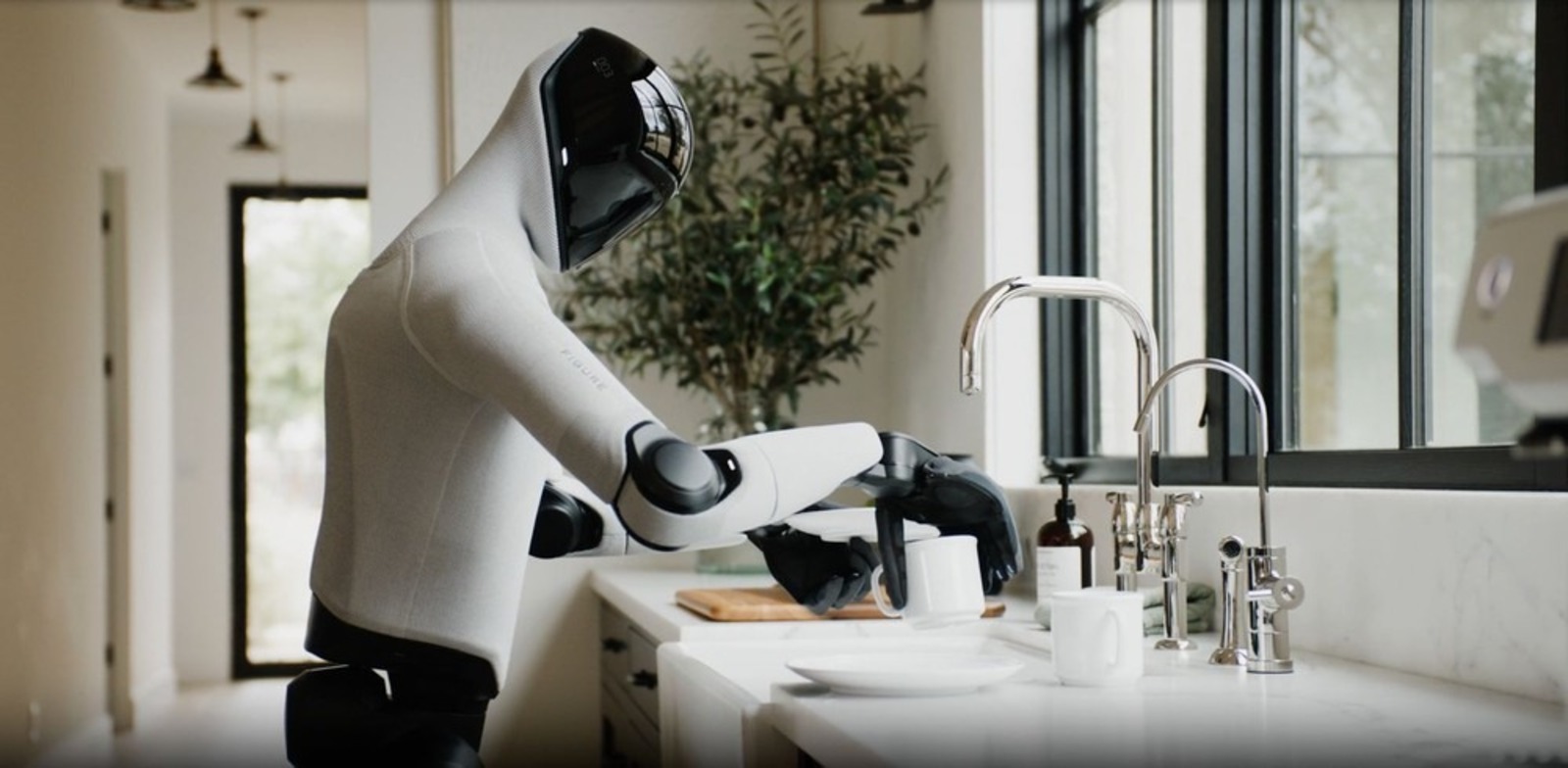


Presented As A Generalist Humanoid For The Home, Figure 03 Reinforces Figure AI’s Bet On Data Learning, Following Previous Industrial Results, And Projects Residential Tests With Autonomy In 2026
Announced on October 9, 2025, the Figure 03, from Figure AI, was presented as a generalist domestic humanoid robot, aimed at various tasks in the home, whose evolution depends directly on the expansion of data to achieve relevant autonomy.
Figure 03: An Announcement That Marked Robotics In 2025
The Figure 03 was described by Figure AI as the third generation of its humanoid line, with a declared focus on domestic environments and various daily tasks.
The proposal includes organizing objects, operating utensils, and interacting with scenarios that constantly change, reinforcing the ambition of an adaptable robot for residential life.
-
A simple stitch in wood with nylon thread can reduce adhesives, speed up production, and make sheets up to 4 times stronger and 14 times more difficult to break.
-
The gigantic steel shell built to contain Chernobyl for a century has been pierced by a drone, exposing a critical system and creating a hole that could cost over 500 million euros to repair.

-
Brazilian Navy reaches a new level by taking over an airport with a 1,600-meter runway used by 1,800 military personnel and autonomous attack drone testing.

-
The Himalayas continue to grow to this day, with tectonic plates advancing 5 cm per year, mountains rising up to 10 mm annually, and the 2015 earthquake that killed 9,000 people may have increased the risk of an even larger seismic mega-event.


The company framed the launch as a strategic step to broaden its scope beyond industrial use, maintaining a narrative of functional generality.
The Central Bottleneck Identified By The Company Itself
Despite the ambitious narrative, Figure acknowledges that full domestic autonomy still faces a central obstacle related to the availability and diversity of data.
According to the company, continuous collection of demonstrations and task records is essential to train the Helix neural network.
The Helix is described as a vision-language-action model, designed for unpredictable environments, with objects and situations that change over time.
Industrial Results Used As A Credibility Basis
The domestic narrative gained strength because Figure had already presented results in the industrial sector before the announcement of Figure 03.
In disclosed tests, Figure 02 was deployed for 11 months at BMW’s plant in Spartanburg, USA.
During this period, the robot operated in 10-hour shifts, Monday through Friday, recording over 90,000 parts handled.
Technical Parameters As References For The Platform
BMW described Figure 02 as a humanoid approximately 1.7 m tall, 70 kg, and capable of carrying up to 20 kg.
These tests were classified as successful in a real production environment, according to the manufacturer itself.
Figure treats these parameters as references for the current stage of the platform, even with Figure 03’s focus directed toward the home.
Helix And The Promise Of Adaptation To Domestic Tasks
In the presentation of Figure 03, Figure AI stated that the robot was designed for Helix, for the home, and for the world at scale.
The announcement highlighted a broad redesign of hardware and software, with the aim of supporting continuous learning from human interaction.
In the technical material, the company asserts that Helix enables manipulation of a wide variety of household items using natural language commands.
Coordination Between Robots And Hands-On Learning
Figure also highlighted demonstrations in which two robots operate simultaneously, coordinating actions in the same manipulation task.
According to the company, this type of interaction reinforces the system’s ability to handle complex and shared scenarios.
The presented strategy is based on the concept of learning by doing, with progressive exposure to new practical situations.
Investments And Declared Horizon For Autonomy
This approach depends on significant investment. On February 29, 2024, Figure reported raising US$ 675 million in a Series B round.
The declared valuation was US$ 2.6 billion, with participation from investors like Microsoft, NVIDIA, Jeff Bezos, OpenAI Startup Fund, among others.
The company also announced a collaboration agreement with OpenAI to develop generative AI applied to its humanoids.
The Path To Residential Tests Of Figure 03
With Figure 03, the declared expectation is to advance to residential tests with selected partners before a wider rollout.
Figure indicates that the combination of a domestic robot, more data, and a Helix trained for variability can elevate levels of autonomy.
In public communications, the company points to 2026 as the target for achieving more advanced capabilities in residential environments.
As a precedent, Figure 02’s industrial trajectory and recent investments form the technical and financial foundation of the company’s current positioning.
With information from Time, Forbes, and other sources.







Que van a comer?