





 Portuguese
  English
  Spanish
  3 min of reading
  0 comments


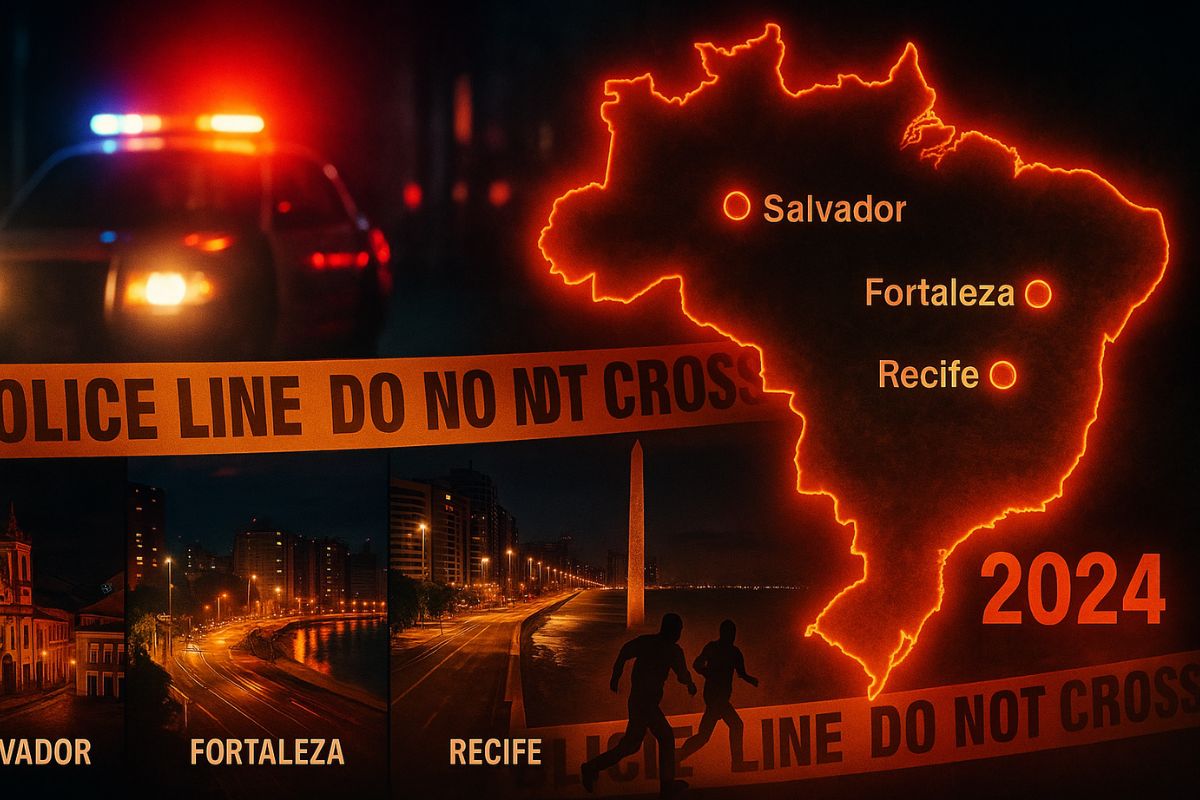
Brazil Has Eight Cities on the List of the 50 Most Violent in the World in 2024, According to Mexican NGO, Highlighting Salvador, Fortaleza, Recife and Feira de Santana — All with Alarming Homicide Rates.
The Brazil has once again appeared worryingly on the ranking of the most violent cities in the world in 2024, prepared by the Citizen Council for Public Security and Criminal Justice, a Mexican NGO that is a reference in this international survey. The study, which mainly considers the homicide rate per 100,000 inhabitants, places eight Brazilian cities among the top 50 positions — with negative highlights for Salvador, Fortaleza and Recife.
According to experts, the result shows how urban violence in the country remains linked to inequality, the presence of organized crime, and the fragility of public security policies. Despite the critical scenario, there are internal differences: some cities that were on the list in previous years have dropped out, while others have entered for the first time.
Which Brazilian Cities Are in the Ranking
According to the report, the eight Brazilian cities that appeared in 2024 were:
-
50 viaducts, 4 tunnels, 28 bridges, and 40 kilometers of bike paths: BR-262 in Espírito Santo will receive 8.6 billion reais for the largest engineering project in the state’s history, inspired by the Immigrant Highway in São Paulo.

-
Brazil produces too much clean energy and doesn’t know what to do with it: over 20% of solar and wind capacity was wasted in 2025 while investors flee and 509 renewable generation projects were abandoned in the last year.

-
Piauí will produce a new fuel that replaces diesel without needing to change anything in the truck’s engine and reduces pollutant gas emissions by half: truck drivers from all over the Northeast are already celebrating the news that will arrive later this decade.

-
A new Brazilian shopping center worth R$ 400 million will be built in an area equivalent to more than 4 football fields, featuring 90 stores, 5 cinemas, a supermarket, a college, and parking for 1,700 cars, potentially generating 3,000 jobs.


- Feira de Santana (BA) – maintains one of the highest homicide rates in the country.
- Recife (PE) – the capital of Pernambuco remains in a critical position.
- Fortaleza (CE) – violence associated with the advance of organized crime.
- Salvador (BA) – the capital of Bahia remains among the most violent cities.
- Maceió (AL) – returned to the ranking after a recent increase in crime.
- Porto Velho (RO) – entered the list for the first time, with high rates.
- Manaus (AM) – returned to the survey after a rise in violence.
- Caruaru (PE) – debuted in the ranking, reflecting recent aggravation.
Compared to previous years, Mossoró (RN) and Vitória da Conquista (BA) left the list, while Caruaru, Porto Velho and Maceió started to appear, revealing changes in the map of urban violence in the country.
What Explains the High Rates of Violence
The report points out that social inequality, low state presence, lack of economic opportunities, and the strengthening of organized crime are determining factors for Brazil to remain among the countries with the most violent cities in the world.
Although some capitals, such as Salvador and Fortaleza, receive thousands of tourists every year, violence is generally more concentrated in peripheral areas, away from tourist hubs. This helps to maintain part of the local economic activity, but does not resolve the insecurity that directly affects residents.
Comparison with Other Countries
Mexico continues to lead the global ranking in the number of violent cities, but Brazil remains among the countries with a significant presence on the list. The difference is that, while some Brazilian municipalities have managed to drop out of the survey in recent years, others have entered, showing worrisome turnover and a lack of consistent long-term policies.
The fact that Brazil has eight cities among the 50 most violent in the world reinforces the structural challenge of public security. Combating only the symptoms is not enough: experts advocate for integration between crime repression and social policies, so that the country can reduce its recurrence in international rankings.
And you, do you believe that urban violence in Brazil can be reduced only with more policing or do you think social investments are the way? Leave your opinion in the comments — we want to hear from those who live this reality up close.








-

2 pessoas reagiram a isso.