





 Portuguese
  English
  Spanish
  7 min of reading
  0 comments


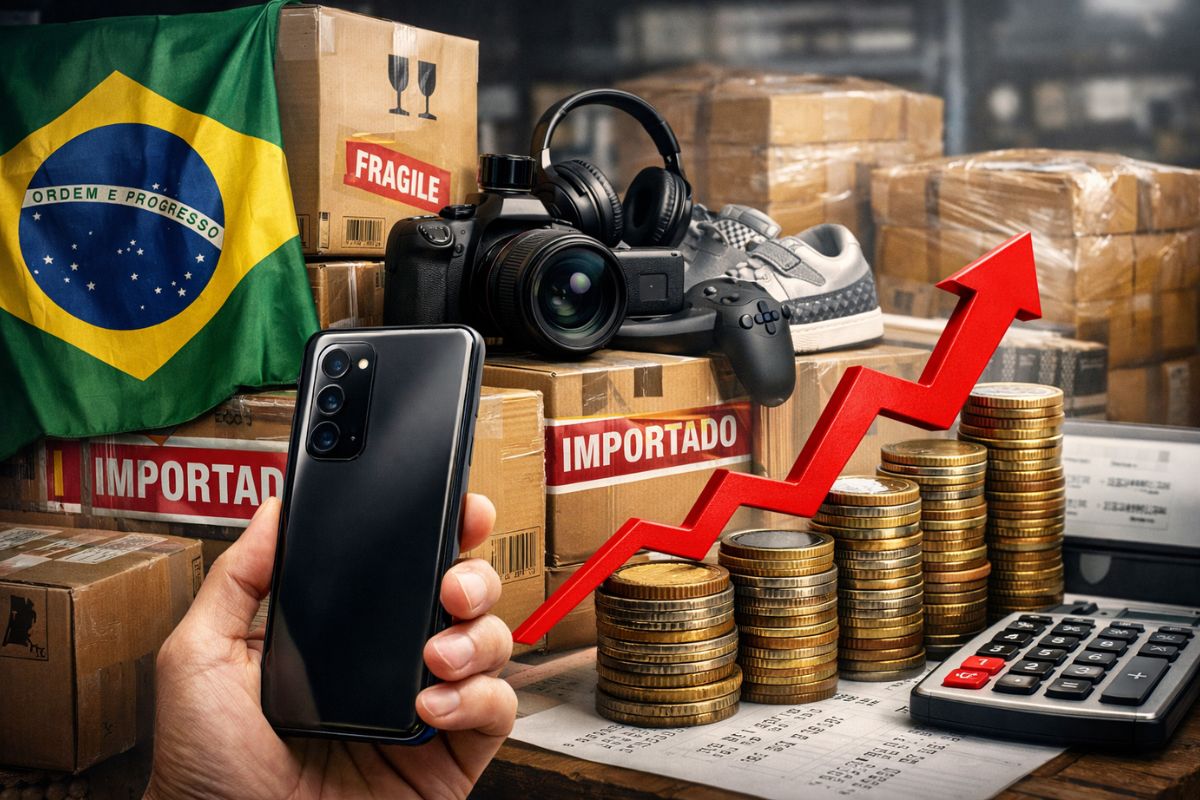
With Import Tax Adjustment of Up to 7.2 Percentage Points, the Measure Affects Capital Goods and IT Items, with Effects That Can Reach TVs, Construction, Medical Exams, and Hospital Maintenance. The Ministry of Finance Claims It Is Moderate Protection; Importers Warn of Pass-Through and Loss of Competitiveness Already This Month.
Brazil raised, at the beginning of this month, the tax on more than a thousand imported products and even included smartphones on the list, in a decision that impacts consumption, investment, and industrial strategy at the same time. The adjustment mainly affects capital goods and IT and telecommunications items, with an increase in taxation of up to 7.2 percentage points.
While the government maintains that the tax is a “moderate and focused” correction to rebalance prices and contain the penetration of imports, importers claim that the cost comes in a chain and can pressure inflation and competitiveness, with repercussions on machines, TVs, hospital maintenance, exams, and construction.
What Changed in the Tax and Why the Smartphone Became a Symbol
The change is broad because the tax was raised for a universe of over a thousand items, including machines and equipment used in production as well as products related to IT and telecommunications.
-
The government requests the Federal Revenue Service for a new system to automate the income tax declaration, reducing errors, time, and bureaucracy for millions of Brazilians.

-
Pix in installments, international Pix, and contactless payment without internet: the Central Bank revealed the new features coming to the tool that is already used by almost every adult in Brazil.

-
Mercado Livre has just started selling medications with delivery in up to three hours to your door, and this move could completely change the way Brazilians buy medicines on a daily basis.

-
In Dubai, rising tensions from the war in the Middle East are causing super-rich individuals to leave the Gulf and direct their fortunes to a new financial refuge in Asia.

Even when the main target seems to be investment, the presence of a high-turnover item like the smartphone causes the debate to escape the industrial sector and go straight into everyday life.
This helps explain why the discussion gained traction: a tax that starts on production goods can end up being visible at the consumer level, whether in the price of a device or in the embedded cost of services and projects.
At the same time, the government insists that the focus is on areas where imports have gained space to the point of creating structural dependency.
The Government’s Logic: Rebalance Prices and Reduce External Vulnerability
In a technical note, the Ministry of Finance pointed out that imports of capital goods and IT accumulated a growth of 33.4% since 2022.
For the economic area, this pace has increased the presence of imports in national consumption to over 45% in December of last year, a level described as capable of weakening links in the production chain and inducing regressions in productive and technological aspects that are difficult to reverse.
The Ministry of Finance also states that the increase in the tax is necessary to rebalance relative prices, mitigate what is considered asymmetric competition, and reduce external vulnerability associated with the sector’s deficit.
The government asserts that tariff instruments continue to be used worldwide to face external shocks and practices such as dumping, and the measure would seek to align Brazil with this type of sectoral response.
The Criticism from Importers: Competitiveness, Investment, and Chain Effects
From the perspective of those bringing goods and inputs from abroad, the central argument is that the higher tax increases the cost of machines, parts, and technologies considered essential for modernization and productivity.
Mauro Lourenço Dias, president of the Fiorde Group, described a scenario where part of the industrial park operates with equipment over 20 years old, often with makeshift modernizations, while the national capital goods industry would not fully meet demand nor keep pace with the global rhythm.
In this context, the increase in tariffs would be less an incentive for substitution and more a cost shock: when investment becomes abruptly more expensive, projects may be postponed or canceled.
According to this view, the consequence is not limited to a specific sector because lost competitiveness tends to affect exports, final prices, and the ability to compete within the Brazilian market itself.
Inflation, IPCA, and the Pass-Through Path: Where the Cost May Appear
The Fiorde Group projected that the increase in the tax could practically appear in items and services that many people do not directly associate with imports: gate motors in condominiums, televisions, and appliances, maintenance of hospital equipment, medical exam costs, and infrastructure projects such as subways and mining projects.
The idea is simple: if machines, parts, and components become more expensive, the cost of operating, maintaining, and building tends to rise.
On the other hand, the Ministry of Finance adopts a more cautious diagnosis regarding the IPCA, arguing that the impact should be indirect, low, and delayed because capital and IT goods are production goods and there are exceptions and regimes that would mitigate the effective coverage.
In the production chain, the government argues that the alteration of the tax could favor domestic products, stimulate linkages, and allow competitive substitution in mechanical and integration links, with potentially positive results for systemic competitiveness.
Schedule, Exceptions, and Requests for Zero Rate Until March 31
Some part of the tax increases has already come into effect, and the remainder is scheduled to start in March. This matters because it creates two windows for reaction: one immediate, with repricing and renegotiation, and another short-term one, where companies try to anticipate purchases, review schedules, or reinforce contracts before the new phase of increases.
At the same time, the government signaled an adjustment valve: requests for temporary reduction of the rate to zero can be submitted until March 31 for products previously benefited, with provisional grants of up to 120 days.
In practice, this mechanism becomes a thermometer of how “focused” the measure can be, as the volume and type of requests may reveal where the tax increase weighs the most.
Which Products Are on the List and What This Reveals About the Tarif Policy
The list of items affected by the tax mixes consumer technology, industrial infrastructure, and specialized equipment, which reinforces the idea that the measure speaks to both industry and services and projects.
Among the products mentioned are smartphones and a variety of machines and devices related to production, logistics, energy, and healthcare.
Some examples mentioned include items such as towers and gantries, boilers, reactors, turbines, pumps, industrial ovens, forklifts, industrial robots, ink cartridges, printed circuits, LCD or LED indicator panels, tractors, drilling platforms, as well as medical equipment like magnetic resonance imaging and computed tomography machines.
The more transversal the list, the higher the chance the tax appears diffusely, sometimes without the consumer being able to identify the source of the increase.
Protectionism Worldwide and the “Tariff Increase” Noise in the US
The issue of tax in Brazil has also been positioned alongside a global debate on commercial protection.
Since the “tariff increase” associated with Donald Trump was imposed, the Brazilian government has been criticizing and trying to reverse the measure, and now a new chapter has appeared: the US Supreme Court decided on Friday (20) that Trump exceeded his authority by imposing a broad increase in tariffs on imports and overturned part of the tax increase, prompting the president to respond with a new rate.
This backdrop helps explain why the Brazilian government insists that tariff instruments continue to be used worldwide, whether for sector protection or measures against external shocks.
At the same time, it exposes a tension: when a country criticizes foreign protectionism but raises its own import tax, the discussion becomes pure economic policy, with different weights for each affected sector.
Where Imported Goods Come From and Why It Enters the Debate
When explaining the scenario, the Ministry of Finance detailed the main sources of imports in the cited breakdown: the United States with US$ 10.18 billion and 34.7% share; China with US$ 6.18 billion and 21.1%; Singapore with US$ 2.58 billion and 8.8%; and France with US$ 2.52 billion and 8.6%.
These figures are used to support the thesis that external dependency is not marginal, and that the tax would be an instrument to reduce this exposure.
For importers and companies dependent on external technology, the same information can serve as a warning: when the chain is integrated with international suppliers, raising the tax can mean trading predictability for uncertainty.
This is where the discussion moves from “being for or against” to how to calibrate protection without hindering modernization, productivity, and access to equipment.
What Companies and Consumers Can Observe in the Coming Weeks
For companies, the impact of the tax tends to first appear in budgets, contracts, and investment schedules, especially where machines, parts, and technology are essential.
The most common reaction is to try to renegotiate prices, seek substitutes, recalculate project returns, and evaluate whether it is possible to absorb costs in the short term without passing everything along.
For consumers, the signal may come more slowly and in a fragmented manner, such as adjustments in electronics, maintenance services, and indirect costs in construction and healthcare.
If the pass-through occurs, it rarely comes with a label saying “tax”, and that is precisely what makes the topic so sensitive: the measure is technical, but its effects can be perceived in everyday life in unexpected ways.
The increase in the tax on more than a thousand imported items opens a classic dispute in economic policy: on one side, the government bets on protection and rebalancing to preserve the industry and reduce external vulnerability; on the other, importers and part of the productive sector fear rising modernization costs, loss of competitiveness, and inflationary pressure, with effects spread across consumption, healthcare, and infrastructure.
Considering your reality, what weighs more for you: protecting the national industry even with the risk of increasing the cost of machines and technology, or prioritizing access to imports to accelerate modernization and productivity? And, if you buy smartphones, work in construction, or depend on equipment, where do you think the tax will appear first in your pocket or in your business?









Seja o primeiro a reagir!