





 Portuguese
  English
  Spanish
  5 min of reading
  1 comment


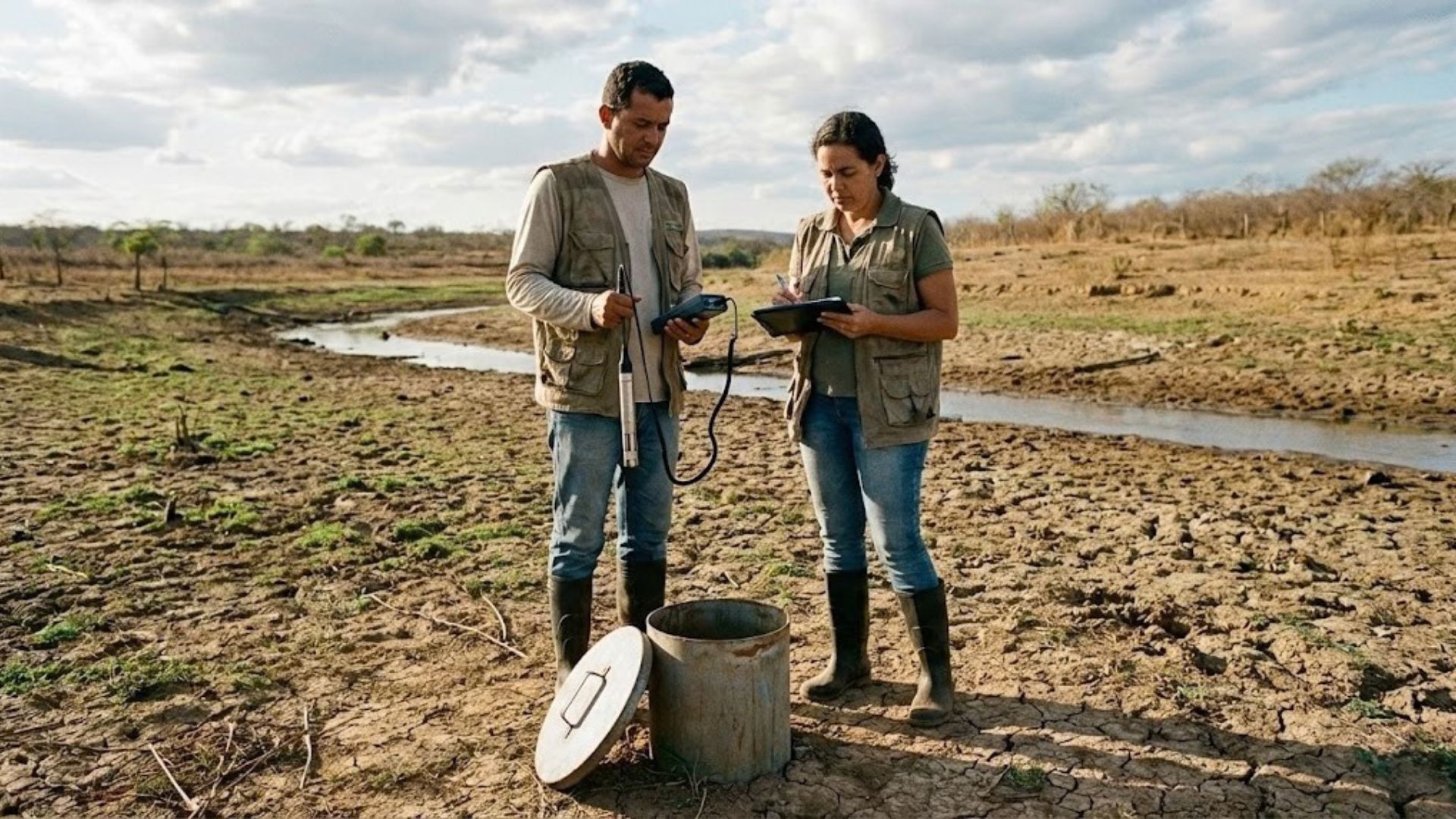


Study Projects Decline in Recharge of Brazilian Aquifers and Indicates Increasing Risk for Supply and Climate.
A study by researchers from the University of São Paulo (USP) and the National Institute for Space Research (INPE) indicates that climate change may significantly reduce the natural recharge of aquifers in Brazil by 2100, with losses of up to 27.94% in specific systems and an increasing risk of regional scarcity.
The work estimates direct impacts on the groundwater that supplies all or part of 112 million people, while projecting a temperature increase between 1.02 °C and 3.66 °C over the century, depending on the emission scenario analyzed.
The Role of Groundwater in Supply
Groundwater accumulates below the surface in geological formations called aquifers and enters this system slowly, when some of the rain can infiltrate the soil and, months later, reach the water table and deeper reserves.
-
Friends have been building a small “town” for 30 years to grow old together, with compact houses, a common area, nature surrounding it, and a collective life project designed for friendship, coexistence, and simplicity.

-
This small town in Germany created its own currency 24 years ago, today it circulates millions per year, is accepted in over 300 stores, and the German government allowed all of this to happen under one condition.

-
Curitiba is shrinking and is expected to lose 97,000 residents by 2050, while inland cities in Paraná such as Sarandi, Araucária, and Toledo are experiencing accelerated growth that is changing the entire state’s map.

-
Tourists were poisoned on Everest in a million-dollar fraud scheme involving helicopters that diverted over $19 million and shocked international authorities.


By supplying wells, springs, rivers, and ecosystems, this source acts as a buffer during dry periods, but it depends on a delicate balance between rain, infiltration, and runoff, which tends to be altered by changes in the climatic regime.

How the Study Projected the Scenario Until 2100
To estimate what may happen between 2025 and 2100, the researchers used a hydrological balance model based on geoprocessing and corrected climate projections from CMIP6, an international initiative that gathers simulations from research centers around the world.
The analysis considered two paths of greenhouse gas emissions, one moderate and another more pessimistic, and translated the expected changes in temperature, rain, surface runoff, and mainly, aquifer recharge on a national scale.
Warming and Changes in the Rainfall Regime
The results indicate that Brazil is likely to warm consistently over the century, while rainfall is expected to become more uneven in space and time, with areas in the North and part of the eastern coastline projected to experience a decline in annual precipitation.
Conversely, the South and portions of the Northeast may register localized increases, but this rise does not mean automatic recharge, because the effect on aquifers also depends on how rainfall is distributed throughout the year and its intensity.
Commenting on the findings, Ricardo Hirata, a professor at the Institute of Geosciences at USP and the first author of the article, states that the reduction could be drastic, particularly highlighting the Southeast and South, which are identified as drier in nearly all the models analyzed.
Why Intense Rain Can Reduce Infiltration
Even in regions where the annual rainfall volume does not change much, the study describes the possibility of rainier summers combined with longer dry periods, favoring intense events concentrated in a short time and increasing surface runoff.
According to Hirata, this type of precipitation can cause flooding while simultaneously reducing the infiltration necessary to recharge aquifers, because water tends to run off the surface instead of gradually penetrating the soil and reaching depth.
The researcher adds that even when water enters the soil, the journey to the aquifer takes time, and studies cited by him indicate a crossing of two to three months to traverse 10 to 15 meters of soil.
Regions and Aquifer Systems Most Affected


In the most affected areas, groundwater recharge may fall by up to 666 millimeters per year, with the most critical situation appearing in the Bauru-Caiuá Aquifer System, with an estimated reduction of 27.94% in the volume recharged by the end of the century.
In addition to this case, the study projects significant losses in aquifers associated with outcropping portions of the Guarani and in systems such as Furnas, Serra Geral, Bambuí Karst, and Parecis, distributed across different states and of regional importance for supply.
As part of the risk is linked to dependence on wells and springs, the researchers highlight the social dimension of the issue, as groundwater supports domestic, urban, and rural uses in thousands of municipalities, including as a supplementary source.
Groundwater Outside the Center of Public Policies
The study draws attention to the fact that groundwater often remains outside the center of discussions on climate change, which frequently focus on rivers, vegetation, and agriculture, leaving aquifers in the background in policy design.
In Hirata’s assessment, the size of the underground storage helps explain why the source remains even in years of drought, and he cites the drought from 2014 to 2016 as a period when cities with surface water supply suffered more than those supplied exclusively by aquifers.
This scenario connects to a national picture of infrastructure: Brazil has about 3 million tubular wells and 2 million dug wells, with extraction estimated between 550 and 600 cubic meters per second, largely intended for private uses.
In the Metropolitan Region of São Paulo, for example, public supply with groundwater is small, but there is a network of private wells cited in the study, with around 13,000 units and a flow rate of 11 cubic meters per second.
Managed Aquifer Recharge as Strategy
In addition to mapping risks, the authors describe an adaptation strategy known as managed aquifer recharge, which includes techniques to increase the infiltration of rainwater and even treated sewage.
This set includes simple structures such as infiltration basins and small dams, as well as methods for direct injection into the aquifer, a practice already adopted in Madrid, according to the study, always with planning and control for water security.
Hirata states that, by directing captured water to planned infiltration areas, the soil acts as a “super-biogeochemical reactor,” with potential for purification during the underground journey, an idea associated with the use of previously treated water.
In large cities, part of the recharge can occur inadvertently, and the study mentions research with isotopes indicating that approximately 50% of the recharge in downtown São Paulo comes from leaks in the water and sewage networks.









Concordo plenamente com você, mas água das nascentes, são equilíbrio dos MARES através das NASCENTES, toda água que usamos vem diretamente. ÁGUAS subterrânea necessário usar bombas o aquarificio, não tem pressão. O MAR sim tem pressão, água do Mar seu PH é de 8.1 a 8.4 diferença pouca para água que usamos é de 7.5 a 8.0 obrigado