





 Portuguese
  English
  Spanish
  4 min of reading
  0 comments


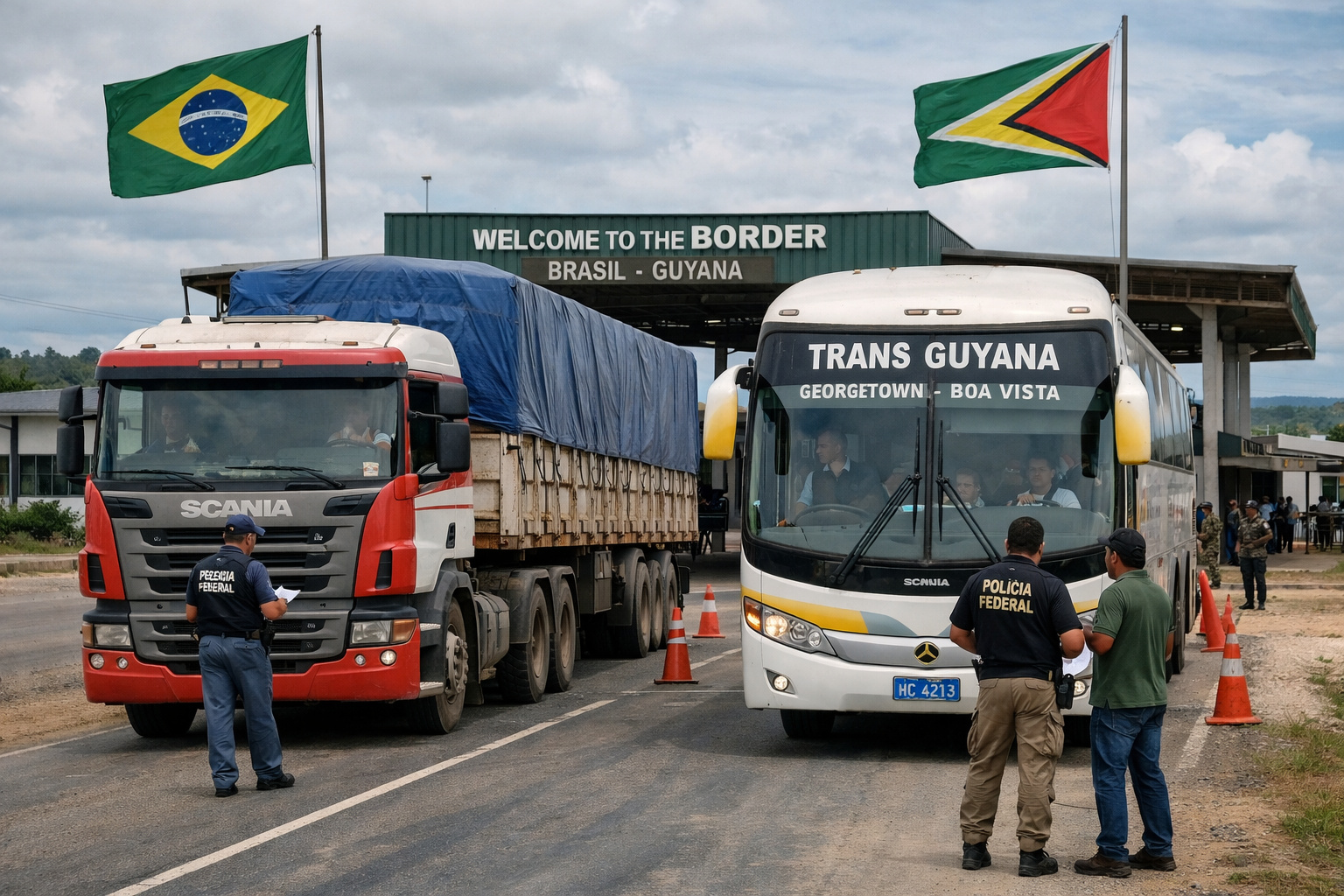
Diplomatic Meeting in Brasília Revives Treaty Signed in 2003, Exposes Technical Impediments, Licensing Failures, and Pressures Governments to Regularize Routes Currently Explored Irregularly
After more than 20 years marked by technical, bureaucratic, and political impasses, the agreement for land transportation of passengers and freight between Brazil and the Cooperative Republic of Guyana has made concrete progress again. Originally signed in Brasília on February 7, 2003, and later enacted by Decree No. 5,561, on October 10, 2005, during President Luiz Inácio Lula da Silva’s first term, the treaty has never been fully implemented in practice, leading to informality and clandestine transportation at the northern border of the country.
However, on this Monday, December 15, 2025, representatives from both governments met in Brasília and stated that, finally, the agreement is expected to materialize in 2026. The resumption of this topic occurs in a context of increasing regional integration, rising flows of goods and people, and concerns about the absence of clear rules for the regular operation of international land transportation between the two countries.
The information was released by the National Land Transportation Agency (ANTT), which emphasized the urgency of putting the agreement into operation to ensure legal certainty, proper supervision, and greater predictability for the sector. As pointed out by Brazilian and Guyanese authorities, the accumulated delay over more than two decades has caused losses for both formal operators and transportation users, in addition to encouraging irregular practices.
-
The government puts R$ 8.6 billion on the table to change the highway (BR) with 50 overpasses, 28 bridges, 4 tunnels, and 40 km of bike lanes in 180 km of historic duplication.

-
BRL 20.1 Million Bridge Project Kicks Off: 200-Meter Construction to Improve Access in Three Cities in Minas Gerais

-
‘Endless Road’ In Brazil Is One of The Largest In The World: 145 Km Stretch On An Important Highway (BR) Crosses The West Of Bahia And Had 135.9 Km Revitalized With R$ 35.3 Million
-
Engineer From ITA Who Worked at Embraer Leads Free Flow Expansion With National Artificial Intelligence and Technology for Toll Without Barriers in Brazil


Stalled Licensing and Irregular Transport Accelerate Pressure for Change

The meeting that marked the new progress in the process was attended by the ANTT director, Severino Medeiros, the agency’s general coordinator for International Relations, Cálicles Mânica, as well as the ambassador of Guyana to Brazil, Compon Bourne, the deputy head of the diplomatic mission, Melissa Tucker, and the minister-counselor Vernon Robinson. The meeting took place at the Embassy of Guyana in Brazil, in Brasília, and focused on objectively identifying the impediments that still keep the agreement non-operational.
According to an official statement from ANTT, the main obstacle lies in the complementary licensing process necessary to authorize Brazilian operators to work regularly in international transportation of passengers and freight. So far, there has been no record of these licenses being granted to interested Brazilian companies, which prevents the start of operations anticipated in the treaty signed in 2003.
Additionally, during discussions, the Guyanese government acknowledged the existence of records of Brazilian transporters making the trip to the capital Georgetown irregularly. For ANTT, this practice reinforces the urgency to move the agreement forward, as the absence of clear rules favors informality, complicates supervision, and increases risks to the safety of passengers and cargo.
In this sense, Severino Medeiros emphasized that the agreement already exists, and the challenge now is to make it operational. According to him, ANTT and the Brazilian government will make every effort to support the regularization of international land transportation in the region, advocating for joint action between the two countries to unlock the pending technical and administrative procedures.
Use of Existing Infrastructure and Expectation of Economic and Social Gains
Another sensitive point addressed in the meeting was border infrastructure. According to the authorities involved, both Brazil and Guyana agree that at this moment, the priority should be the use of already available structures, such as operational highways and customs posts. The strategy aims to avoid new delays resulting from the need for large works or immediate investments in heavy infrastructure.
The rationale advocated by both parties is to put the agreement into operation first and only then assess, based on the actual operating experience, which additional investments will be necessary to improve the efficiency, safety, and capacity of international transportation between the two countries. As explained by the general coordinator for International Relations at ANTT, Cálicles Mânica, only with the agreement operationalized will it be possible to identify the most appropriate structural and regulatory improvements accurately.
At the end of the meeting, Severino Medeiros made ANTT available to act directly in unblocking the process, including the possibility of holding a technical meeting in Georgetown with the relevant Guyanese authorities to accelerate the complementary licensing procedures. The expectation is that this joint effort will allow for the start of regular operations anticipated in the treaty in 2026.
The unblocking of the agreement is seen as a strategic step for the region. Among the expected gains are the reduction of informality, greater safety in the transportation of passengers and cargo, stimulation of bilateral trade, generation of economic opportunities, and strengthening integration between the two neighboring countries. For ANTT, it is also about fulfilling its institutional mission to promote regulated, safe, and efficient land transportation, now also beyond national borders.
Source: Diário do transporte








Seja o primeiro a reagir!