





 English
  Francês
  Alemão
  Italiano
  Japonês
  Norueguês
  Portuguese
  Spanish
  4 min of reading
  0 comments


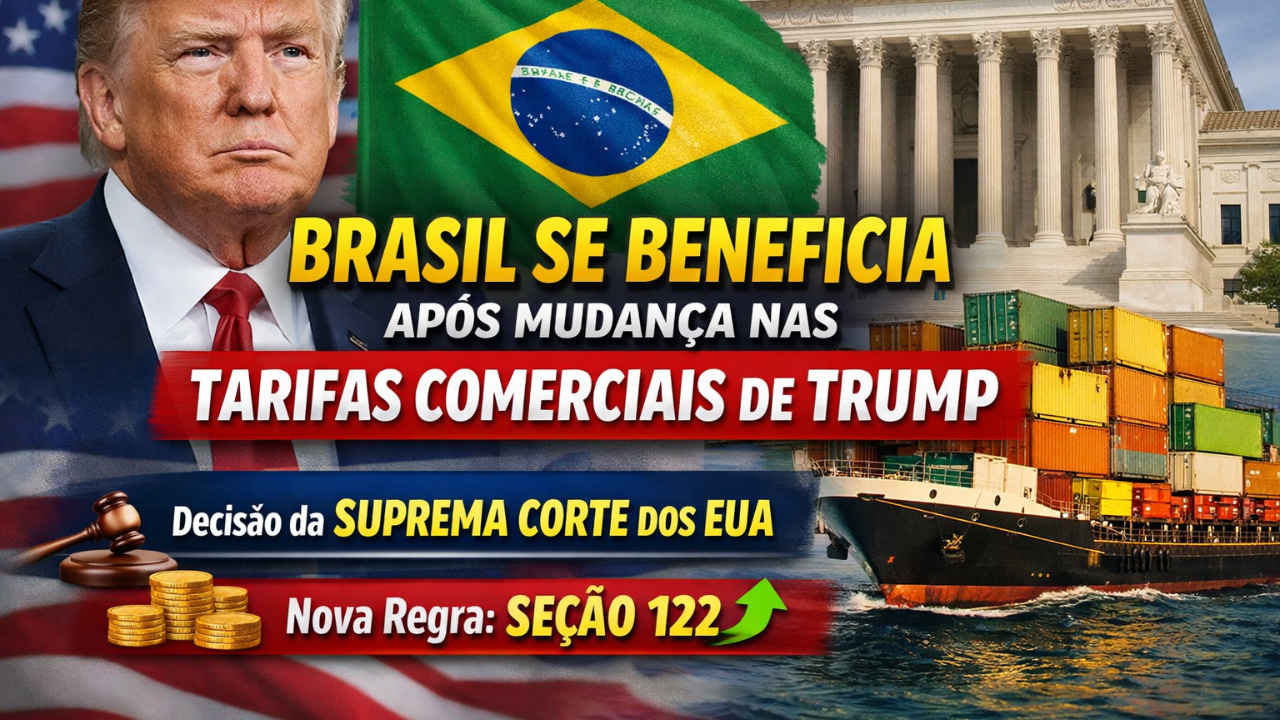
U.S. Supreme Court Decision Changes Donald Trump’s Trade Tariff Policy, Reduces Impact on Brazil with Implementation of Section 122.
Brazil is among the countries most benefited by the U.S. Supreme Court decision which, by a vote of 6 to 3, overturned trade tariffs imposed by Donald Trump last year.
The decision was made on Friday (2/20), in the United States, considering that the president exceeded his authority by using emergency powers to tax trading partners.
As a consequence, Trump announced the temporary implementation of Section 122, setting a 15% tariff on imported products for 150 days.
-
Middle East War Hits Fertilizers and Transportation and May Strain Brazilian Wallets
-
Russia Considers Suspending Gas to Europe After Surge in Energy Prices
-
How A War Thousands of Miles From Brazil Started Disrupting Global Shipping Routes, Raising Container Costs, and Putting Up to 40% of Brazilian Beef Exports at Risk
-
Iran-U.S. War Drives Up Oil Prices and Pressures Global Financial Markets

The change significantly reduced the tax burden on Brazilian exports, which explains why Brazil is among the biggest winners of this turnaround.
Shortly after the decision, the new model took effect from Tuesday (2/24), altering the way trade tariffs are applied.
Previously, rates varied by country; now, they have become more uniform. Thus, Brazil, which was among the most penalized, saw its position change dramatically.
Brazil Among the Major Beneficiaries of Trade Tariffs
According to a survey by Global Trade Alert (GTA), Brazil records the third largest average drop in trade tariffs applied by the U.S.
The estimated reduction is 13.56 percentage points. As a result, the country has moved from one of the highest taxed nations to the 125th position in the ranking of highest rates.
Prior to the U.S. Supreme Court decision, Brazilian products faced an average tariff of 26.33%.
Now, with the implementation of Section 122, the expectation is that this average will drop to 12.77%. In practice, this means more competitiveness for Brazilian companies in the American market.
The study itself indicates that the change created “clear winners and losers,” placing Brazil in the first group.
The Role of Donald Trump and Section 122 in Trade Tariffs
The turnaround began when the U.S. Supreme Court deemed illegal the use of the International Emergency Economic Powers Act (IEEPA), adopted by Donald Trump.
This mechanism allowed for the imposition of higher tariffs on the grounds of a threat to national security.
It was based on this law that Brazil faced rates of up to 40% on various products.
At the time, Trump stated that “the scope and severity of the recent policies, practices, and actions of the Brazilian government constitute an unusual and extraordinary threat to the national security, foreign policy, and economy of the U.S.”
Moreover, the U.S. government even mentioned a supposed “witch hunt” against former president Jair Bolsonaro as a political justification for the differentiated taxation.
With the legal defeat, Trump replaced the IEEPA with the Section 122 of the Trade Act of 1974.
This provision grants temporary and limited powers to impose tariffs of up to 15% for 150 days in cases of imbalance in the balance of payments.
According to the GTA, “The shift from the previous tariff regime to the Section 122 regulations, with a 15% rate, produces clear winners and losers among the 20 main countries whose products are imported by the U.S.”
“Countries that faced high surcharges under the IEEPA observe significant tariff reductions: Brazil (-13.6 percentage points), China (-7.1), and India (-5.6) are the most benefited since the fixed surcharge under Section 122 replaces the specific rates of each country under the IEEPA, which were much higher.”
More Uniform Trade Tariffs: Who Loses with the Change?
While Brazil gained, some countries began to pay more.
“On the other hand, countries that already faced low tariffs before the decision now pay more.
The United Kingdom (+2.1 percentage points), Italy (+1.7), and Singapore (+1.1) recorded the largest increases because the 15% surcharge of Section 122 exceeds what they were paying under the IEEPA regime,” the report points out.
Thus, the difference between highly taxed countries and those with low taxation has decreased considerably.
Brazil’s Reaction After the U.S. Supreme Court Decision
Over the weekend, President Luiz Inácio Lula da Silva commented on the situation.
According to him, Brazil “made the right decisions” in response to Trump’s so-called tariff blitz.
“I believe we made the right decisions. Some things had already been changed by the American government itself and now we had another decision from the American justice contradicting what President Trump’s thesis was,” Lula stated.
He further added: “Obviously, I cannot judge the decision of the Supreme Court of another country, let alone my own.”
What Could Happen Now with Trade Tariffs?
Despite Brazil’s victory in this episode, the scenario remains uncertain.
Section 122 is valid for 150 days, and the U.S. Congress will need to evaluate its continuity.
In addition, other trade tariffs remain active, such as those imposed under Section 232, which affect sectors like steel and aluminum — including Brazilian products.
The Trump administration is also considering invoking Section 301 of the Trade Act of 1974, which allows for investigations into practices deemed “discriminatory” or “unfair.”
Therefore, although Brazil has achieved significant relief from trade tariffs, the environment still requires caution.
The outcome will depend on upcoming political and legislative decisions in the United States, as well as the strategy adopted by Donald Trump to maintain his active trade policy.
See more at: Trump’s Tariff Blitz: Understand Why Brazil is One of the Biggest ‘Winners’ After Changes – BBC News Brazil









Seja o primeiro a reagir!