





 Portuguese
  English
  Spanish
  6 min of reading
  0 comments


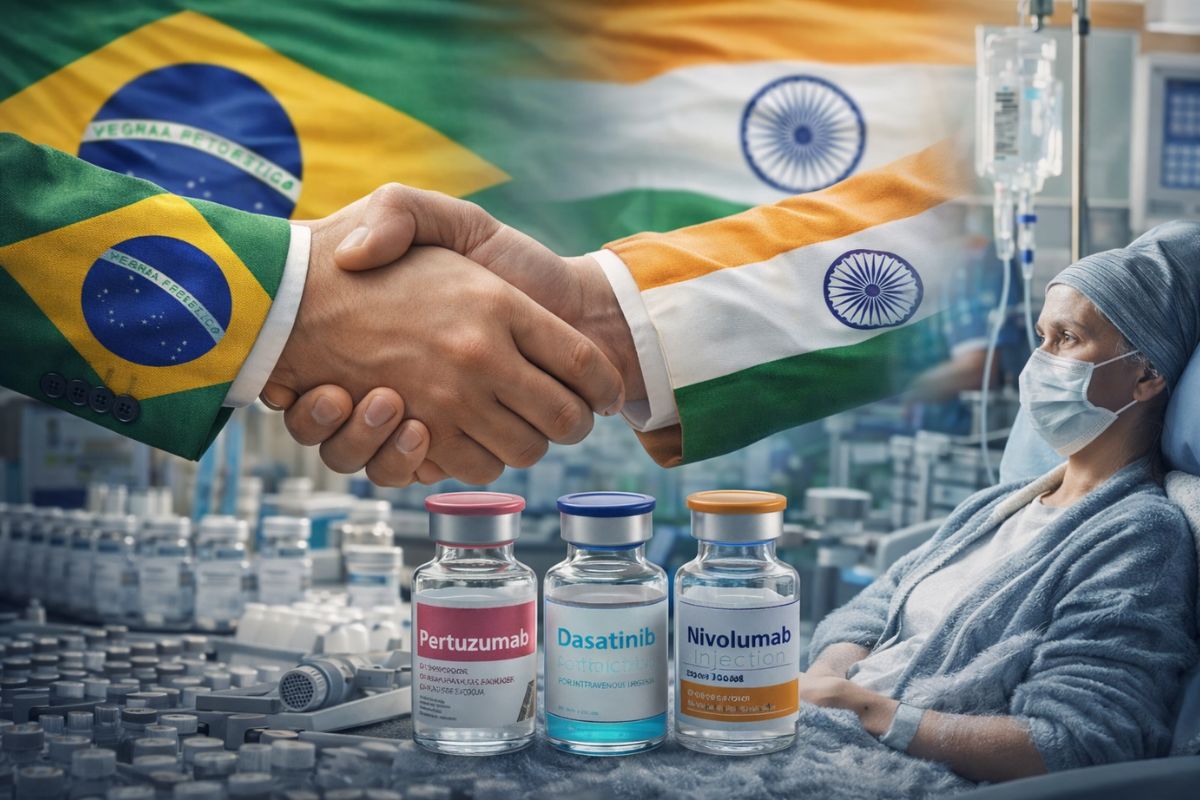
With Expected Investment in the First Year, The Agreement Between Brazil and India Opens the Way for SUS to Offer Pertuzumab, Dasatinib, and Nivolumab at No Cost to Patients, Reducing External Dependency, Increasing Local Production of Oncological Medicines, and Extending for Five More Years the Bilateral Cooperation in Strategic Public Health.
The investment of up to R$ 722 million announced by the Ministry of Health places Brazil in front of an operation that mixes access, national production, and industrial policy. During an official mission in India alongside President Luiz Inácio Lula da Silva, Minister Alexandre Padilha signed a partnership aimed at the production of oncological medicines within the Unified Health System.
In practice, the move attempts to tackle one of the most sensitive points of cancer treatment: the cost. The medicines pertuzumab, dasatinib, and nivolumab, cited as targets of the agreement, can vary from R$ 3,500 to R$ 20,500, depending on the dosage. By bringing them into the SUS structure, the government tries to turn an expensive and restricted treatment into a public offer at no cost to the patient.
What Changes for Those Who Depend on SUS
The first expected effect of this agreement is to broaden access. The stated focus is to ensure that patients treated by SUS receive medicines used in the treatment of breast cancer, skin cancer, and leukemias without the financial burden that currently characterizes these products outside the public network.
-
In a flooded well, archaeologists found a 1,700-year-old Roman egg that still contains clear and yolk intact inside the very thin shell.

-
Something is happening around the Earth: Inside the huge explosion of fireballs in 2026

-
A hot air bubble coming from Argentina expands over Brazil, causing thermometers to exceed 38 degrees with a thermal sensation of 40 degrees in late March, affecting 6 states at once.

-
The radish leaf that almost everyone throws away has more polyphenols, flavonoids, and fiber than the consumed root, and a 2025 study showed that the leaf contains compounds that protect the intestine, combat inflammation, and may inhibit the growth of cancer cells.

It is not just about buying cheaper medicine; it is about reorganizing the entry point to treatment.
This point is central because the cost of oncological therapies often pushes families into an impossible equation.
When a single medication can reach the R$ 20,000 mark, the gap between diagnosis and appropriate treatment becomes not only medical but also economic. The agreement with India aims to reduce precisely this barrier.
Alexandre Padilha’s statement helps to understand the political design of the measure.
In announcing the partnership, the minister stated that Brazil leaves India with agreements capable of ensuring modern medicines for the treatment of breast cancer, skin cancer, and leukemias, with increased access and the potential to save lives, “especially women.”
The embedded message is clear: the government wants to connect foreign policy, public health, and concrete outcomes for the patient.
There is also an important symbolic effect.
As SUS begins to prepare to produce or structure the supply of high-value medicines, it stops merely acting as an end buyer and attempts to take a more active role in the chain.
This changes the scale of the discussion and repositions the public system at the center of the pharmaceutical strategy.
Which Medicines are Included in the Agreement and Why They Matter So Much
The three highlighted medicines in the announcement were pertuzumab, dasatinib, and nivolumab. They appear as the initial axis of the partnership and are described as widely used in cancer treatment.
The most sensitive data, however, lies not in the technical name of the drugs but in the price they can reach outside public policy.
According to the information disclosed, these medicines can cost between R$ 3,500 and R$ 20,500, depending on the dosage. This range shows why the agreement gained immediate political weight.
In oncology, the value of each step of the treatment directly affects access time, therapeutic continuity, and the system’s ability to serve more people without increasing exclusion.
By placing these medicines at the center of the investment, the Ministry of Health signals that it wants to act in areas of greater social and budget sensitivity.
Cancer exerts increasing pressure on the public system because it involves complex diagnosis, prolonged therapies, and high-cost drugs.
Choosing oncological medicines for the partnership is also choosing one of the most expensive zones of public assistance.
There is also a component of predictability. When the government relies exclusively on purchasing high-value medicines from external sources, it becomes more vulnerable to price, supply, and international fluctuation.
By seeking production linked to SUS, the government attempts to gain control over part of this equation, even though this depends on the effective implementation of the partnership and the promised technology transfer.
The Weight of Technology Transfer in the Brazilian Plan
The agreement was not presented merely as an operation to supply SUS.
Padilha emphasized that the partnership also enables technology transfer, with the promise of strengthening national production, generating jobs and income, and enhancing the autonomy and security of Brazilian patients.
This may be the most strategic layer of the entire announcement.
When the government speaks of national production of oncological medicines, it is not only looking at the patient who receives the medication now.
It aims to change a larger structure involving productive dominance, industrial capacity, and reduced dependency on external suppliers.
The medicine ceases to be just a consumable item of the system and also becomes a piece of sanitary sovereignty.
This point becomes even more relevant because the agreement was signed with India, a country that holds a prominent position in the global pharmaceutical industry.
For Brazil, the partnership offers an opportunity to shorten technological gaps in sensitive areas of oncological care and to build a stronger base for production and supply within SUS.
The investment of R$ 722 million in the first year, therefore, cannot be viewed merely as assistive spending. It also serves as a bet on productive capacity.
If technology transfer progresses effectively, the country will gain not only broader access to medicines but also tools to sustain this access for a longer time with less external fragility.
The Partnership Goes Beyond Cancer and Extends for Five More Years
Padilha’s visit to India also included the signing of an addendum to the Memorandum of Understanding between the two countries, extending bilateral cooperation in health for five more years.
This detail broadens the scope of the agreement and shows that oncological medicines are the most visible front but not the only one.
According to the Ministry of Health, the expanded cooperation includes joint initiatives in the production of medicines, active pharmaceutical ingredients, biomanufacturing, vaccines, and artificial intelligence.
Furthermore, it foresees technical exchange in strategic areas such as oncology, diabetes, cardiovascular diseases, and the prevention of chronic diseases.
In other words, the cancer agreement is also an entry point for a broader agenda of sanitary and technological reorganization.
This five-year extension matters because it provides a political and institutional horizon for the partnership.
Instead of an isolated action, Brazil attempts to consolidate a path of cooperation in critical public health sectors. This can affect not only the supply of medicines but also the country’s capability to formulate policies based on a broader and more permanent technical exchange.
Internally, this design reinforces the government’s attempt to connect direct patient care with the structural strengthening of SUS.
While speaking of free medicine, the ministry also talks about biomanufacturing, inputs, and artificial intelligence.
The discourse, therefore, is not limited to individual treatment: it seeks to frame the investment as part of a broader architecture for modernizing the system.
The agreement between Brazil and India combines two politically strong promises: expensive cancer medicines entering SUS at no cost to the patient and national production gaining strength with technology transfer.
The investment of up to R$ 722 million in the first year emphasizes the gamble and shows that the government wants to turn a diplomatic partnership into measurable health outcomes.
If implementation follows the announcement, the impact could be significant for patients who currently encounter the cost of high complexity therapies and for a public system that seeks to gain autonomy in critical areas.
The question remains direct: for you, is the most decisive point of this agreement the free access to medicines, national production within SUS, or the chance for Brazil to rely less on external suppliers in such sensitive treatments?







-

-

-

4 pessoas reagiram a isso.