





 Portuguese
  English
  Spanish
  5 min of reading
  10 comments




Government Starts 2024 with Accumulation of Billion-Dollar Debt from State-Owned Companies. According to the Central Bank, there is an astonishing difference of R$ 9.4 billion compared to the same period in 2022.
Brazilian federal state-owned companies are facing an astonishing deficit of R$ 2.9 billion recorded in the first half of 2024. This number represents a significant increase compared to the same period last year, when the negative balance was R$ 1.6 billion. The current situation highlights the government’s difficulties in managing the finances of these companies, especially in a complex and constantly changing economic scenario.
According to data from the Central Bank, the fiscal deterioration of federal state-owned companies becomes even more concerning when compared to the results of 2022, during Jair Bolsonaro’s government. Back then, the accounts of these companies showed a surplus of R$ 6.5 billion, a striking contrast to the current situation. This difference of R$ 9.4 billion in just two years reinforces the magnitude of the challenges facing Luiz Inácio Lula da Silva’s government in its management.
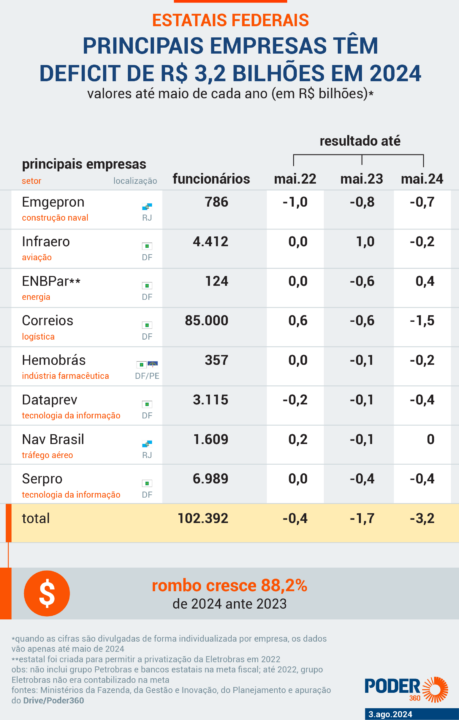
Read the infographic below with the results of the main federal state-owned companies from January to May 2024:
Bimonthly Report on Revenues and Expenditures for 2024 Indicates a Negative Balance of R$ 4.2 Billion.
The primary result reflects the balance between revenues and expenditures, excluding interest payments on debt. Although the government has established a fiscal target of a primary deficit of R$ 7.3 billion for 2024, the latest projection, according to the third Bimonthly Report on Revenues and Expenditures for 2024, indicates a negative balance of R$ 4.2 billion. This difference occurs after deducting expenses from the investments of the New PAC, the Growth Acceleration Program.
-
A new Brazilian shopping center worth R$ 400 million will be built in an area equivalent to more than 4 football fields, featuring 90 stores, 5 cinemas, a supermarket, a college, and parking for 1,700 cars, potentially generating 3,000 jobs.

-
Larger than entire cities in Brazil: BYD is building a 4.6 km² complex in Bahia with a capacity for 600,000 vehicles per year, but the discovery of 163 workers in conditions analogous to slavery has shaken the entire project.

-
With an investment of R$ 612 million, a capacity to process 1.2 million liters of milk per day, Piracanjuba inaugurates a mega cheese factory that increases national production, reduces dependence on imports, and repositions Brazil on the global dairy map.

-
Brazilian city gains industrial hub for 85 companies that is equivalent to 55 football fields.


However, it is essential to note that the figures presented do not include companies from the Petrobras group and state banks, which are outside the fiscal target. This exclusion highlights an even more challenging scenario for federal state-owned companies.
The trajectory of the primary results of federal state-owned companies over the years shows fluctuating performance. Since 2002, there have been periods of surplus, but deficits have become more frequent. This history raises questions about the sustainability of public management in the long term, especially under different administrations.
Efficiency and Fiscal Responsibility Should Prevail in the Management of State-Owned Companies and Poor Management by the Current Government Has Contributed to the Increase in the Deficit
Fabio Pina, economic advisor at Fecomercio-SP, highlights that the deficit is part of a larger context of fiscal results. He disagrees with economists who justify the shortfall by the “social function” of public spending. According to Pina, efficiency and fiscal responsibility must prevail in the management of state-owned companies, under penalty of compromising long-term social well-being.
On the other hand, the pursuit of fiscal balance, according to Pina, can bring evident improvements in the management of public companies. When resources are managed efficiently, the positive impact on society is undeniable, and the government can reduce interest expenses, which represent the majority of the nominal deficit.
This view is supported by Ecio Costa, an economist and professor at the Federal University of Pernambuco (UFPE). He reinforces that the data shows a deterioration in the management of state-owned companies under different governments, with emphasis on the positive performance of the previous government. Costa argues that the current poor management has contributed to the increase in the deficit.
Among the main state-owned companies, the primary deficit reached R$ 3.2 billion between January and May 2024, according to the third Bimonthly Report on Revenue and Expenditure Evaluation. Created to facilitate the privatization process of Eletrobras, ENBPar, for example, reported a surplus of R$ 385.2 million during that period. This positive result underscores the importance of efficient management even amid economic challenges.
Correios, Serpro, Hemobrás, ENBPar, Dataprev Registered Billion-Dollar Deficits by May 2024
On the other hand, seven of the main state-owned companies reported deficits by May 2024. Correios, for example, faced a shortfall of R$ 1.5 billion, worsening by almost R$ 900 million compared to the same period in 2023. Emgepron, responsible for naval projects, also had a significant negative balance of R$ 651.3 million.
These data highlight the need for structural reforms in the management of state-owned companies. Although the consolidated results of state-owned companies show a significant deficit in the first half of 2024, when analyzed individually, the numbers reveal a concerning situation for many of these companies, which struggle to maintain their financial sustainability.
In response to criticisms, some state-owned companies have spoken out. Correios, Dataprev, ENBPar, Hemobrás, and Serpro sent statements to Poder360, defending their managements and explaining the factors that contributed to the negative results. These statements, while relevant, do not dissipate concerns about the financial health of federal state-owned companies.
The Ministry of Management and Innovation, in an official statement, denied that the results represent a “shortfall.” According to the ministry, the budgetary logic of state-owned companies is different from that of the general fiscal budget of the government. The deficit recorded largely reflects an increase in long-term investments, which, according to the government, will be beneficial for the future of the companies.
Correios, for example, highlighted that they have “cash reserves” and do not require government funding. The company also mentioned that cost-reduction measures are underway, and that indicators are expected to improve throughout the year.
Dataprev attributed its deficit to a higher volume of cash outflows in the first half of 2024, in addition to a decline in customer revenue and dividend payments. The company is confident that these issues will balance out in the coming months.
ENBPar, in turn, emphasized its commitment to efficiency in management and mentioned that it will continue investing in innovation, sustainability, and operational efficiency. The company is determined to overcome challenges and ensure value for its shareholders and society.
Hemobrás, which recorded recurring operating income in recent years, attributed the primary deficit to the large volume of investments made in 2024. The company stressed that, despite the negative result, it remains committed to its mission and expects a recovery in the coming months.
Finally, Serpro highlighted that the seasonality of revenues and expenses impacts the financial result in the first half. The expectation is that the second half will bring a primary surplus of R$ 200 million, balancing the accounts by the end of the year.
The deficit of R$ 2.9 billion recorded by federal state-owned companies in the first half of 2024 is a clear warning to the government. Continuing this scenario could further compromise the country’s fiscal situation. Therefore, it is essential for the government to adopt effective measures to ensure the financial health of state-owned companies and, consequently, the balance of public accounts.
Source: poder360










Dá-lhe. Nenhuma novidade. Povo maioria sem caráter só querem ganhar as migalhas do PT populista. Só auxílio. Aí votam. Uma hora a conta vem. Venezuela foi duas décadas e olhem o resultado
Os administradores profissionais do anterior governo ,que exigia diplomas universitários e qualificação para ocupar cargos de relevancia na administração pública, foram substituídas por nomeação de Políticos e “Companheiros” que hajam demostrado suas “capacidades” na militância política. Tá ahí as consequências!!!. Tô certo ou tô errado ??
Alguma novidade nisso?