





 Portuguese
  English
  Spanish
  4 min of reading
  0 comments


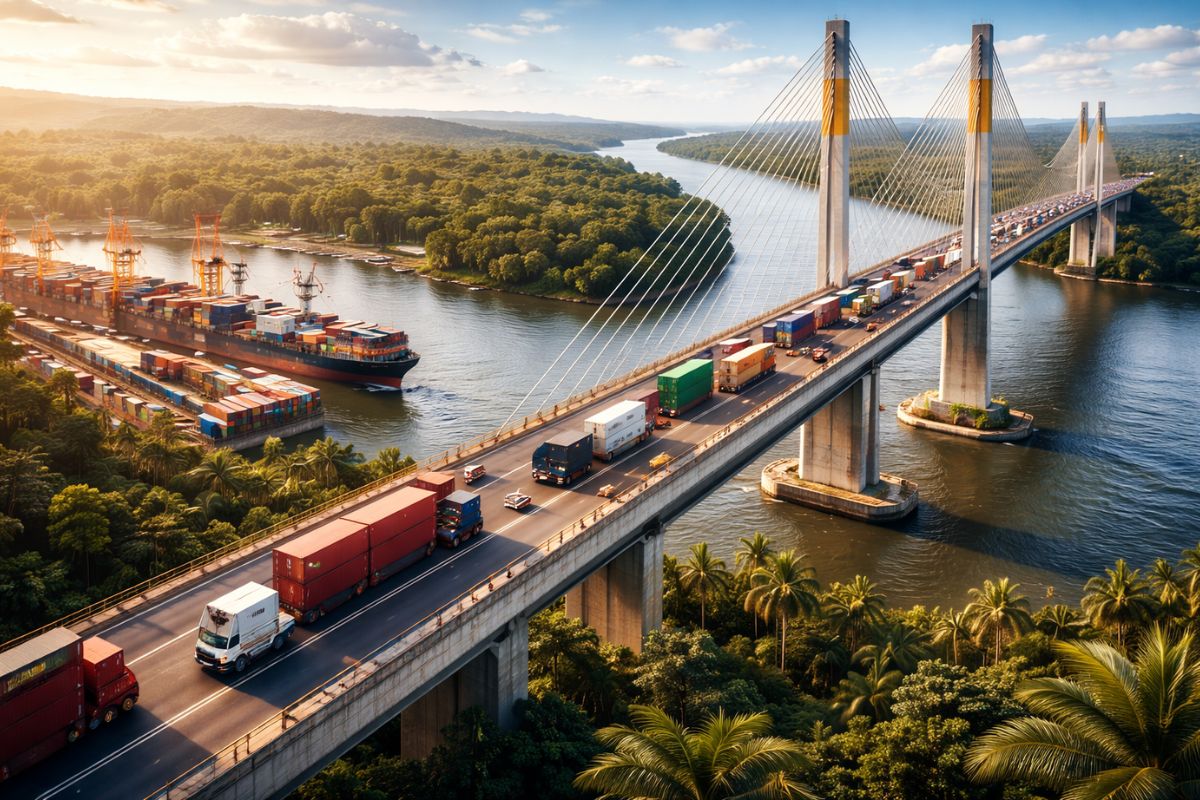
Billion-Dollar International Bridge Of 1.3 Km Over The Paraguay River Connects Porto Murtinho, In Mato Grosso Do Sul, To Carmelo Peralta, In Paraguay, Integrates The Bioceanic Route And Shortens Routes To The Pacific, With Up To 250 Trucks Per Day And Inauguration Expected For 2026 Promises To Cut Up To 15 Days In Imports.
In Brazil, the billion-dollar international bridge under construction in the Midwest has become a strategic piece for imports and exports by connecting Porto Murtinho, in Mato Grosso do Sul, to the city of Carmelo Peralta, in Paraguay. The project is part of the Bioceanic Route and, according to industry experts, can reduce the arrival time of cargo from China by up to 15 days.
The logic is to shorten the global route: today, much of the goods from Asia reach Brazil via the Atlantic in journeys that can last nearly a month. With the billion-dollar international bridge and the international roadway corridor to ports in Chile and Peru, access to the Pacific Ocean changes the route and repositions the flow of cargo on the continent.
Where The Work Is Happening And How The Route Shortens The Way To The Pacific

The billion-dollar international bridge is being built over the Paraguay River, linking Porto Murtinho (Mato Grosso do Sul, Brazil) to Carmelo Peralta (Paraguay).
-
Abandoned house for 15 years disappears in the woods, shocks owner with unrecognizable scenery and is reborn in an intense transformation after almost 90 hours of work in just 10 days.

-
In just three hours, a natural stone floor transforms the entrance of the house with an organic effect, immediate drainage, and a sophisticated non-slip finish that doesn’t puddle water, dries quickly, and impresses with the final result.
-
‘Interlocking brick’ made of earth arrives in the construction industry with cost reductions of up to 40% on the project.

-
Espírito Santo will receive the largest engineering project in its history with the duplication of BR 262, which will have 50 viaducts, 28 bridges, and 2-kilometer tunnels cutting through the most challenging mountainous region of the entire state.
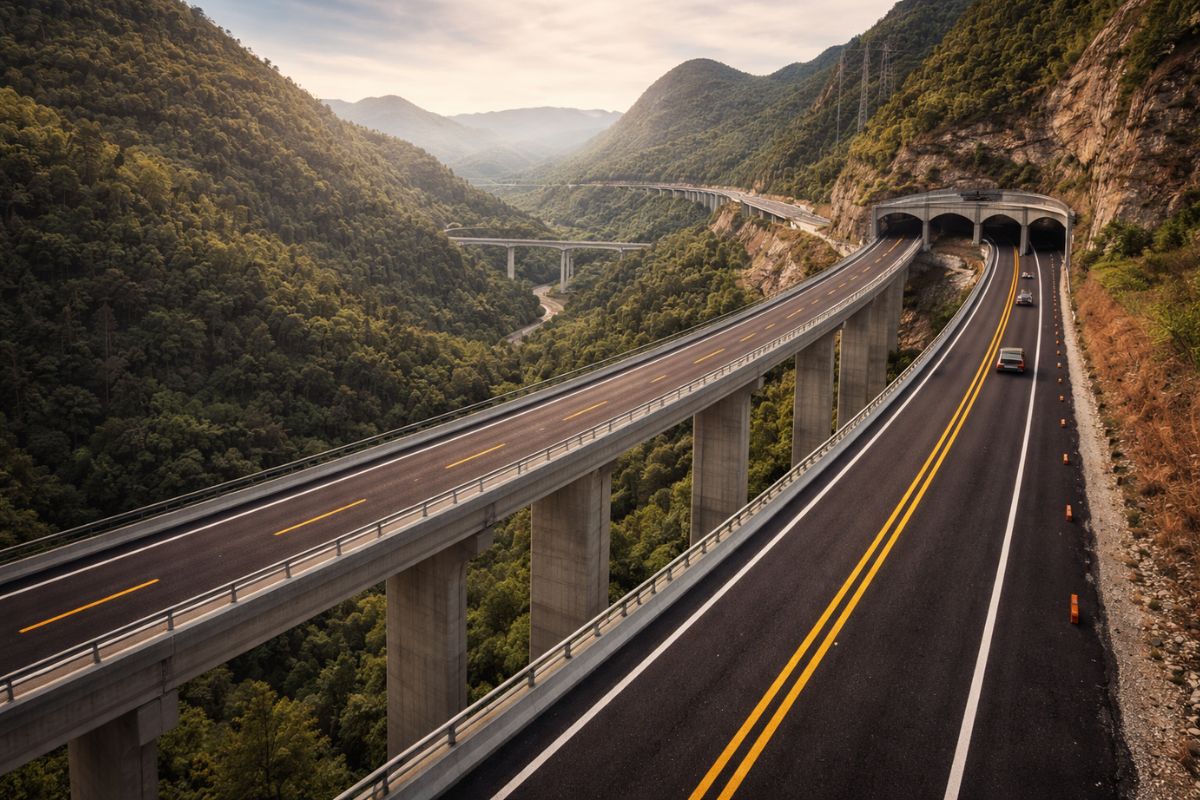

The axis is part of the Bioceanic Route, a corridor designed to connect the Brazilian Midwest to international road networks that reach the ports of Chile and Peru, on the Pacific Ocean.
In practice, the billion-dollar international bridge acts as a geographical shortcut for foreign trade: by allowing direct crossing and integrating the road network of the corridor, it opens an alternative to the traditional maritime route through the Atlantic.
The aim is to reduce time and increase predictability, especially in supply chains originating from Asia.
Dimension And Capacity: 1.3 Km And Up To 250 Trucks Per Day
With approximately 1.3 kilometers in length, the billion-dollar international bridge crosses the Paraguay River and has been designed to facilitate an estimated daily passage of up to 250 trucks.
This volume sustains the expectation of logistical gains because the work is not just a physical connection, but a regular outlet for cargo.
By concentrating this flow at the Brazil-Paraguay border, the billion-dollar international bridge tends to reorganize overland movement to the ports of the Pacific, reducing steps and hours lost on longer routes.
Fewer days in transit mean lower indirect costs, especially for goods sensitive to deadlines.
Investment Above R$ 1 Billion And Progress Of The Works
The total investment in the project exceeds R$ 1 billion, encompassing the construction of the billion-dollar international bridge and the road access works.
Official data indicates that the bridge is about 82% completed and is expected to be inaugurated in 2026.
On the Brazilian side, the access works to the logistics corridor have an approximate length of 2,300 kilometers and are about 30% completed.
To complete the project, approximately R$ 200 million from the Growth Acceleration Program is still needed, amounts that must be secured in the federal budget for 2026.
Without these access roads ready, the bridge loses part of its promised effect, because the corridor depends on the whole.
TIR Convention And The Dispute For Time At The Borders
At the end of 2025, the Federal Government adhered to the Customs Convention on the International Transport of Goods under the TIR Carnets, a system aimed at simplifying customs procedures.
The proposal is to reduce crossing time at the borders and make the corridor faster, more predictable, and competitive.
In this framework, the billion-dollar international bridge does not solve everything on its own: it needs efficient customs to avoid becoming a bottleneck.
Secretary Jaime Verruck, from the Secretary of Environment, Development, Science, Technology, and Innovation of Mato Grosso do Sul, summarized the logic with a focus on flow: road, bridge, and port must operate with speed and predictability so that the corridor is a real alternative to the Asian market, in conditions similar to Argentina and Chile.
Why The Promise Of Cutting Up To 15 Days Changes The Balance Of Foreign Trade
The majority of Asian cargo arrives in Brazil via the Atlantic in journeys that can last nearly a month.
The billion-dollar international bridge, integrated into the land corridor to the Pacific, repositions the maritime exit and entry point, reducing the ocean segment towards China and, consequently, the total number of days on the route.
The estimated reduction of up to 15 days is the type of number that changes inventory planning, replenishment window, and financial cost of idle goods.
For importers and exporters, time has become currency, and the bridge gains relevance precisely by shortening the calendar of global supply chains.
Do you believe that the billion-dollar international bridge will really cut up to 15 days in imports from China, or is the biggest risk in the road accesses and border bureaucracy?









-

-

-

-

11 pessoas reagiram a isso.