





 Portuguese
  English
  Spanish
  3 min of reading
  0 comments



Survey by Instituto Esfera Shows That Brazil Already Exceeds 34% of GDP in Taxes and May Be the Country with the Highest Global Increase in Tax Burden by 2050
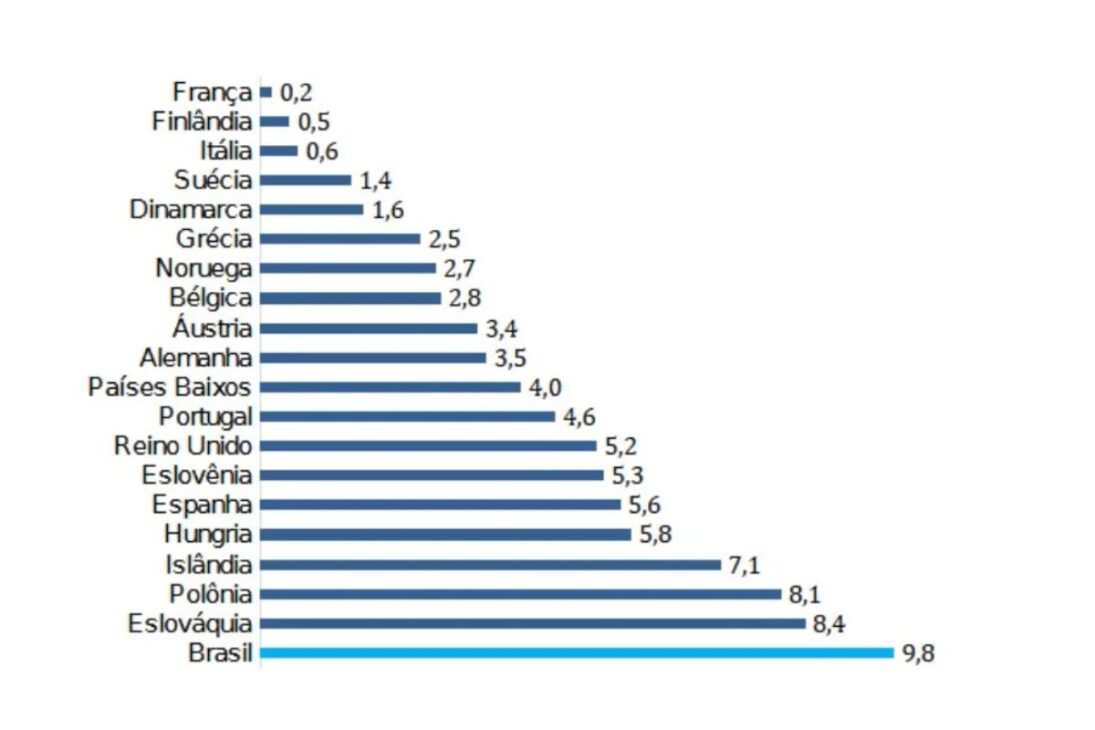
A study from the Instituto Esfera, cited by IstoÉ Dinheiro, projects that Brazil will be the country with the largest increase in tax burden by 2050, reaching a jump of 9.8 percentage points. This advance places the country in a critical position against emerging economies, in a scenario where taxation already consumes more than one third of national GDP.
According to the survey, Brazil surpassed the 34% of GDP mark in taxes in 2024, while so-called tax expenditures, fiscal benefits, and renouncements exceed 4% of GDP.
For specialists, the lack of clear governance in granting these advantages threatens to further increase fiscal pressure in the coming decades.
-
Larger than entire cities in Brazil: BYD is building a 4.6 km² complex in Bahia with a capacity for 600,000 vehicles per year, but the discovery of 163 workers in conditions analogous to slavery has shaken the entire project.

-
With an investment of R$ 612 million, a capacity to process 1.2 million liters of milk per day, Piracanjuba inaugurates a mega cheese factory that increases national production, reduces dependence on imports, and repositions Brazil on the global dairy map.

-
Brazilian city gains industrial hub for 85 companies that is equivalent to 55 football fields.

-
Peugeot and Citroën factory in Argentina cuts production by half and opens a layoff program for more than 2,000 employees after Brazil drastically reduced purchases of Argentine vehicles.


Brazil Among the Leaders in Taxation
The study reminds us that Brazil is already among the most heavily taxed emerging economies, in contrast to other developing countries that seek to maintain leaner tax systems to attract investments.
The upward trend until 2050 reinforces the warning for entrepreneurs and workers, who may feel the weight on consumption, income, and the country’s competitiveness.
According to Camila Funaro Camargo Dantas, CEO of Instituto Esfera, tax expenditures are not “villains” by nature but need to be clear instruments of public policy, with defined starts and ends.
Otherwise, the country risks sustaining a system that generates costs without delivering effective social returns.
The Weight of Fiscal Renouncements
The report highlights that Simples Nacional accounts for about 22% of federal government renouncements, followed by incentives to the agricultural sector, benefits in income tax for individuals, and regional development programs.
In some cases, such as in the Ministry of Agriculture, tax expenditures can be five times greater than the ministry’s direct budget.
This imbalance reinforces the study’s criticism: Brazil lacks robust mechanisms for transparency, periodic review, and efficiency criteria to assess whether these policies truly deliver returns to society.
Reforms as a Way Out
A possible solution pointed out by the survey is the regulation of tax reform, ongoing until 2028.
Among the proposals is the creation of the General Law on Tax Expenditures (LGGT), which would limit incentives to 2% of GDP starting in 2027 and create rules for granting, evaluating, and gradually reducing these benefits.
Economist Pedro Fernando Nery, author of the research “Tax Expenditures in a Scenario of Growing Tax Burden: The Challenge of Reforming,” notes that this adjustment would be essential to avoid the increase in tax burden compromising economic efficiency and fiscal justice in the country.
The prospect of Brazil leading the increase in tax burden by 2050 raises an alarm for society, government, and the productive sector.
The challenge lies in balancing revenue, incentives, and competitiveness without suffocating companies and consumers.
And you, do you believe that Brazil will be able to limit tax expenditures or will the burden of taxes continue to grow uncontrollably? How might this trend impact your daily life? Share your opinion in the comments.









-

Uma pessoa reagiu a isso.