





 Portuguese
  English
  Spanish
  5 min of reading
  3 comments


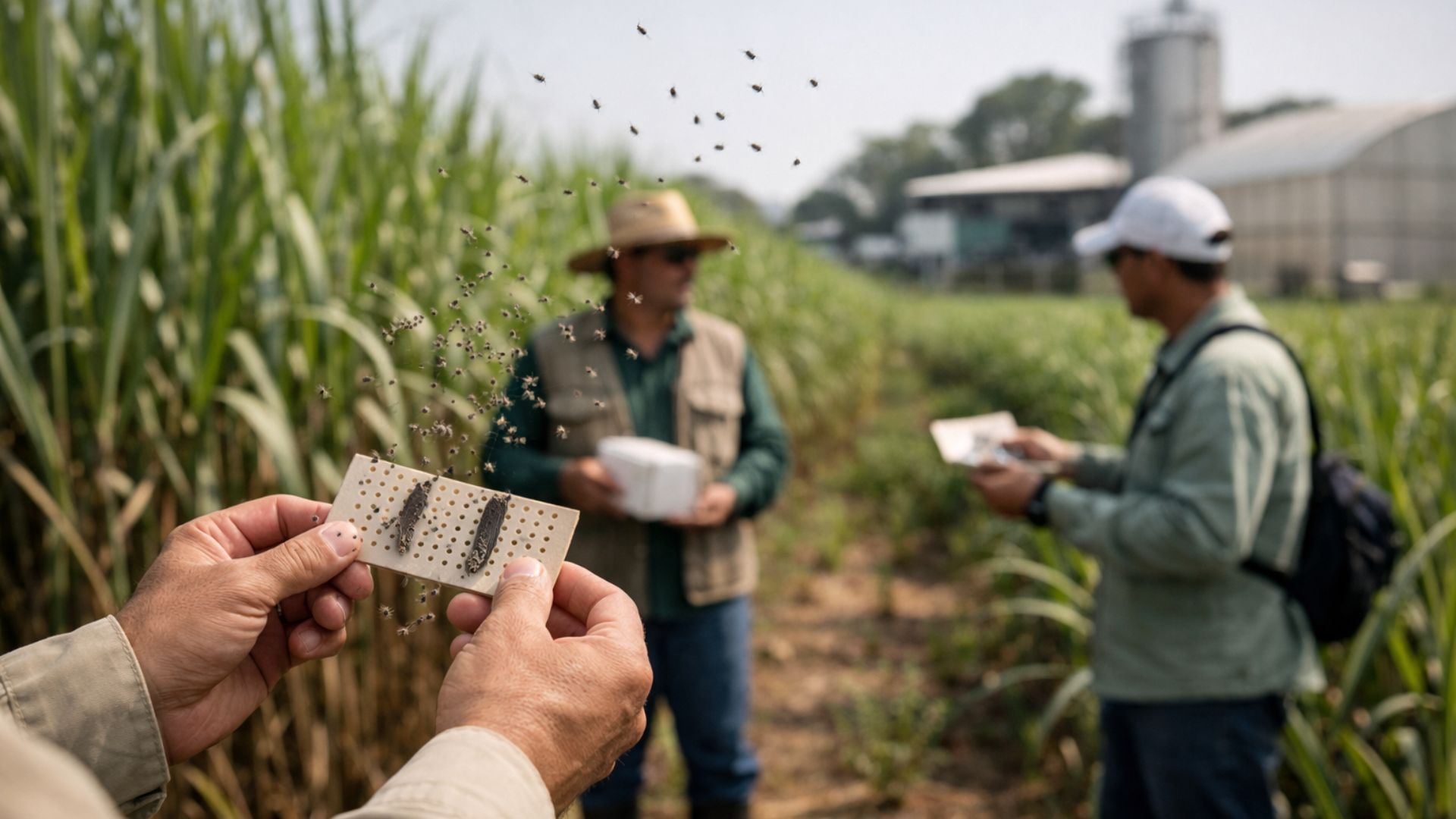


Annual Production of Billions of Insects in Brazilian Biofactories Sustains the World’s Largest Biological Control Program, Applied Over Millions of Hectares of Sugarcane to Combat Pests, Reduce Chemicals and Preserve Strategic Agricultural Productivity.
The Scenario Is Not Intuitive for Those Who Associate Pest Control Only with Spraying and Machines.
In Brazil, the most applied biological control strategy in agriculture involves the mass rearing and release of micro wasps in sugarcane fields. The practice has industrial scale.
Technical and academic documents describe an approximate volume of 21 billion parasitoids produced annually in biofactories to meet release programs in sugarcane areas.
The objective is to control the sugarcane borer and reduce dependence on insecticides in the crop that supports sugar and ethanol chains.
-
The eggshell that almost everyone throws away is made up of about 95% calcium carbonate and can help enrich the soil when crushed, slowly releasing nutrients and being reused in home gardens and vegetable patches.

-
This farm in the United States does not use sunlight, does not use soil, and produces 500 times more food per square meter than traditional agriculture: the secret lies in 42,000 LEDs, hydroponics, and a system that recycles even the heat from the lamps.

-
The water that almost everyone throws away after cooking potatoes carries nutrients released during the preparation and can be reused to help in the development of plants when used correctly at the base of gardens and pots, at no additional cost and without changing the routine.

-
The sea water temperature rose from 28 to 34 degrees in Santa Catarina and killed up to 90% of the oysters: producers who planted over 1 million seeds lost practically everything and say that if it happens again, production is doomed to end.

The Pest That Threatens Sugarcane
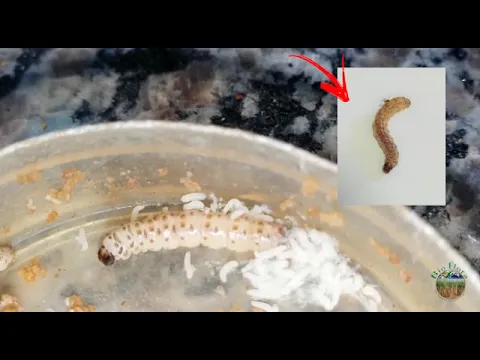
The main target of this effort is the sugarcane borer, a common name given to the larval stage of an insect that burrows into stalks and opens the way for agronomic losses and industrial problems.
In the logic of applied biological control, control does not depend on a chemical product that kills by contact.
It depends on a natural enemy, created in the laboratory and taken to the field at the right time.
In the most well-known case in sugarcane, this role is performed by Cotesia flavipes, a parasitoid micro wasp associated, in Brazil, with large-scale programs aimed at controlling the borer.
Industrial Scale in Brazilian Sugarcane Fields

The scale of this operation appears in two fronts: in the treated area and in the infrastructure needed to maintain the supply of insects.
A technical text from Epagri describes that sugarcane concentrates the largest applied biological control program in the world.
The release of the larval parasitoid Cotesia flavipes occurs over more than 3.5 million hectares, in addition to other agents used in the same crop.
In parallel, an academic work from Unesp records that, to supply these releases, approximately 21 billion parasitoids are produced annually in about 40 biofactories in Brazil.
The history is described as a program with decades of use and continuous improvement.
How the Releases of Micro Wasps Work
The term “little wasps” is often used as a shortcut to explain to the public the tiny size of these insects and their role as natural enemies.
In practice, this is a highly controlled technical system.
Micro wasps are multiplied in a controlled environment and then taken to the sugarcane field and released at defined points.
One of the challenges reported by studies related to this type of program is that the result in the field depends on the biological quality of the produced insects, the right moment of release, and the monitoring of the pest in the crop.
Applied biological control is described as a continuous process, not as an isolated action.
Direct Attack on the Sugarcane Borer
Cotesia flavipes acts by parasitizing the borer in its larval stage.
The micro wasp lays eggs in the host.
From then on, its development directly interferes with the survival of the caterpillars that burrow into the cane.

The same academic work that describes the annual scale records the existence of technical recommendations based on field sampling.
These recommendations indicate quantities of parasitoids per hectare and organization of release points to increase the chance of encounters between micro wasp and pest.
Biofactories and Logistics of Live Insects
How this process moves from the laboratory to the field is an essential part of public interest in the agenda.
The system presupposes biofactories operating routines of rearing, conditioning, and distribution logistics.
In biological control programs, the “product” is alive.
Time, temperature, and transport conditions directly affect the final efficiency of the control.
A technical record presented in academic proceedings also describes a practical side effect of the traditional release model.
The recurring use of plastic containers to condition pupae in large-volume releases opens debate about logistical and environmental impacts within the biological control chain itself.
Reduction of Insecticides and Integrated Management
In the debate about the reduction of insecticides, biological control is not treated as a slogan.

It is described in sources as an agricultural management tool.
Epagri characterizes biological control as a practice adopted by producers seeking to control pests efficiently and without chemical applications.
The agency also records the market growth in Brazil, with agents registered for different crops.
Reports from the FAPESP Research Institute describe the adoption of biological control as a response to problems associated with the improper use of insecticides.
The case of sugarcane appears as one of the most consolidated in the country.
Quality and Monitoring Determine Success
The large-scale use requires strict standardization.
The Unesp study that consolidates the annual number of micro wasps discusses precisely the quality of the biological material produced.
The work compares performance parameters of insects originating from different biofactories.
Differences in quality can compromise the expected result in the field.
This quality control is described as crucial for the credibility of the method, as failures in biological control tend to lead producers back to chemical solutions in situations of high pest pressure.
A Model Associated with Large Agricultural Areas

Another characteristic of the Brazilian model is the association with crops of large territorial extension.
Epagri draws attention to the fact that biological control in Brazil is widely applied in continuous areas.
This contrasts with the perception that biological methods would be restricted to small productions or specific niches.
In the case of sugarcane, it is a technological package incorporated by part of the sector, which operates in parallel with other agricultural managements.
Billions of Insects and a New Look at the Field
The journalistic interest in the topic lies in the contrast.
While popular imagination associates pest control with chemical pesticides, the Brazilian sugarcane industry hosts an operation based on billions of microscopic insects.
The goal described in the sources is to reduce pest pressure and, thus, decrease the need for chemical interventions.
Curiosity remains about how this bio-industry organizes itself, how it measures results in the field, and what other crops could reach a similar scale with already registered natural enemies.








Bom dia
Como conseguir as vespas sou produtor cana
E estou estou com problemas de ataque de brocas.
Existem empresas como a Koppert e a Vittia que vendem !!
Tenho um fornecedor bom, entre em contato 16992396661