





 Portuguese
  English
  Spanish
  4 min of reading
  0 comments


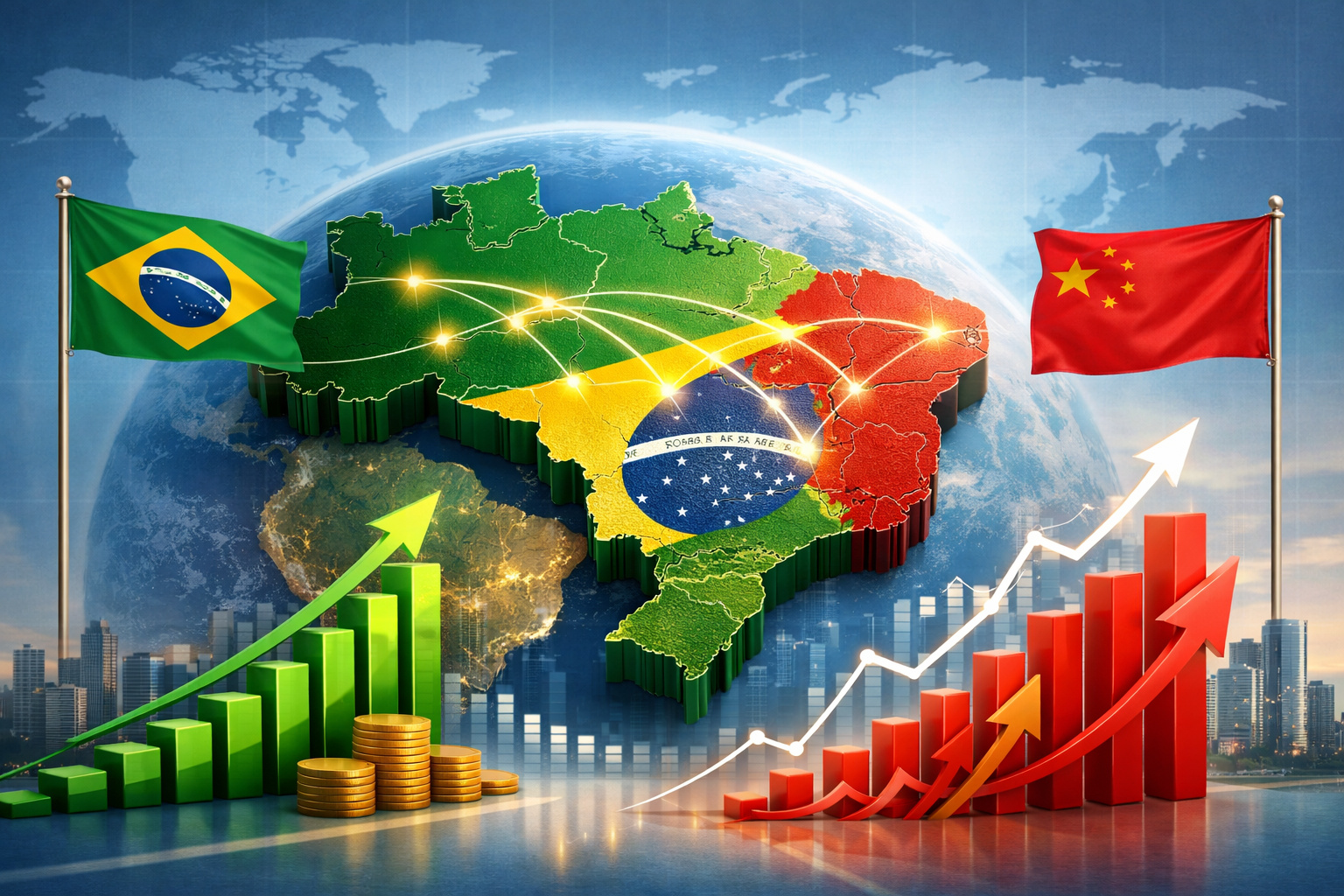
Even In An Adverse International Scenario, The Country Consolidates Strategic Position By Receiving Billions In Chinese Investments And Expanding Its Global Economic Relevance
Brazil has been consolidating an increasingly relevant position in the international economic arena. In recent years, in addition to significant advances in the trade balance, the country has started attracting increasing volumes of direct investments from China. This movement occurs even in a context of global retraction of foreign capital flows.
In this sense, Chinese investments in Brazil are not limited to foreign trade. They involve strategic acquisitions, joint ventures, asset purchases, credit concessions, and supply contracts. Furthermore, there is a strong presence in logistics, infrastructure, and energy projects.
The information was disclosed by specialized vehicles in international economics. According to data presented in sector reports, entities such as the Brazil-China Business Council (CEBC) have been closely monitoring this movement. According to the surveys, Chinese presence in the country has gained intensity and diversification over the past few years.
-
The government requests the Federal Revenue Service for a new system to automate the income tax declaration, reducing errors, time, and bureaucracy for millions of Brazilians.

-
Pix in installments, international Pix, and contactless payment without internet: the Central Bank revealed the new features coming to the tool that is already used by almost every adult in Brazil.

-
Mercado Livre has just started selling medications with delivery in up to three hours to your door, and this move could completely change the way Brazilians buy medicines on a daily basis.

-
In Dubai, rising tensions from the war in the Middle East are causing super-rich individuals to leave the Gulf and direct their fortunes to a new financial refuge in Asia.


Brazil Advances In Global Ranking And Stands Out Among The Largest Recipients Of Chinese Capital
Historically, Brazil occupied intermediate positions in the ranking of destinations for Chinese investments abroad. However, this reality changed significantly in 2025. Currently, the country ranks as the second main destination for China’s investments in the world.
Between 2007 and 2023, China invested US$ 73.3 billion in Brazil. This amount corresponds to almost R$ 400 billion at the current exchange rate. In total, 264 projects were accounted for across the national territory, demonstrating the breadth of investments.
The Brazilian electric sector accounted for the largest share of this capital. During this period, it received US$ 33.2 billion, equivalent to 45% of the total invested. Next, the manufacturing industry follows with US$ 5.3 billion, representing 7% of the total.
In addition, infrastructure projects absorbed US$ 3.3 billion, about 5% of Chinese investments. The agricultural sector directly received US$ 2.4 billion, which corresponds to 3% of the invested volume.
When analyzing the global stock of Chinese investments between 2007 and 2023, Brazil appears as the fourth largest recipient of China’s productive capital. In this select group, it is the only developing country. Ahead are the United States, with US$ 193.6 billion, Australia, with US$ 102.6 billion, and the United Kingdom, with US$ 99.9 billion.
In 2025, Brazil Concentrates 10% Of All Chinese Investments Made Abroad

The latest data reinforces this trend. In the first half of 2025, Chinese companies invested US$ 22 billion worldwide. Of this total, Brazil received US$ 2.2 billion. This equals 10% of all investments made during the period.
This volume represents a growth of 5.3% compared to the same period in 2024, when the country had received US$ 2.09 billion. Meanwhile, Indonesia led the ranking with US$ 2.59 billion. Still, the Asian country recorded an annual decline of 22.9%.
These numbers caught the attention of foreign governments. In the United States, for example, the intelligence agency’s budget bill for fiscal year 2026 included a specific investigation. The focus is on China’s advance in the Brazilian agricultural sector and its impacts on the global supply chain and food security.
At the same time, on August 11, the presidents of Brazil and China spoke by phone. The dialogue occurred amid escalating trade disputes between China and the United States. Recently, the Americans imposed 50% tariffs on Brazilian products.
According to the Chinese state news agency Xinhua, the Chinese leader stated that the ties between the two countries are experiencing their best historical moment. He highlighted the alignment of development strategies and the construction of a shared future.
On the Brazilian side, the president stated that there was a commitment to expand cooperation. The mentioned sectors include health, oil and gas, digital economy, and satellite technology. Furthermore, the countries intend to continue identifying new business opportunities.
Chinese Investments Grow Despite Global Decline In Foreign Capital
Another relevant point is the contrast with the international scenario. In 2023, the last available year in the CEBC survey, Chinese investments in Brazil totaled US$ 1.73 billion. This amount represents a growth of 33% compared to the previous year.
This increase occurred on a reduced base, as the previous year had a decline of 78%. Still, the movement is noteworthy. This is because total foreign investments in Brazil fell by 17% in 2023, according to data from the Central Bank.
Globally, the Organization for Economic Cooperation and Development (OECD) pointed to a 7% decrease in foreign investment flows. For Brazil, the retraction was 13%. Meanwhile, the United Nations Conference on Trade and Development (UNCTAD) indicated a 2% decline worldwide and a 10.2% decline in the country.
Despite this, China moved in the opposite direction. According to analyses from financial institutions, the country adopted a more selective posture. Nonetheless, it maintained Brazil as a strategic partner.
Although the United States continues to lead as the primary source of foreign direct investments in Brazil, China advanced rapidly. Between 2010 and 2023, American investments rose from US$ 109.7 billion to US$ 272.9 billion, a growth of 148.7%.
In the same period, Chinese investments jumped from US$ 7.9 billion to US$ 53.2 billion. This represents an impressive growth of 575%. As a result, China moved up from the 16th to the 5th position among the main sources of foreign capital in the country.
In your opinion, does this increase in Chinese investments represent a strategic opportunity or a risk for the future of the Brazilian economy?









-

-

9 pessoas reagiram a isso.