





 Portuguese
  English
  Spanish
  5 min of reading
  0 comments


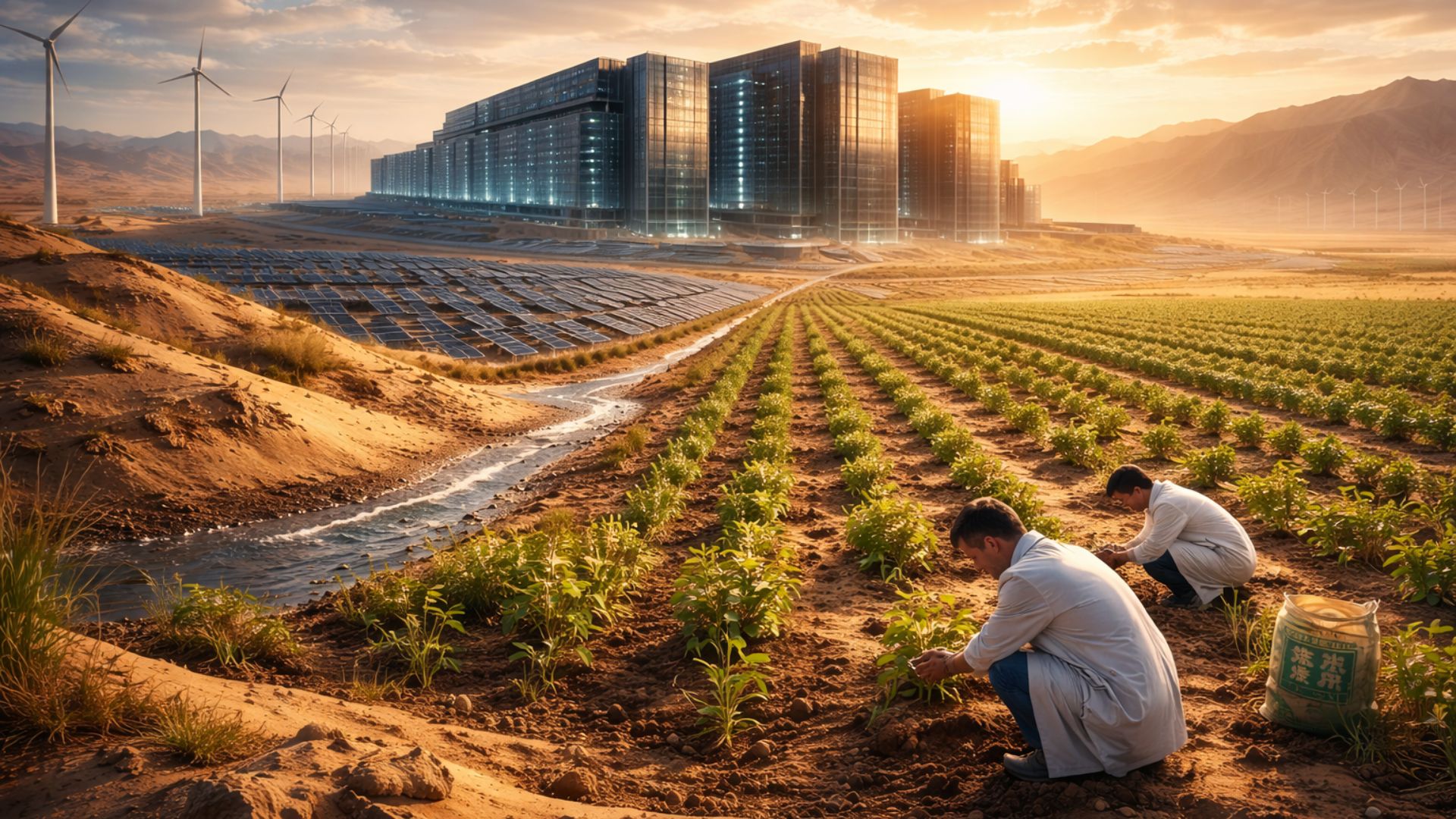
Silent Transformation in Arid Regions of China Combines Digital Infrastructure, Renewable Energy, and Biotechnology to Reduce Emissions, Redistribute Computing Capacity, and Restore Degraded Ecosystems, Repositioning Deserts as Strategic Areas for Technology, Energy Security, and Large-Scale Environmental Restoration.
China has accelerated the productive occupation of arid areas by combining digital infrastructure, renewable energy, and biotechnology to curb desertification and expand data processing capacity.
At the center of this strategy is the “East Data, West Computing” program, launched in early 2022, which shifts part of the processing from the wealthier and denser eastern regions to hubs in the interior and western parts of the country.
By June 2024, the eight national hubs linked to the plan totaled more than 1.95 million racks and had attracted over 200 billion yuan in investments.
-
Brazil became 18 square kilometers smaller in the new official update from IBGE, which redrew the boundaries of 784 municipalities in 13 states and even changed the names of cities that you might know, such as Açu, which is now called Assú.

-
Stephen Hawking said that the worst enemy of knowledge is not ignorance but the illusion of knowledge, and he dedicated his entire career to proving that science dies when people act as if they already have all the answers.

-
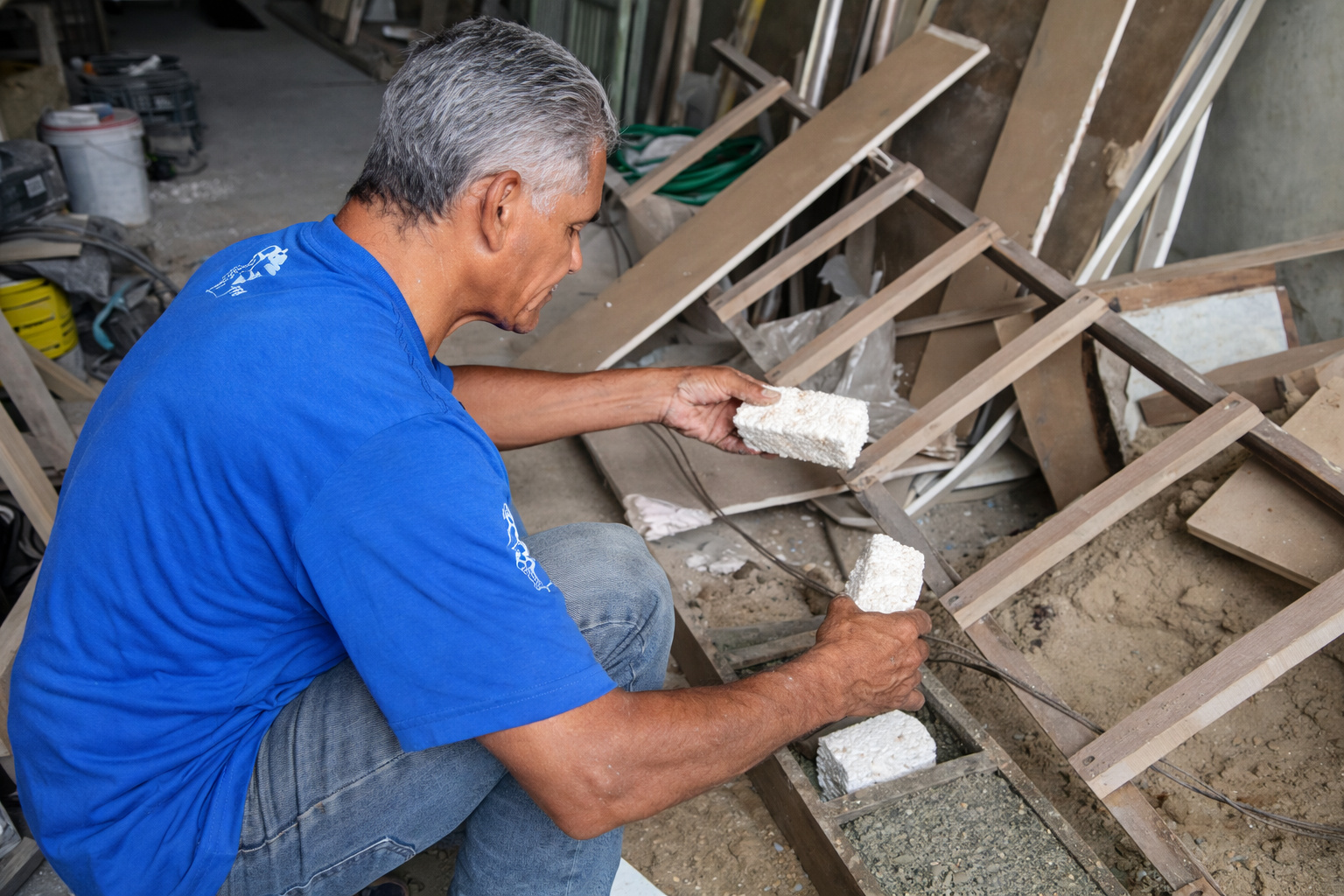
A man gathered Styrofoam, PET bottles, sand, and cement to build a recycled block using a mold made from an old board and a 50mm pipe to easily raise walls.
-
Man uses technique to save plaster with 20mm polystyrene panels, promises efficient thermal insulation and impresses with low cost in the construction.


Gobi Desert and the Advancement of Data Centers in China
The logic of the project is economic and energy-related.
While the east concentrates companies, users, and demand for computing, the west has large available areas and broader access to sources such as solar and wind energy.


The Chinese government has begun to treat this redistribution as part of its strategic infrastructure, aiming to build a national computing power network and reduce energy pressure on major urban centers.
Meanwhile, Beijing has strengthened the decarbonization agenda of the sector by establishing in 2024 that the national average PUE of data centers should drop to less than 1.5 by 2025.
Energy Efficiency and Renewable Energy in Digital Expansion
In this equation, the cold climate of the northern and western areas has become a technical asset.
Studies and policies used in the formulation of the project indicate that colder regions allow for a significant reduction in cooling costs, one of the largest components of electricity consumption in data centers.
Chinese regulatory requirements have also become stricter for facilities in priority hubs.
Projects in national hub nodes must operate with PUE of up to 1.2, a lower level than the historical industry average.
Academic projections on the evolution of this system suggest that, with technological advancement and greater participation of clean electricity, some hubs could approach PUE 1.1 after 2030, a scenario considered advanced.
Digital Infrastructure and Chinese Technological Sovereignty
The transfer of computing capacity to the interior also responds to a geopolitical and industrial calculation.
Since the tightening of U.S. restrictions on the export of advanced technologies, China has started to invest more in expanding its own computing base.
The government presented the plan as part of building a “digital China”, with hubs distributed mainly in western regions where energy resources and land availability favor large-scale facilities.
At the same time, industrial policy pressures the sector to operate with less carbon.
The official 2024 plan for the green development of data centers envisions annual increases in the use of renewable electricity and greater control over energy and water efficiency.
Recent studies indicate that the combination of better PUE and greater participation of clean energy can significantly reduce emissions from national hubs over the coming decades.
In other words, desert and arid regions have become part of China’s energy and digital architecture.
Scientists Use Cyanobacteria to Regenerate Desert Soils
Alongside the race for more efficient data centers, China has opened another front in the deserts: the biological reconstruction of soil.
Researchers linked to the Chinese Academy of Sciences have developed a solid inoculant based on cyanobacteria to accelerate the formation of biological crusts over sand.
When this material is spread and activated by rain, the microorganisms begin to bind sand particles, retain moisture, and form a more stable surface structure.
Technology That Accelerates Soil Formation
The advancement has drawn attention because it shortens a naturally slow process.
The formation of these crusts, which in natural conditions can take about 15 years, has been reduced to between one and two years with the new formulation, maintaining a microbial survival rate above 60%.
The innovation has been incorporated into the Three‑North Shelterbelt Program, one of China’s largest ecological initiatives created in 1978.
The expectation announced for this stage is to recover between 80,000 and 100,000 mu of desert areas in the next five years, equivalent to approximately 5,300 to 6,700 hectares.
The Fight Against Desertification Gains a New Biological Approach
The country has been using physical methods for decades to curb the advance of dunes.
Among the most well-known is the straw grid technique, used in erosion control and sand fixation actions since the mid-20th century.
This method reduces wind speed over the surface and helps stabilize the sandy terrain.
The new approach seeks to advance precisely at this point by acting on the microbial layer that supports ecosystem regeneration.
This difference changes the scale of Chinese ambition.
Instead of merely containing the mobility of sand, the goal now is to create conditions for the land to retain water, fix nutrients, and support vegetation more persistently.
Deserts Become Integrated into Economic and Environmental Strategy
The articulation between computing, climate, and environmental recovery reveals a change in scale in Chinese territorial policy.
Areas previously regarded as unproductive margins now serve a dual purpose: supporting the expansion of digital infrastructure and serving as a laboratory for solutions to combat desertification.
The movement fits into a broader agenda of economic, energy, and food security, where the occupation of physical space involves data, electricity, and ecological restoration.
In this redesign, the desert is no longer seen merely as a symbol of scarcity but is treated as strategic infrastructure at stake in the 21st century.
The consolidation of this experience depends on distinguishing between official targets, technical projections, and results already demonstrated in the field.
This distinction helps to define whether the Chinese model represents merely a set of ambitious projects or a new development paradigm for arid regions.






-

-

2 pessoas reagiram a isso.