





 Portuguese
  English
  Spanish
  5 min of reading
  1 comment


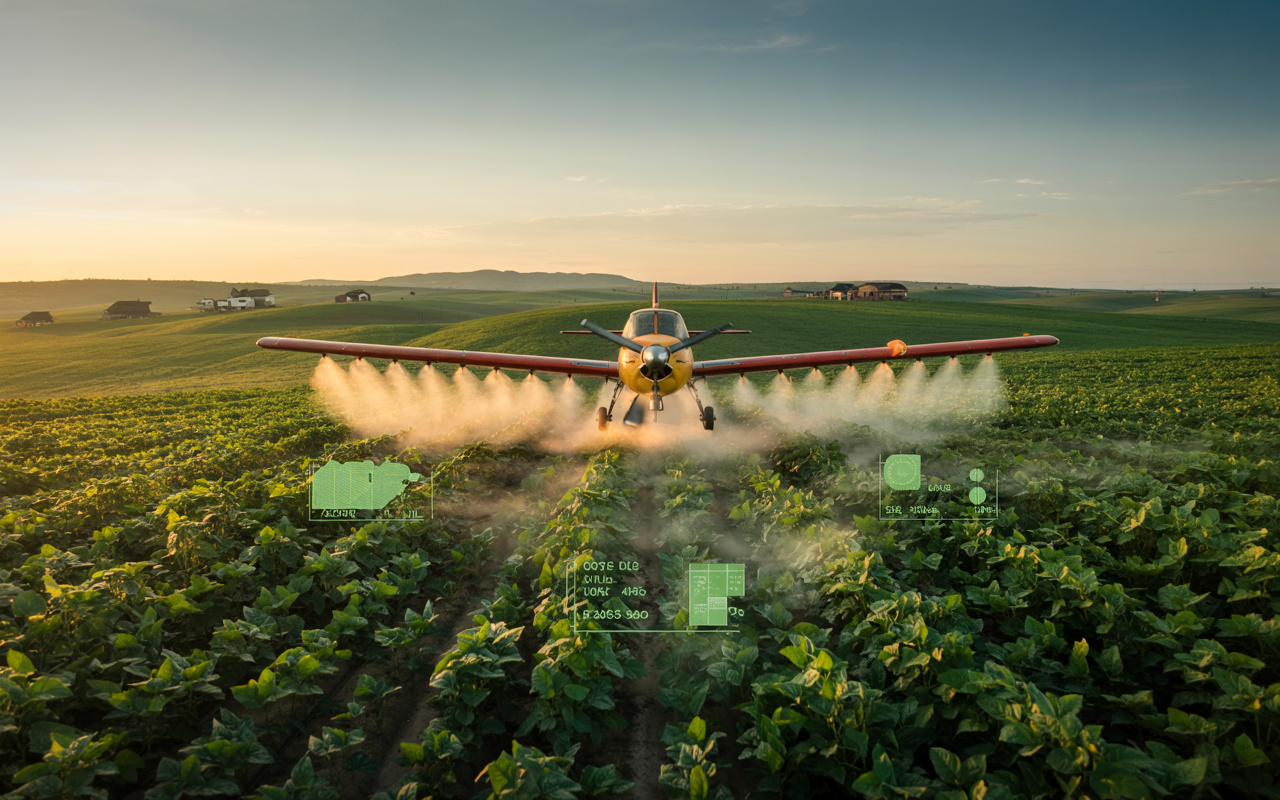

With More Than 2,700 Aircraft, Brazil Has the Second Largest Agricultural Aircraft Fleet in the World. See How Precision Aviation Drives Agriculture with Technology and Combats Pests on a Large Scale.
In the silent skies of the Brazilian countryside, an invisible fleet to most of the population plays one of the most strategic roles in agribusiness: agricultural aircraft, which daily fly over soybean, corn, cotton, and sugarcane fields to protect, nourish, and enhance productivity in the field. With more than 2,700 registered aircraft by the beginning of 2025, Brazil has established itself as the second largest agricultural spraying fleet on the planet, behind only the United States. This aerial army of agriculture is made up of state-of-the-art turboprops, domestic models like the Embraer Ipanema, and helicopters adapted for specific missions, operating with high precision, agility, and onboard technology.
Brazilian agricultural aviation is not just a logistical solution — it is a key part of modern, sustainable, and technology-driven agriculture, with a direct impact on global food security and the country’s trade balance.
Agricultural Aviation: What It Is, How It Works, and Why It’s Strategic


Agricultural aviation is the use of aircraft for aerial application of inputs in the field: fertilizers, agricultural pesticides, bio-inputs, seeds, and even biological pest control. It is also used in firefighting operations, sowing in remote areas, and environmental management.
-
While Russia dominates the global wheat market, Brazil emerges as an unexpected competitor in the Cerrado, offering grain available in July and August when stocks in the Northern Hemisphere are at their lowest point of the year.

-
China returned almost 20 Brazilian ships with soybeans, but now everything could change: the country that buys 80% of the grain is considering relaxing regulations after impurities held up shipments of thousands of tons and caused million-dollar losses.

-
The drought of the cerrado was considered an enemy of wheat, but Brazilian scientists turned the lack of rain into a competitive advantage by creating a grain with quality that is already attracting the attention of international mills around the world.

-
THE OWNER of Brazil: a farmer who came from laundries, created an ’empire’ and today runs a company valued at R$ 42 billion after tripling its value in less than a year and receiving a billion-dollar investment from the USA.


The main differentiator of aerial spraying is speed and large-scale coverage. A single aircraft can treat up to 500 hectares per day, with uniform distribution and significantly reduced soil trampling — something common in ground applications.
Additionally, modern aircraft are equipped with agricultural GPS, height sensors, flow controlled by software, and precision agriculture technologies, which reduce the use of inputs, avoid overlap, and minimize environmental impact.
Today, the sector is responsible for about 35% of the spraying carried out in Brazil, being essential in regions with high humidity, flood-prone soils, or large productive areas — such as MATOPIBA, the Midwest, and western Bahia.
The Second Largest Spraying Fleet in the World
According to data from the National Civil Aviation Agency (ANAC), Brazil had 2,432 registered agricultural aircraft in 2021 — 2,409 fixed-wing aircraft and 23 helicopters. Since then, the number has continued to grow.
By the beginning of 2025, the country reached 2,722 aircraft, consolidating itself as the second largest agricultural fleet in the world, surpassing agricultural powerhouses like Australia, Argentina, and Canada. The global leader is still the United States, with about 3,600 aircraft.
This growth is driven by technological advancement, the expansion of cultivated areas, and the demand for productivity with sustainability. The Brazilian field has become highly dependent on aerial solutions to maintain competitiveness.
The Prominence of the Embraer Ipanema and Turboprops in Agriculture
Among the most popular models in Brazil is the Embraer Ipanema, a national agricultural aircraft with over 1,500 units already produced since the 1970s. Currently, the model is manufactured by Embraer Indústria Aeronáutica, in Botucatu (SP), and it is the only aircraft in the world powered by ethanol with certification for agricultural aviation.
In 2024, 65 new units of the Ipanema were registered, a significant number that reinforces the sector’s confidence in domestic solutions adapted to Brazilian territory.
Besides the Ipanema, larger turboprops have been gaining space, such as the Air Tractor AT-402 and AT-802 models, Thrush 510G, and PZL Dromader, which offer greater payload capacity and autonomy, making them ideal for large properties and multi-application missions.
The use of helicopters has also been growing in niches like banana plantations, coffee farms, and mountainous areas, where fixed-wing flight is unfeasible.
Precision Agriculture and Aerial Technology in the Field
The integration of precision agriculture with agricultural aviation has raised the level of the sector in Brazil. Today, aircraft operate with embedded systems for:
- Digital Crop Mapping
- Variable Rate Application
- Electronic Flow Control
- Real-Time Satellite Tracking
- Compatibility with Drone Data and Local Weather Stations
This technological synergy allows for customized applications by parcel, reducing losses, maximizing the use of inputs, and preventing contamination of sensitive areas.
Specialized companies in agricultural aviation also offer post-flight reports, with application maps and efficiency analysis, which strengthens the use of data in decision-making in the field.
Economic Impact and Food Security
The advancement of Brazil’s aerial fleet is not just a statistical curiosity — it is a determining factor in national agricultural productivity. The ability to quickly protect crops, especially in scenarios of emerging pests, prevents billion-dollar losses and ensures internal and external supply.
Approximately 60% of Brazil’s agricultural exports depend on crops that utilize agricultural aviation at some stage of the production cycle — whether in planting, phytosanitary control, or harvest. Soybeans, corn, cotton, rice, and sugarcane are among the main beneficiaries.
Additionally, agricultural aviation generates over 10,000 direct and indirect jobs, drives aviation maintenance centers, parts factories, and certified workshops, contributing to the GDP of general aviation and the agro-industrial sector.
Challenges and Regulations
Despite the advancements, the sector still faces regulatory, climatic, and public image challenges. Aerial application is often the target of unfounded criticism regarding drift and contamination — even though it is one of the most regulated and monitored modalities by ANAC, MAPA, and IBAMA.
Aircraft must operate with a specific license (CAVAG), pilots with agricultural training and certification (IFR or VFR agricultural) and a previously approved application plan. The sector has also adopted good environmental practices and buffer zones, in addition to promoting education and dialogue initiatives with rural communities.
Another growing concern is the training of new agricultural pilots. The sector demands highly specialized professionals, with experience at low altitudes, maneuvering in restricted areas, and technical mastery of onboard equipment. Initiatives like SINDAG and rural aviation schools have been fundamental in training new generations.


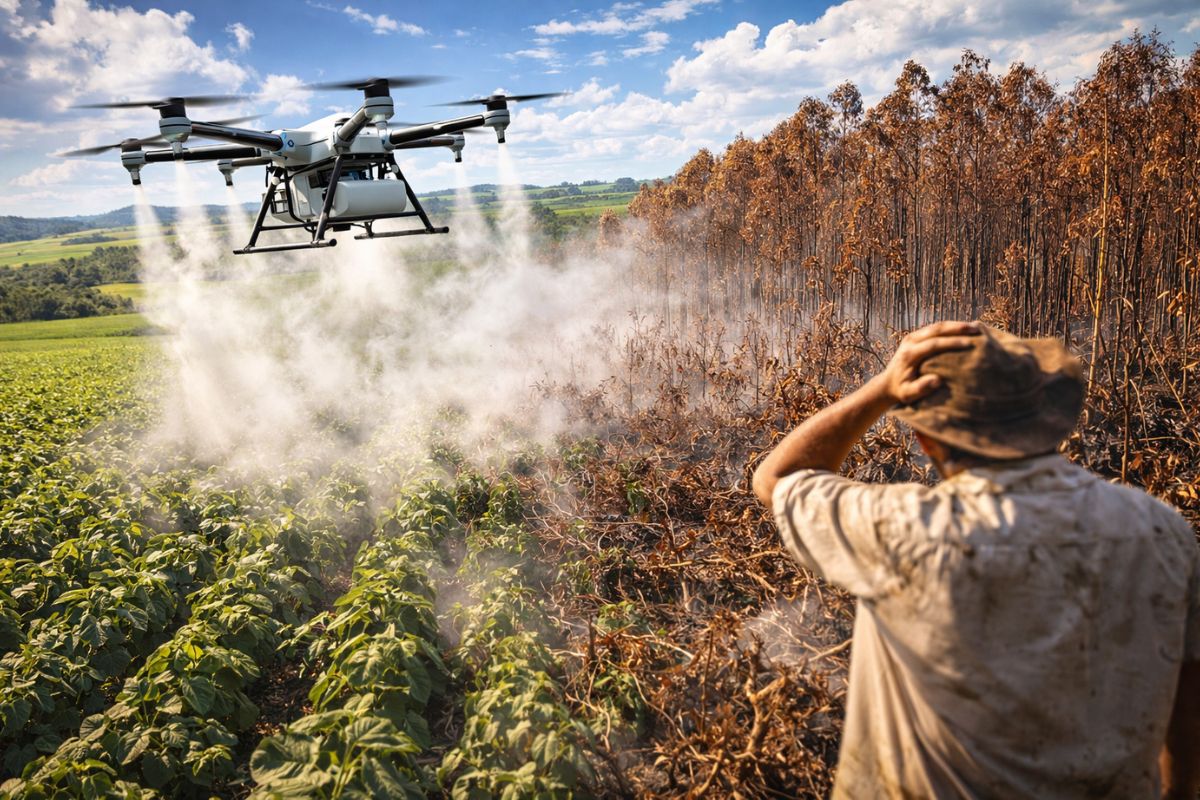







E tome glifosato (Roundup) nas nossas mesas, escondidos nos legumes e frutas.
Depois as pessoas se espantam do aumento de casos de câncer do sistema digestório, especialmente intestinos.