





 Portuguese
  English
  Spanish
  7 min of reading
  0 comments


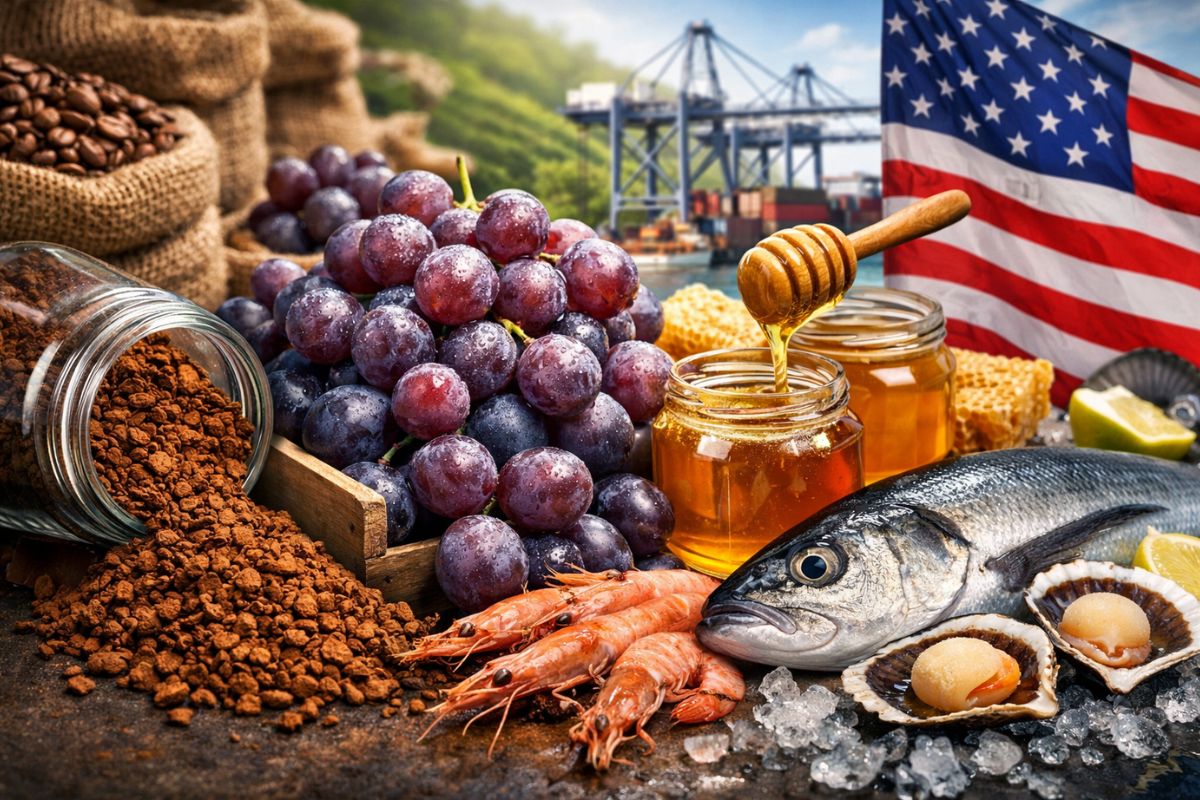
In Brazil, The Suspension Of The Tariff By The Supreme Court Revives Expectations For Relief For Instant Coffee, Grapes, Honey, And Fish, Which Were Left Out Of The 10% And 40% Exemptions. With 55% Of Exports In 2024 Covered, Uncertainty Remains After Trump Announced A New Global Rate Of 10% Without Detailing Affected Products.
Brazil has once again placed four segments that felt the direct impact of American tariffs on the radar: instant coffee, grapes, honey, and fish. The Supreme Court’s decision to suspend the tariff announced by Trump reopens a gap for sectors that heavily depend on the U.S. market and that had not been included in previous exemptions.
At the same time, relief is not yet automatic. A few hours after the judicial announcement, Trump spoke of new global rates of 10% and said he would sign an executive order, without explaining which goods would be affected. For Brazil, the result is a transitional scenario in which the rule changes, but insecurity remains for exporters and those negotiating long-term contracts.
What The Suspension Of The Tariff Changes In Practice
When the Supreme Court suspends a tariff, the most immediate effect is halting the application of the rates that were in effect, at least until the legal dispute is resolved or there is a new legal basis for charging.
-
The government requests the Federal Revenue Service for a new system to automate the income tax declaration, reducing errors, time, and bureaucracy for millions of Brazilians.

-
Pix in installments, international Pix, and contactless payment without internet: the Central Bank revealed the new features coming to the tool that is already used by almost every adult in Brazil.

-
Mercado Livre has just started selling medications with delivery in up to three hours to your door, and this move could completely change the way Brazilians buy medicines on a daily basis.

-
In Dubai, rising tensions from the war in the Middle East are causing super-rich individuals to leave the Gulf and direct their fortunes to a new financial refuge in Asia.


For Brazil, this matters because the additional cost not only affects the final price; it impacts freight, insurance, margins, delivery times, and the willingness of the American buyer to maintain volumes.
At the business end, tariffs are not an accounting detail; they are a deciding factor. An importer from the U.S. may reduce orders, demand discounts, change the source of the product, or simply postpone purchases.
Therefore, the suspension opens a window to resume negotiations but does not eliminate the risk, especially after the announcement of a global rate of 10% without a clear list of products.
Why Part Of Brazilian Agribusiness Was Left Out Of The Exemptions
At the end of 2025, there were two decisions that alleviated part of the exports. The first, on November 14, removed the reciprocal tariff of 10% applied in April to about 200 food products from various countries.
The second, on November 20, was directed at Brazil and suspended the 40% surcharge announced in July for more than 200 items, expanding a list that already had almost 700 exceptions.
Even so, the coverage was partial. The Brazilian Confederation of Agriculture and Livestock (CNA) estimated that the reversal reached 55% of the value exported by Brazil to the U.S. in 2024.
Included, for example, were coffee beans and beef, which are among the best-selling items in the American market.
The remaining 45% included sectors that do not lead the ranking but have high dependence, such as instant coffee, honey, fish, and grapes.
Instant Coffee: When The Tariff Changes The Ranking And Reduces Volume
In Brazil’s case, instant coffee has a decisive trait: a historical and continuous presence in the American retail market.
In 2024, sales of instant coffee to the U.S. accounted for 10% of all coffee exports from Brazil, while most of the rest consists of coffee beans, which ended up benefiting from exemptions.
The impact of the tariff was felt in market dynamics. According to the sector, last year 38% of what Americans imported in instant coffee originated from Brazil, a level that helps explain why any additional tax reorganizes competition, shelf space, and contracts.
After the additional 40% tax imposed in July, there was a change in the ranking of destinations, with Russia taking a prominent position relative to Brazil, which was noted as unprecedented. And since then, the volume exported to the U.S. in August, September, and October fell by about 50% compared to the same period in 2024.
Grapes: Strong Exports, Exclusion, And Price Negotiation Decline
Grapes enter this dispute for a simple reason: they were being negotiated with real weight in the trade flow with the U.S. In 2024, the country was the destination of 12% of all fresh fruits exported by Brazil, and in this context, only grape exporters earned US$ 41.5 million, according to Abrafrutas.
According to AgroStat, 23% of all grapes exported by Brazil in 2024 went to the United States, a figure that highlights how the American market is not “just another customer”; it is part of the sector’s support.
With the tariff escalation, a demand shock occurred. Between October and November, grape sales to the U.S. fell by 73% compared to the same period in 2024. Although there was a category of “fresh fruits” on the exceptions list published by the White House in November, grapes were left out, according to confirmation from the sector.
One explanation raised was the fact that the U.S. is also a major producer and is projecting a bumper crop, as well as the significant competition from Chile and Peru.
Part of the bunches that stopped going to the U.S. was redirected to Europe and South America, but the central loss appeared at the negotiation table: with less demand, the bargaining power to defend prices declines.
Honey: Double Taxation And Dependence On A Single Buyer
For honey, the issue goes beyond the “momentary tariff.” In addition to the 50% tariff related to the tariff, Brazilian honey was already subject to an import tax of 8.04% in the U.S., which raises the cost floor even before any additional surcharge.
When a chain already operates with pressured margins, every percentage point becomes a fight for survival along the way, from the beekeeper to the exporter.
The degree of dependence on the American market is also noteworthy. According to AgroStat, the U.S. represented nearly 80% of all natural honey exports from Brazil, a level that concentrates risk and reduces short-term alternatives.
There have been reports of contracts guaranteed until December 2025 for part of the operations, which helps explain why sudden changes in tariffs, exceptions lists, and bureaucratic requirements can disrupt planning, cash flow, and renewal of agreements, especially in cooperatives and regional hubs.
Fish: US$ 300 Million Per Year And Direct Impact On Communities
In the fish sector, the impact is significant in value and even greater in social reach. According to the industry association, fish sales from Brazil to the United States generate about US$ 300 million per year, and Americans represented almost half of all food exports in 2024, according to AgroStat.
This means that the effect of tariffs is not limited to a handful of large companies; it reaches an extensive network of suppliers, processing, logistics, and distribution.
The sector’s reading is that tariffs hit hardest where sensitivity is greatest, in small and medium enterprises and in chains that support coastal and riverside communities.
The topic has also entered the commercial strategy debate: the president of Abipesca advocated for urgency in placing Brazilian fish back into bilateral negotiations and summarized the need in a short but direct statement: “We need reciprocity and strategy.”
With every round in which the product is left out, the competition for space tends to favor international competitors who can offer predictability to the American buyer.
Entities And Government: Legal Security, Strategic Silence, And Information Seeking
The institutional reaction from Brazil has been heterogeneous, and this says a lot about the moment. The Brazilian Coffee Industry Association (Abic) assessed that the Supreme Court’s decision reinforces legal security and respect for legal competencies in international trade relations.
It also pointed out that unilateral measures, such as the tariff, create uncertainty and chain effects from the field to retail.
Other entities took a more cautious stance. Representatives of fruits, instant coffee, and coffee exporters indicated that they were still seeking information to understand the developments.
Some associations and the CNA opted not to comment at that moment, signaling that Brazil was still trying to gauge the real impact of the suspension and the announcement of a global tax of 10%.
In government, Vice President Geraldo Alckmin classified the Supreme Court’s decision as important and assessed that the global tariff of 10% preserves competitiveness, while Trump publicly criticized the suspension and promised to proceed with new charges.
What Brazil Needs To Observe From Now On
The central point for Brazil is that the suspension of the tariff does not resolve the dispute; it reopens the game. The difference between “being outside of the exemption” and “having a chance again” depends on details that typically appear in lists, annexes, and executive orders: which product codes are included, what rate applies, when it starts, whether there are category exceptions, and if the importer can internalize the burden without passing it on in full.
For exporters from Brazil, the priority becomes managing uncertainty. This involves renegotiating deadlines, reviewing price clauses linked to tariffs, diversifying destinations when possible, and maintaining traceability and compliance to avoid losing ground for non-tariff reasons.
And on the diplomatic side, sector pressure tends to grow to ensure that instant coffee, grapes, honey, and fish are not forgotten in the next rounds, precisely because they depend on a market that pays for volume but demands predictability.
In your daily life, do you feel that Brazil should insist more on agreements to reduce this dependence on the American market, or does it make sense to prioritize the U.S. even with so much fluctuation? If you work with coffee, fruits, honey, or fish, what has been the most concrete effect you’ve seen after the tariffs: order decline, price renegotiation, change of destination, or difficulty closing new contracts?









-

2 pessoas reagiram a isso.