





 Portuguese
  English
  Spanish
  5 min of reading
  3 comments


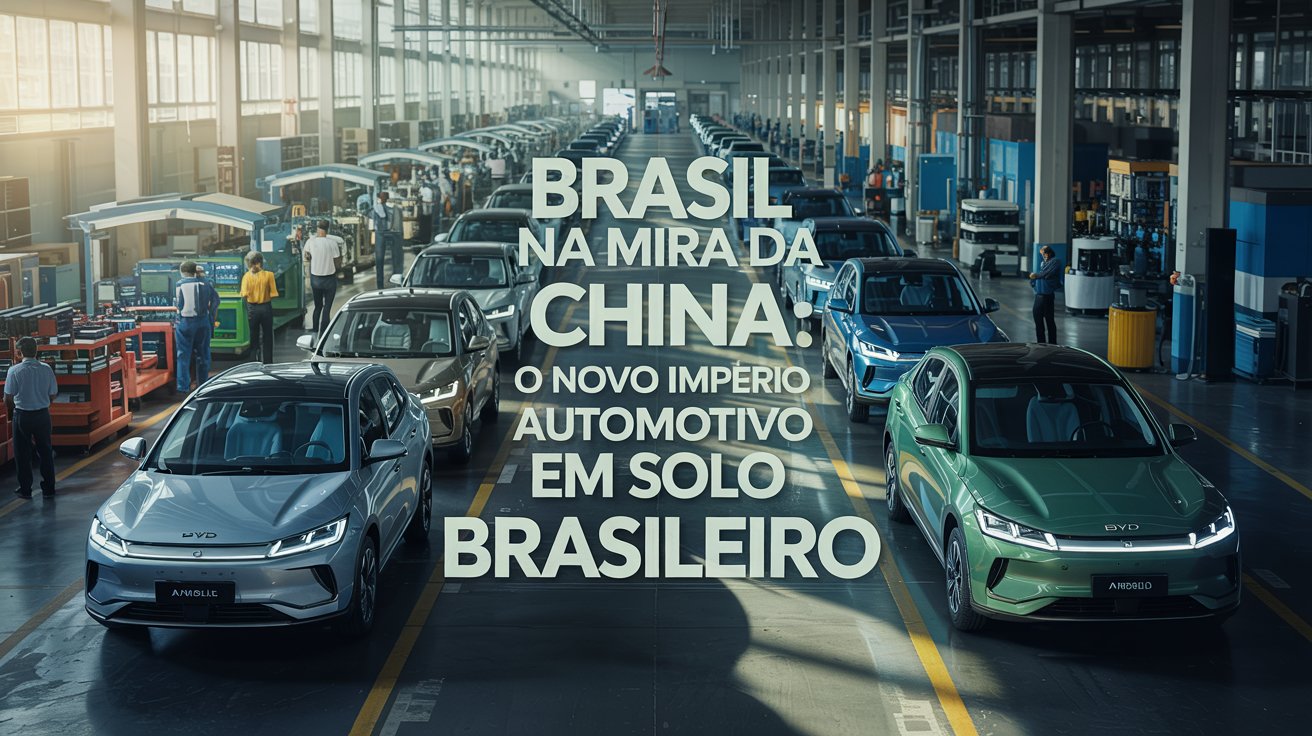

Chinese Brands Like GWM, BYD, and GAC Motor Transform Abandoned Factories of Ford, Mercedes, and Mitsubishi into Productive and Technological Hubs, Reviving the National Automotive Sector with Promises of Jobs, Innovation, and Exports Amid a Competitive Landscape.
Brazil has become a key player on the global chessboard of the Chinese automotive industry.
Amid a scenario of industrial reconfiguration, giants like GWM, BYD, Geely, and GAC Motor are occupying spaces left by traditional automakers, such as Ford and Mercedes-Benz, and reshaping the future of mobility in the country.
The movements are not isolated — they involve billions of reais, job creation, and a new chapter for factories that had already lost their relevance.
-
Spain surprises the world by erecting 62 artificial dunes, mixing sand with natural remains of posidonia, and causing the structure to lose only 1.4% of its volume in 1 year.

-
With 16 Bulava missiles, improvements in acoustic stealth, and a design focused on silent patrols, Russia’s nuclear submarine was born to ensure Moscow’s invisible retaliation and has become one of the pillars of its maritime strength.

-
‘Populous’ city in Rio among the worst in Brazil in national ranking and exposes silent development crisis.
-
Couple buys house in the South Zone of São Paulo, opens a hidden door in the garage, and finds a secret wine cellar with dozens of old wines forgotten since the 1970s.
The Chinese presence in the Brazilian automotive sector is now a well-defined strategy, focusing on reindustrialization, nationalization of components, and expansion into Latin American markets.
GWM (Great Wall Motors), for example, has chosen to reactivate the Mercedes-Benz plant in Iracemápolis (SP).
Meanwhile, BYD is converting the former Ford complex in Bahia into a center for electric vehicle production.
Geely, in turn, has established a partnership with Renault.
And GAC Motor is preparing an ambitious entry into the Midwest.

GWM Opens New Era in Iracemápolis
The Mercedes-Benz factory, deactivated in Iracemápolis in 2021, will be reopened by GWM as early as July 2025.
The Chinese automaker plans an initial production of 50,000 vehicles per year.
There is a clear intention to increase this number in the medium term.
In addition to production, GWM aims to raise the localization rate of components from the current 35% to 60% by 2026, an important advancement to consolidate roots in the Brazilian productive sector.
The brand has already hired 400 workers.
It is expected to double by December, signaling the resumption of economic activity in the region.

BYD Transforms Camaçari into Electric Vehicles Hub
BYD is converting the Ford factory in Camaçari (BA) into a mega complex dedicated to the production of electric vehicles, hybrids, and batteries.
The total investment is estimated at R$ 5.5 billion.
The projected capacity is up to 150,000 units per year.
The full operation is expected to start by the end of 2026.
It promises to generate up to 20,000 direct and indirect jobs, revitalizing the Bahia automotive hub.
As the company has already revealed, the goal is clear: to make Brazil an export platform for electric vehicles to all of Latin America.

Geely Bets on Partnership with Renault
Unlike its competitors, Geely has opted for a collaborative approach: it has become a minority shareholder in Renault’s Brazilian operation.
The agreement will allow the Chinese automaker to utilize part of the idle capacity of the factory in São José dos Pinhais (PR).
The market has already nicknamed the model as “industrial coworking.”
The first model of the brand to land in Brazil will be the EX5 SUV.
It will still be imported from China, with a launch expected for July 2025.
Local production, however, is in the plans — and will depend on market acceptance.
GAC Motor Prepares Billion-Dollar Investment in Goiás
The latest move comes from GAC Motor.
In 2024, the company announced a US$ 1.3 billion investment (approximately R$ 7.4 billion) to initiate its national production in 2026.
The plant will be installed in Catalão (GO), site of the current factory of HPE Automotores, which assembles Mitsubishi vehicles.
Although Mitsubishi states that the factory is not for sale, the expectation is that a partnership model similar to Geely’s with Renault will be replicated.
The national production — except for batteries — is expected to begin by the second half of 2026.
The annual capacity of the plant has not yet been disclosed.

Why Did Brazil Become a Priority?
According to automotive consultant Milad Kalume, Brazil remains among the world’s ten largest markets in production volume and sales, making it highly strategic for those looking to dominate Latin America.
However, he highlights structural limitations.
“Adding the anticipated capacities of GWM and BYD, we have up to 200,000 vehicles per year. This does not even consider Geely and GAC. But the current Brazilian market is around 2.5 million units per year, which is still insufficient to absorb this entire expansion,” Kalume points out.
Another obstacle is the macroeconomic environment.
With the basic interest rate still at 14.75% (data from May 2025) and scarce credit, consumption power remains limited.
The consultant explains that, for sustainability to occur, the country should operate with a base of 3.5 million units per year.
This number will only be possible with lower interest rates, easier credit, and higher income for the population.
Logistics and Structure Influenced the Chinese Choice
Aside from the promising market, Chinese automakers opted for factories located in established industrial hubs — such as São Paulo, Paraná, Bahia, and Goiás.
This significantly reduces logistics costs and accelerates production.
Kalume emphasizes: “It’s much easier to reactivate a factory in Iracemápolis than to build one from scratch in Acre.”
Traditional Automakers Feel Threatened
Behind the scenes, there is a climate of apprehension among traditional brands.
The Chinese advance is fast, well-planned, and features modern models that combine good design with competitive prices.
Even with the import tariff set at 35%, the Chinese can maintain aggressive margins.
This worries entities like Anfavea (National Association of Motor Vehicle Manufacturers), which discusses alternatives to curb this advance.
The fierce competition may force established brands to revise their strategies, lower prices, and modernize their lines.
This competition, although tense, could benefit the end consumer with more technological and affordable options.
However, the success of this reconfiguration will depend on a strengthened production chain, coherent public policies, and Brazil’s ability to sustain global competition.
The origin of the investors, in this context, is secondary.
What matters is whether the country will be able to seize this historic opportunity to boost its industry.
But with so many promises, billions in investments, and the revival of previously abandoned factories, is Brazil really prepared to become the new automotive hub of Latin America?






Aumento de poder de compra, não combina com governo ****…
Que venham os chineses, assim os fabricantes tradicionais vão abaixando a **** deles e tratem de vender produtos melhores e com preços menores.
Concordo plenamente…