





 Portuguese
  English
  Spanish
  9 min of reading
  1 comment


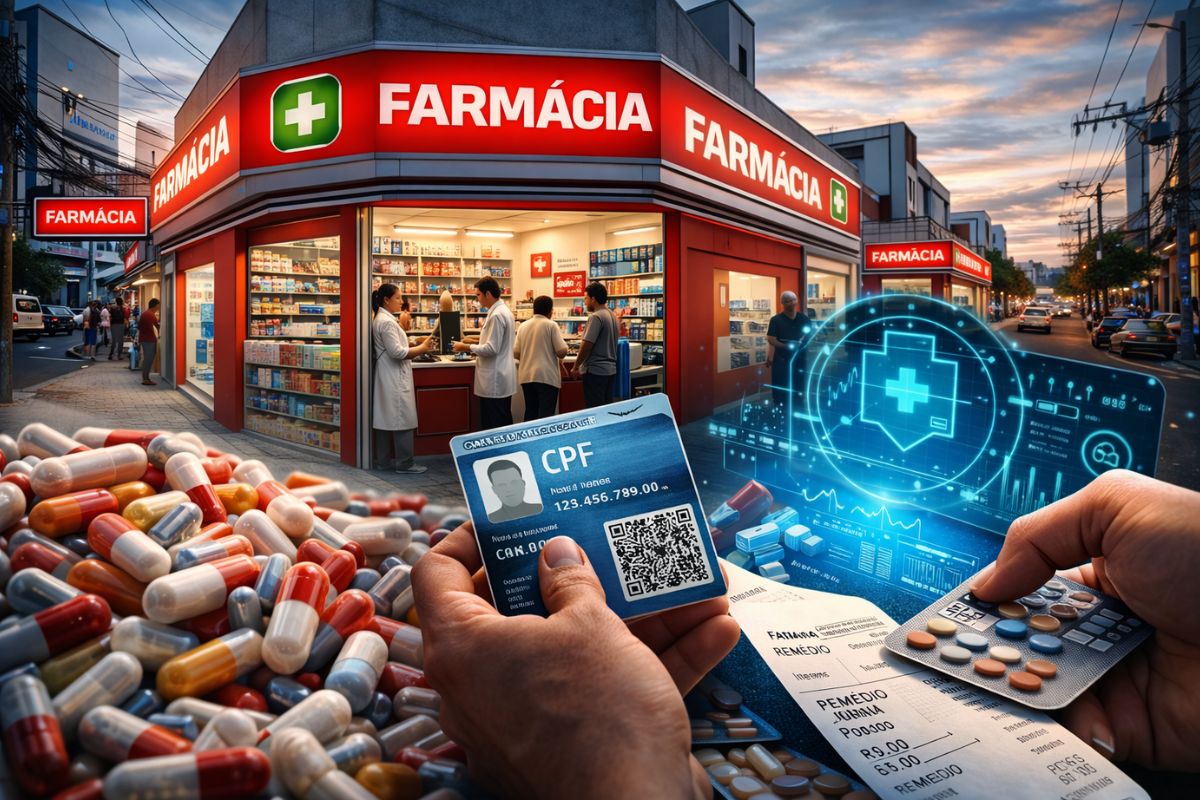


In the Land of Pharmacies, Discounts with CPF on the Receipt, Mass Self-Medication, Popular Pharmacy, and the Use of Health Data Show How the Counter Became the Central Piece of Health and Profit.
In Brazil, the scene repeats itself in almost every city. Pharmacies side by side, open until late, brightly lit, always crowded, have transformed the country of commercial streets into the authentic land of pharmacies. Where other businesses close, they resist, multiply, and occupy the best corners.
This advance is not a product of chance. In just a few decades, Brazil has about 90,000 active pharmacies, with growth exceeding 60% since the early 2000s, mainly driven by large chains. Being the land of pharmacies means much more than having medicine available – it reveals a business model based on volume, data, self-medication, public programs, and quick money that circulates, not always with the care that health deserves.
How Brazil Became the Land of Pharmacies

Walking through Brazilian cities has become almost an urban observation exercise. In many streets, pharmacies share the same sidewalk, sometimes the same corner, competing for the attention of passersby and the urgency of those in need of something right away.
-
Brazilian city bets on the business environment to generate jobs and attract investments in the energy sector — secretary reveals strategy at Macaé Energy 2026.

-
50 viaducts, 4 tunnels, 28 bridges, and 40 kilometers of bike paths: BR-262 in Espírito Santo will receive 8.6 billion reais for the largest engineering project in the state’s history, inspired by the Immigrant Highway in São Paulo.

-
Brazil produces too much clean energy and doesn’t know what to do with it: over 20% of solar and wind capacity was wasted in 2025 while investors flee and 509 renewable generation projects were abandoned in the last year.

-
Piauí will produce a new fuel that replaces diesel without needing to change anything in the truck’s engine and reduces pollutant gas emissions by half: truck drivers from all over the Northeast are already celebrating the news that will arrive later this decade.


It’s not an exaggeration or a personal impression. Brazil now has about 90,000 active pharmacies, nearly double what it had at the beginning of the 2000s.
This leap was driven by large chains. They account for around 11% of the points of sale but concentrate over 50% of all sales in the sector. Few stores, high volume, strong bargaining power.
In some cities, the concentration is so visible that certain streets are informally nicknamed pharmacy street. Interestingly, this happens even in areas where other businesses cannot sustain themselves.
Shops close, markets change addresses, but pharmacies remain there, steadfast. When a country is recognized as the land of pharmacies, the discussion shifts from just economic to social: what sustains so many units so close together and what does this reveal about our relationship with medicine, health, and consumption.
Pharmacy That Doesn’t Just Live on Medicine: The Invisible Business Model
To understand why so many pharmacies manage to stay open at the same time, we need to look beyond the medication counter.
The modern pharmacy has ceased to be just the place to “buy medicine.” It has become a high-turnover business based on volume, convenience, and product diversification.
Today, the pharmaceutical sector generates over 150 billion reais a year in Brazil, growing at a double-digit rate.
A growing portion of this revenue comes from hygiene, beauty, supplements, vitamins, convenience items, and private labels, which offer higher margins than traditional medicines.
You walk in to buy a painkiller and leave with shampoo, sunscreen, vitamins, and some other counter promotion.
Nothing is improvised. The store layout, the positioning of the cash register, the queue, and the gondola ends are designed to increase the average ticket.
The more frequently customers enter the pharmacy, the stronger the model of the land of pharmacies becomes, even when the visit has nothing to do with a medical prescription.
Territorial War: Pharmacies Side by Side Are Not a Mistake, They Are Strategy
Seeing three or four pharmacies competing for the same corner seems excessive, but it’s strategy. The pharmaceutical retail sector has begun to treat location as a central asset, supported by data intelligence and consumer behavior analysis.
The large chains use maps of foot traffic, income profiles, and consumption history to decide where to open new units, even if it means being door-to-door with competitors or another store of the same chain.
In many cases, opening a pharmacy next to another produces more results than betting on an entire neighborhood with little traffic.
The logic is simple. Location weighs on the customer’s decision, especially when the purchase involves urgency. The street turns into a pharmaceutical corridor.
The competition is for territory, visibility, and capturing the customer at the very moment of need. Meanwhile, independent pharmacies face a much tougher game, relying on association networks, personalized service, and ties with the neighborhood to survive.
When the Pharmacy Replaces the Doctor: Self-Medication as the Rule
In the land of pharmacies, the counter ceases to be just the beginning of treatment and often becomes the end of care. Self-medication is a widespread habit.
Research indicates that nine out of ten Brazilians take medication without a prescription, mainly painkillers, antipyretics, anti-inflammatories, and vitamins.
This behavior has a real cost. Industry estimates and authorities associate self-medication with about 20,000 deaths a year in Brazil, as well as poisonings, liver and kidney problems, chemical dependence, and increased bacterial resistance. Anvisa classifies self-medication as a public health issue.
In this scenario, the pharmacy takes the place of the doctor’s office. Investigative journalism has already shown clerks receiving commissions from laboratories to recommend medicines and vitamins, a practice known as “pusher therapy,” turning commercial goals into orientation criteria.
The customer enters with a simple complaint and leaves with a combo of products, not necessarily because they need them, but because the system rewards sales volume.
In a country with difficult and prolonged access to medical consultations, faced with pain and urgency, the shortest path becomes the counter.
CPF at the Register: The Discount That Buys Your Data

The scene has become automatic. The product goes through the register, the price appears high, and the question comes: CPF on the receipt? Within seconds, the amount drops.
The impression is one of advantage. But, in practice, this “discount” is almost never an extra benefit but rather the real price conditioned on providing your data.
In many cases, the price without CPF serves as an anchor, an artificially inflated price used to encourage customer identification.
The CPF becomes the key that unlocks the price and, at the same time, the gateway to a detailed history of your purchases.
Consumer protection agencies have begun to question this practice. Consumer protection agencies have fined chains, the Public Prosecutor’s Office has opened investigations, and some municipalities have even prohibited the requirement of CPF for discounts in certain contexts. Experts highlight the central point: consent.
When a person feels they need to provide their data to pay less for essential medication, the decision ceases to be truly free.
When Health Data Becomes Silent Product
Once the CPF enters the pharmacy’s system, it ceases to serve only for that specific purchase. It starts to connect transactions over time, revealing diseases, treatments, consumption habits, and sensitive aspects of the customer’s life.
Investigative journalism has shown pharmaceutical networks storing up to 15 years of purchase history from tens of millions of Brazilians.
Each box of medicine, supplement, contraceptive, or controlled drug feeds a database capable of inferring diagnoses, treatment changes, and life phases with a high degree of precision.
These data are considered sensitive under legislation precisely because they reveal intimate health and behavioral information. Yet, they have become the basis for targeted advertising both inside and outside pharmacies.
Internal structures, similar to media companies, allow advertisers to reach “people who take antidepressants” or “those who recently purchased diabetes medication,” without directly seeing the CPF but using the profile built from purchases at the counter.
In practice, advertisements appear on social media, video platforms, and search engines, and the consumer rarely knows that the ad is linked to a purchase made at the neighborhood pharmacy, reinforcing the idea that the land of pharmacies is also the land of monetized health data.
Popular Pharmacy: Public Policy in the Crosshairs of Crime
The Popular Pharmacy program, with over 20 years of existence, has become one of the main public policies for access to medications in Brazil, offering free or heavily discounted medicines for chronic diseases like diabetes and hypertension. It is precisely this capillarity that has attracted criminals.
Federal Police investigations revealed organized groups using the program to divert resources, register false dispensations, and launder money linked to international drug trafficking.
Real and fake pharmacies, CPFs used without consent, falsified medical prescriptions, and even medications registered as delivered to already deceased individuals have entered the machinery of diversion.
In one of the schemes, almost 40 million reais were diverted by a single group, money that helped fund the purchase of drugs in neighboring countries. Government audits began to block thousands of attempts at irregular authorizations daily.
The same CPF that appears as the “discount key” in retail becomes currency in sophisticated frauds within the public program.
Who Rules the Counter: The Invisible Power of Pharmacies in the Chain
Behind the shelves, pharmacies have ceased to be merely the final link in the chain to occupy a central place between industry and the public.
With thousands of points of sale, large chains have begun to dictate conditions for shelf space, visual prominence, and presence at the register.
This dispute is known as trade marketing. Laboratories pay for visibility, product launches gain prime space, and fast-moving products compete for inches on the shelf.
The pharmacy stops being just a distribution channel and becomes a market organizer; the larger the chain, the greater the power to impose commercial standards.
A significant part of the revenue comes precisely from this relationship with the industry, rather than direct sales to the consumer. This helps explain why new units continue to emerge even in already saturated areas.
Growth is also in this ability to extract value from those who need the counter to reach customers.
Fast-Moving Money: Why the Sector Is So Attractive for Schemes
Pharmacies move money all the time. They conduct thousands of small transactions, repeated day after day, across different neighborhoods, cities, and states. Few sectors combine volume, frequency, and predictability like the pharmaceutical retail sector.
This constant flow creates an appearance of normalcy. Amid so many ins and outs, it is difficult to immediately distinguish what is a real sale, an accounting error, or a simulated operation.
The chain is still long: industry, distributors, wholesalers, retail chains, and regional associations connect through invoices, tax benefits, and special regimes.
In this tangled web, companies are created solely to intermediate, simulate sales, or disappear after fulfilling accounting functions.
The ideal commodity for this scenario is medication: high demand, fast turnover, regulated prices, continuous flow year-round.
When the model expands, it creates not only more points of sale but a financial infrastructure capable of absorbing large volumes of money without drawing too much attention, which explains the sector’s recurring presence in fiscal and financial investigations.
The Paradox of the Land of Pharmacies: More Counter, Less Care
Brazil has never had so many pharmacies, but this has not automatically translated into more health. The land of pharmacies is also the land of self-medication, the medicalization of routine, and medicine treated as a continuously consumed product.
In recent decades, the pharmaceutical industry has quadrupled in size globally and become one of the most profitable in the global economy.
In Brazil, this movement found fertile ground: difficulty accessing doctors, a culture of resolving symptoms with medication, pharmacies as points of convenience, large-scale public programs, and personal data transformed into economic assets.
While more medication has never been sold, issues like irrational use, chemical dependence, bacterial resistance, and vulnerabilities in healthcare continue to advance.
Points of sale have not automatically meant more prevention, early diagnosis, or continuous monitoring.
This does not make the pharmacy a villain. It remains an essential asset, especially in an unequal country.
But the unregulated growth, mainly guided by market logic, helps explain why Brazil became the land of pharmacies and why this abundance coexists with deep gaps in care.
And you, looking at the neighborhood where you live, feel that Brazil became the land of pharmacies more for health care or more for turning medicine into a high-turnover business?






Vão tomar no **** rebanho de **** em vez de ficarem sujando os comércios legais pq vcs não colocam nas redes sociais e no jornal ou do artístico cheio de **** e maconhas e bandidagens de todo tamanho…
Mentirosos **** **** de plantão…
Vão cuidar das mentiras de vocês e parem de perseguirem o que não cabem a vcs.
Seus lixos.
Vcs não são de nada…