





 Portuguese
  English
  Spanish
  6 min of reading
  3 comments


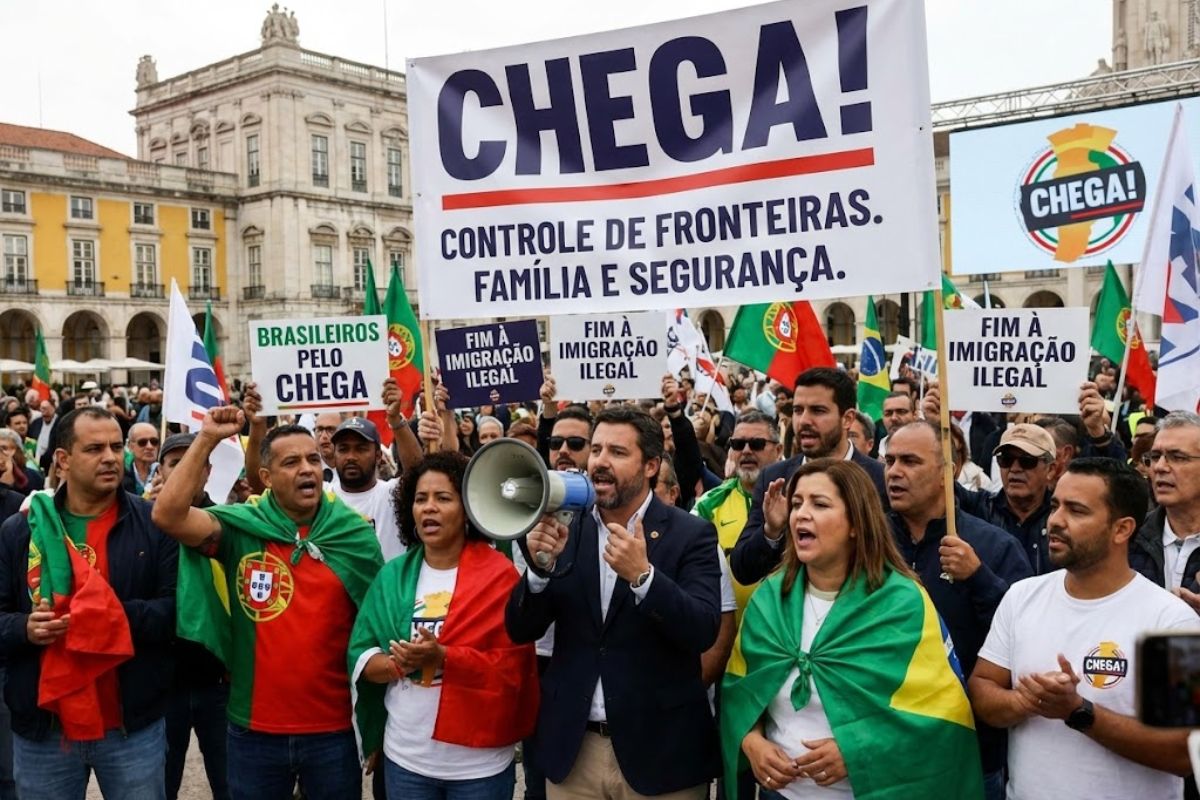


In Full Dispute, Brazilians in Portugal Align with Chega, Advocate Strict Control of Immigration, Talk About Family Protection, Embrace Anti-Left Speech, and Become a Showcase for a Project That Promises to Close the Door to New Immigrants Amid Allegations of Xenophobia and Tension Between Brazilians and Portuguese.
Supporters of Chega occupy the streets of Lisbon, Braga, and other cities with flags, posters, and anti-immigration speeches. Among them, Brazilians in Portugal appear on the front lines, presenting themselves as conservatives, defenders of the family, and critics of the left they left behind in Brazil, while helping to strengthen a party that promises to tighten borders and more rigorously control those still dreaming of crossing the Atlantic.
At the same time, the increasing presence of Brazilians in Portugal occurs against a backdrop of rising allegations of xenophobia, pressure on public services, and debates about housing and precarious work. Between 2017 and 2022, reports of xenophobia against Brazilians grew by 833%, precisely when the Brazilian community solidified as the largest foreign population in the country, representing between 4% and 8% of residents, according to official estimates.
Marches, Slogans, and Brazilians on the Front Lines

In Lisbon, one of the most recurring scenes is Chega demonstrations in symbolic locations, like Largo da Graça, near one of the most famous viewpoints in the capital.
-
A forgotten cord on the floor of a basement in Vienna leads a plumber to a box containing 30 kilograms of gold with Mozart’s face, hidden before World War II. The treasure, worth 2.3 million euros, was just centimeters away from a worker who ignored the sign a day earlier.

-
A couple buys an old chalet, breaks the kitchen floor for renovation, and finds over a thousand coins of gold and silver hidden since the English Civil War over 4 centuries ago.

-
Rigid bags with their days numbered: new trend prioritizes comfort in 2026.

-
YouTuber creates an excavator equipped with a giant 4.5-meter sword to challenge his brother to a rematch, and the invention quickly goes viral on social media.


There, Brazilians in Portugal can be seen giving interviews, waving flags, defending the party, and repeating that it is not about being against immigration, but against immigration that is disorganized, uncontrolled, and lacking clear criteria.
Sandra, who identifies as conservative and claims to have lived in Portugal for 22 years, summarizes this argument by stating that Chega is the party that represents the causes she defends, especially in the cultural agenda.
For this group of supporters, the focus on tightening immigration combines with a strong discourse against the left, corruption, and the alleged permissiveness of the Portuguese political system.
Conservatism, Family, and Break with the Brazilian Left

Among the most frequent faces in the demonstrations is Cibelli, from Pernambuco, who presents herself as one of the first militants of Chega in the country, with membership number 501.
She has kept campaign material since 2019, the year the party was founded, and displays flyers from previous elections as proof of her ideological proximity to the party.
Cibelli describes a trajectory of breaking away from the Brazilian left she supported in her teenage years and asserts that today she identifies with Chega’s conservatism, especially in defending the family and rejecting what she calls “indoctrination” of children on issues of sexuality and identity.
In the view of these Brazilians in Portugal, the state and schools should not interfere in the moral education of children, reinforcing a cultural agenda aligned with bolsonarismo and leaders of the international Christian right.
Bridges with Bolsonarismo and the Global Right


The bond between Chega and bolsonarismo has been consolidated in recent years.
The Portuguese party has approached supporters of Jair Bolsonaro living in Portugal, called for demonstrations against visits from President Lula to the country, and brought militants to disrupt parliamentary sessions during speeches from the Brazilian leader.
André Ventura, leader of Chega and a former seminarian, presents himself as a figure with a strong Christian appeal, featuring traits of political messianism.
The discourse bears similarities to the narratives of Donald Trump and Bolsonaro, employing moral outrage, dramatic phrases, and direct confrontation with the left.
Brazilians in Portugal who support the party see in Ventura a spokesperson for Christian conservatism, anti-corruption, and the defense of a stricter social order, including immigration.
Brazilian Electorate Coveted and the Paradox of the Immigration Agenda
Chega does not hide that it directly targets the vote of Brazilians in Portugal who have acquired citizenship or equal political rights.
Marcos Santos, a Brazilian who holds the vice-presidency of the party in Porto, is an example of this strategy, seeking luso-Brazilians who claim not to depend on state support and see themselves as “upright” workers.
Experts in Portuguese politics point to a paradox: Brazilians in Portugal, frequent targets of xenophobia and anti-immigrant rhetoric, begin to support a party that calls for strict immigration control and reinforces the idea that the country is “overcrowded”.
One of the arguments used by militants is that restrictions would serve to prevent overload in housing, health, education, and social assistance, preserving conditions for those who are already settled and integrated.
Xenophobia on the Rise and the Discourse of the Foreign Enemy
The escalation of allegations of xenophobia against Brazilians, which increased by 833% between 2017 and 2022, occurs in a context of indignation against immigrants in various Portuguese cities.
In Braga, in the north, where there is a high concentration of Brazilians, uncomfortable comparisons are made by researchers: the rhetoric that migrants are indispensable to the economy, but socially unwanted, echoes arguments used in Brazil’s slave-owning past against abolition.
At the same time, Chega and sectors of the European far right reinforce the figure of the “external enemy” linked to Islam. Brazilians in Portugal are presented as culturally close immigrants to the Portuguese, contrasting with migrants from majority Muslim countries.
Even with a small Islamic community in the country, the rhetoric of “Islamization” and religious threats is used as a mobilizing axis to unite conservative groups, including evangelical Brazilians.
Immigration Numbers and Pressure on the Labor Market
Official data indicate that Portugal had around 800,000 foreigners from outside the European Union in legal situations in 2022, double the number a decade earlier.
The majority are Brazilians, followed by citizens from the United Kingdom, Cape Verde, Italy, and India.
With many Portuguese leaving for other countries, the national labor market has begun to rely on immigrant labor for unskilled functions and basic services.
Experts remind us that the volume of entries is not just a result of “open doors,” but of the economic structure itself: the Portuguese labor market, with low wages and the need for workers, pulls immigrants into sectors that the local population does not want or cannot meet the demand.
In this logic, the immigration control championed by Chega and some Brazilians in Portugal simplifies a complex dynamic, where the country needs the foreigners it publicly criticizes.
Internal Critics, Evangelical Churches, and Resistances to Chega
Not all Brazilians in Portugal buy into Ventura’s project.
In evangelical churches in Lisbon, believers report knowing many Bolsonaro supporters who back Chega but reject the idea that a party can “save” a country facing structural problems in budget, public services, and wages.
For these critics, Chega works with illusion and promises quick solutions to issues that require long-term reforms and broad agreements.
They acknowledge the existence of discrimination and xenophobia but fear that a harsher discourse against immigrants will only legitimize hostilities against already vulnerable communities.
This internal resistance shows that the group of Brazilians in Portugal aligned with Chega is loud and visible but not necessarily the majority within the community.
Brazilians in Portugal Between Political Voice and Narrow Door
At the center of this scenario, Brazilians in Portugal become simultaneously the targets and spokespeople for a project that promises to control immigration more forcefully.
By defending Chega on the streets, in churches, and on social media, this group tries to separate itself from the image of a problematic immigrant and present itself as part of the “good people” who want order, family, and tighter borders.
The lingering question for analysts is whether this political bet will result in greater inclusion and security for those already established or whether, conversely, it will help to consolidate a more hostile environment for all newcomers, including Brazilians who are still considering migrating.
In a country where the Brazilian community is large, diverse, and often a direct target of prejudice, alignment with a hardline immigration agenda may have difficult-to-reverse effects.
In your opinion, are Brazilians in Portugal who support Chega protecting their position in the country or contributing to a scenario where the door will be even narrower for new immigrants, including Brazilians?









We have seen similar in UK. With sons and daughters of immigrants supporting or even proposing anti immigrant policy. The chair of “Reform Ltd” is Muhammad Yusuf, but he dare not use his real name (opting for ‘Zia’) or walk through a crowd of his own supporters in casual attire.
It’s a very weird version of Stockholm syndrome, and deluded to think the rhetoric is real.
In both UK and Portugal immigrants add substantially more into the tax system than they take out, yet all we hear is “Immigrant moochers”.
Quando pessoas são desinformadas, ignorantes, alienadas, egoístas, sem cultura, sem educação, individualistas, desrespeitosas, elas serão assim em qualquer lugar.
Muito sábias suas palavras, caro Adriano. Disse tudo.