





 Portuguese
  English
  Spanish
  6 min of reading
  0 comments


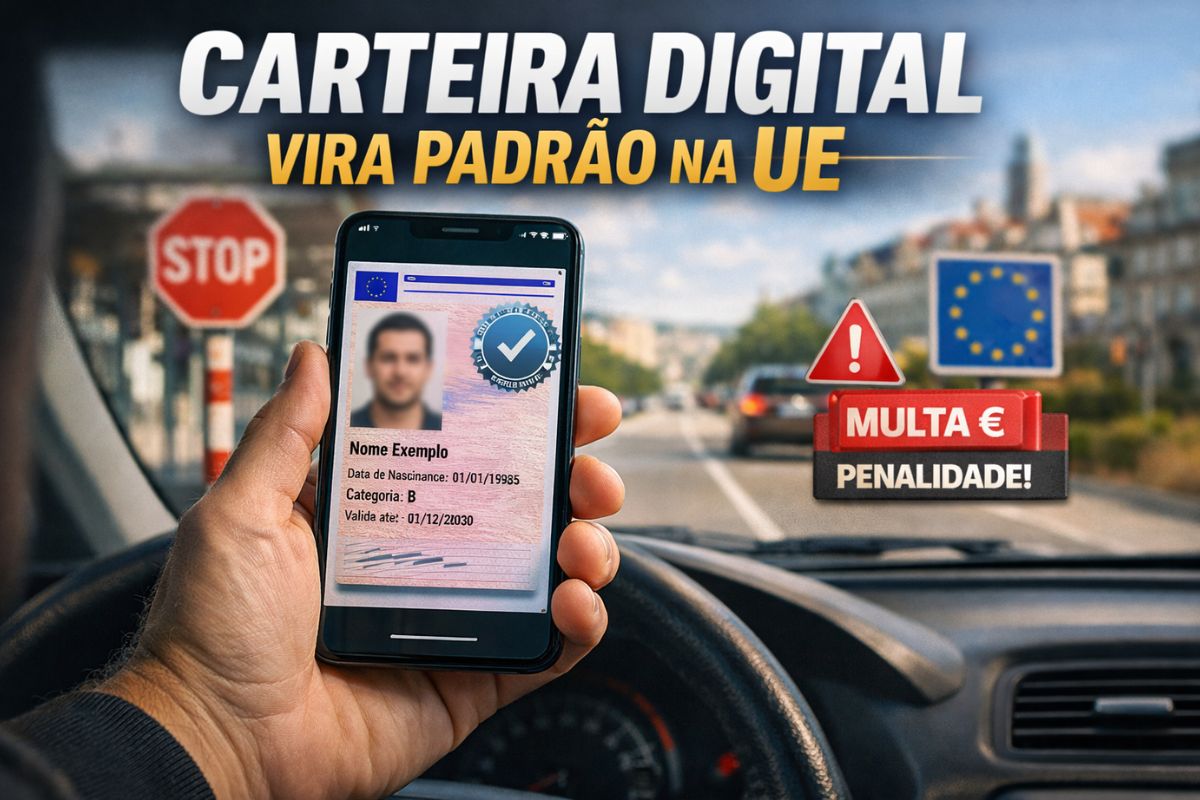
The New Driver’s License Rules in the European Union Affect Brazilians in Portugal, Allowing Driving at 17 with an Experienced Driver, Officially Recognizing Digital Licenses on Mobile Phones and Tightening Enforcement of Fines, Travel, Work, and Exchange for Those with Brazilian Driver’s License, Portuguese License, or Planning to Live Abroad in 2025.
In 2025, the European Union broadly updated the driver’s license rules to reduce accidents, facilitate mobility between countries, and fully incorporate digital reality on the roads. The change directly impacts Brazilians in Portugal, who will have to deal with a digital license on their mobile phones, the possibility of driving earlier, and increased information sharing about violations within the European bloc.
At the same time, these regulations open the door for driving from the age of 17, reinforce the probationary period for new drivers, and enhance cooperation between countries to recognize fines and penalties for traffic violations. In practice, this affects the routine of travel, work, exchange, and even how Brazilians in Portugal plan to switch their Brazilian driver’s license, obtain a Portuguese license from scratch, or continue using only their Brazilian license.
What Changes in the European Driver’s License for Brazilians in Portugal
The new European rules provide a period of up to four years for each country to adapt its national legislation, as is the case in Portugal.
-
The Senate approves a bill that criminalizes misogyny, hatred, or aversion towards women, and includes the crime in the Racism Law with a penalty of up to 5 years.

-
Chamber Approves Bill That Allows Pepper Spray for Women Over 16 and Imposes Strict Rules for Purchase, Possession, and Use as Self-Defense
-
Chamber Approves Law to Combat Leucaena, Fast-Growing Plant That Dominates Land and Threatens Native Species in Various Regions of the Country

-
Asset Division: Know What Cannot Be Divided in Case of Divorce


The common objective is to reduce deaths on the roads, modernize the driver’s license, and facilitate cross-border enforcement without creating a completely new system all at once.
Among the central points is the recognition of the digital driver’s license as an official driving document throughout the European Union.
The physical license will continue to exist, but the mobile phone will, in practice, become the main document holder for drivers, including for Brazilians in Portugal who already have a Portuguese license or another European license.
Another structural change is the possibility of starting to drive category B vehicles from the age of 17, provided the young person is accompanied by an experienced driver as defined by national law.
Additionally, the minimum probationary period for new drivers is set at two years, with special attention to serious violations committed early in their driving careers.
Digital License on Mobile Phone and Enforcement of Fines by the European Union
The digital driver’s license will be recognized in traffic controls across all European Union countries through official formats and government applications.
This applies to European citizens and, in practice, to Brazilians in Portugal who have exchanged their Brazilian driver’s license for a Portuguese license or hold a license from another Member State.
For the driver, this digitization means less reliance on the physical card and greater integration with databases of fines, points, and penalties.
The same technology that allows storing the license on the mobile phone also facilitates information sharing between police from different countries, including about violations committed during trips across Europe, which is relevant for Brazilians in Portugal who often rent cars in other locations within the bloc.
In daily life, this translates into more connected checkpoints, where verification of the digital license, violation history, and any restrictions tends to be done in seconds.
Ignoring notifications or failing to respond to fines from another country poses a greater risk of affecting the driver’s license status in Portugal.
Driving at 17 and the Impact on Brazilian Families
One of the most discussed measures is the possibility of driving light vehicles from the age of 17, accompanied by an experienced driver.
The European directive does not set a unique model for the tutor, allowing each country to define the criteria of age, years of license, and clean violation history for this role.
For Brazilians in Portugal, this opens an important perspective for children growing up in the country and planning to obtain their license.
If Portugal fully adopts this model, 17-year-olds will be able to start driving earlier under supervision, which directly affects study routines, part-time work, internships, and travel during internal exchanges in Europe.
At the same time, the reinforced probationary period makes any serious violation more costly for those who have just obtained their license.
Fines for speeding, using a mobile phone while driving, or driving under the influence of alcohol are likely to weigh more heavily in the analysis of this first two-year cycle.
Brazilian Driver’s License, Portuguese License, and Tourists: Profiles of Brazilians in Portugal
The practical effect of the new rules varies according to the profile of each Brazilian in Portugal.
Tourists entering the country for short periods generally continue to be able to drive with their Brazilian driver’s license and identification document, although some rental companies or countries may also require an international driving permit.
For this group, the changes have more impact on European enforcement than on the basic acceptance of the Brazilian driver’s license.
On the other hand, Brazilians residing in Portugal who still drive only with their Brazilian driver’s license need to be extra cautious.
The directive does not in itself alter internal deadlines, but it reinforces the importance of regularizing the situation by exchanging the Brazilian license when possible to avoid issues during enforcement, fines, and renewals.
Being out of the national deadline may mean, in practice, driving illegally.
Those who have already exchanged their Brazilian driver’s license for a Portuguese or another European Union country license are now fully subject to European rules.
In this case, violations committed in any country within the bloc can have consequences in the country of residence, even for Brazilians in Portugal who travel by car to Spain, France, or other destinations and then return to drive in Portuguese territory.
Fines, Checkpoints, and Information Exchange on Violations
One of the pillars of the new regulation is the strengthening of information sharing on traffic violations among Member States, preventing drivers from escaping fines by crossing internal borders of the European Union.
This directly affects Brazilians in Portugal with European licenses, who may have penalties applied in another country officially recognized in Portuguese territory.
Violations related to speeding, driving under the influence of alcohol or drugs, disrespecting pedestrians and cyclists, and improper use of mobile phones while driving remain among the most monitored.
In Portugal, using a mobile phone while driving remains classified as a serious violation, with high fines, point loss, and the possibility of driving prohibition, a scenario that becomes even more relevant with the digital integration of licenses.
In practice, Brazilians in Portugal driving with a Portuguese license or another European license need to incorporate the idea that their violation record is European and not just national.
Unresolved fines while traveling may resurface during renewal processes or checks on the status of the license in the country of residence.
Work, Exchange, and Professional Drivers from Brazil in Portugal
The new rules also affect the world of professional drivers.
For trucks in category C, the license can generally be obtained from the age of 18 if the driver holds a professional competence certificate, while for buses in category D, the reference is, in general, starting from 21 years with specific training.
Without these certificates, the minimum ages increase.
For Brazilians in Portugal who work or intend to work as heavy vehicle drivers, this means planning their careers considering mandatory courses, minimum ages, and the impact of serious violations on their professional record.
Fines for speeding with heavy vehicles, using mobile phones, or disrespecting pedestrians can compromise job opportunities in a market that seeks labor but requires responsible history.
Brazilian students on exchange, interns, or young workers also come into focus.
The combination of digital licenses, probation periods, age limits, and cross-border enforcement means that driving in Europe increasingly becomes an extension of academic and professional life.
Errors made on the roads cease to be just a specific travel problem and begin to weigh on relationships with insurers, employers and authorities.
In light of these changes, do you think Brazilians in Portugal are prepared to deal with digital licenses, drive at 17, and face stricter European enforcement regarding fines and violations?










-

Uma pessoa reagiu a isso.