





 Portuguese
  English
  Spanish
  5 min of reading
  0 comments


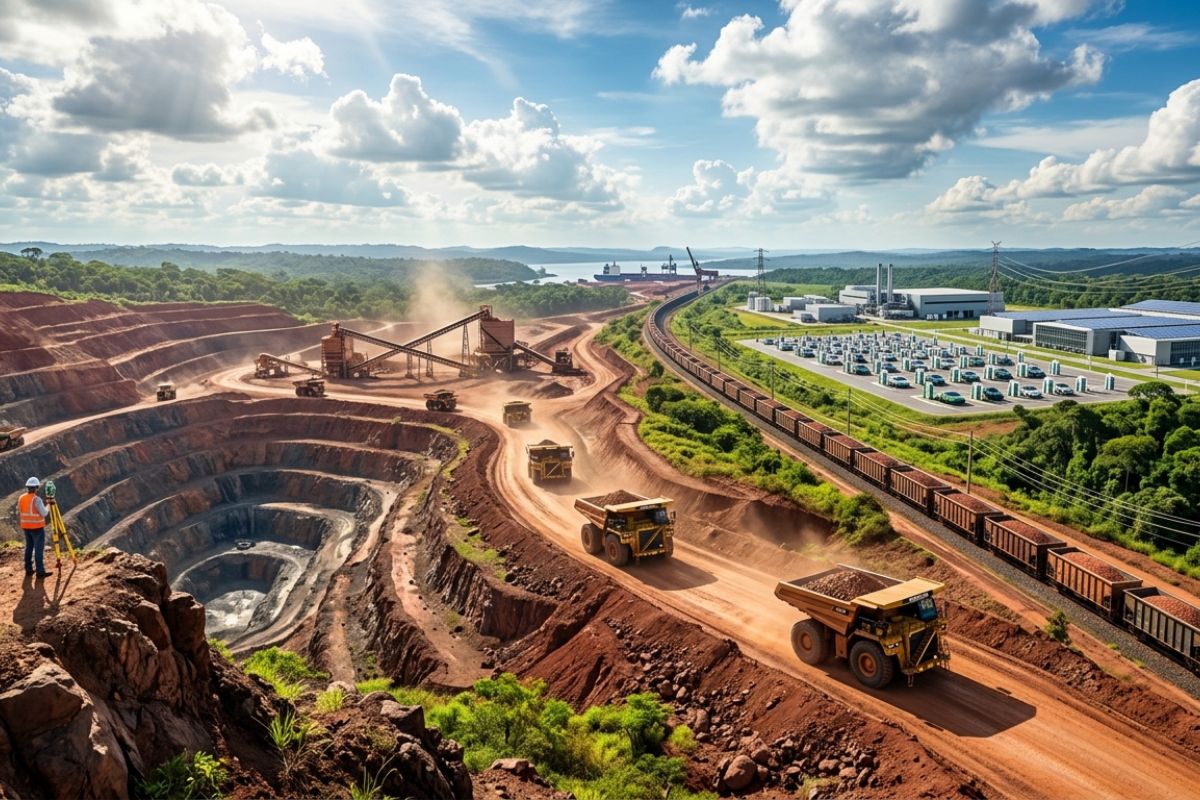
With global copper demand accelerating, the IEA projects a deficit of up to 30% by 2035, and Carajás concentrates the bet for Brazil to rise from about 1% of global production
The race for copper is gaining momentum because the metal has become the foundation of practically all technology related to the electrification of the economy. Electrical grids, electric vehicles, wind turbines, solar panels, batteries, electronics, and digital infrastructure depend on this input to function at scale.
With this pressure, Brazil appears as a candidate to gain ground: it has significant reserves and already concentrates production in defined hubs, especially in Pará, with a focus on Carajás. The challenge is to keep pace with global demand and transform potential into real copper supply in the coming years.
Why copper has become the “metal of electrification”
The sector’s diagnosis is straightforward: copper is essential for transmitting and distributing energy, in addition to being present in practically the entire electrification chain. This includes electrical grids, charging infrastructure, components of electric vehicles, and renewable generation equipment.
-
China surpasses the United States and becomes the largest trading partner of São Paulo with about US$ 31 billion in transactions, accelerated growth redefines the economic axis of the richest state in Brazil.
-
BRICS breaks the barrier of US$ 1 trillion in internal trade, accelerates the weight of the Global South, and pressures Brazil to react in the new economy.

-
Electrolux surprises, closes colossal factory and lays off 400 people in a mass dismissal that will have a direct effect later this year, following a cost review, with an impact of R$ 272.5 million and R$ 109 million in cash in Chile.
-
The Lula government is pursuing re-election and is therefore preparing a package with discounts of up to 80% on debts, subsidies for diesel, gas for 15 million, and energy, after reaching 51% disapproval six months before the election.
At the same time, the relatively low cost, durability, and high electrical and thermal conductivity help explain why copper repeatedly appears as a central input in modern technologies.
AI and data centers are expected to further accelerate the demand for copper
In addition to electric cars, another demand driver is artificial intelligence. The training and operation of AI models occur in large data centers that require enormous electrical infrastructure.
In these facilities, copper is used in power distribution, cooling systems, and network infrastructure, precisely because of its conductivity and durability properties. The result is additional pressure on a market that was already heating up.
IEA projects supply deficit and the market is already feeling it in prices
The accelerated growth of demand is already raising alarms about supply. The IEA projects that the global copper market may face a deficit of up to 30% by 2035 if new mining projects do not advance at the necessary pace.
Prices, according to the data, already reflect this pressure. Copper surpassed $14,500 per ton in January 2026, after exceeding $12,000 per ton for the first time in December 2025.
Brazil currently has about 1% of global copper production
Currently, Brazil accounts for about 1% of global copper production, with production concentrated in a few mines in the country. This means that any relevant expansion has the potential to reposition Brazil, especially if new projects come online within the timeframe expected by the market.
A study by Ibram indicates that the country is expected to receive about $8.6 billion in investments in the copper sector by 2030, indicating that the growth cycle is already on the radar.
Carajás drives production and concentrates the most emblematic mines
The main production hub is in Pará, which hosts some of the largest mines in the country, such as Sossego and Salobo, in the Carajás mineral province.
Goiás appears as the second-largest national producer, with a focus on the Chapada mine. Another important hub is the Serrote mine in Alagoas, which began operations in 2021. This map shows that Brazilian copper already has consolidated bases, but still with a small share in the global scenario.
Where the next copper discoveries in Brazil might be
In addition to expanding existing mines, the sector is betting on the possibility of new discoveries. The SGB has prioritized mapping and prospecting for copper, with a special focus on Carajás.
The base also mentions other regions with potential, such as Vale do Curaçá in Bahia, and the Goiás Magmatic Arc. There are also underexplored areas considered promising, such as Rondônia–Juruena–Teles Pires and Tapajós. The message is that the potential is not restricted to a single hub, although Carajás leads the attention.
Furnas Project, Ero Copper, and Vale: a big bet on copper
Among the most notable projects is the Furnas Project, by the Canadian Ero Copper in partnership with Vale, located in Carajás, Pará.
Preliminary studies indicate a mine with an initial lifespan of 24 years, with an average annual production equivalent to about 108,000 tons of copper equivalent in the first 15 years of operation.
The plan aims for an annual production of approximately 70,000 tons of copper, along with gold and silver as by-products, which help reduce operational costs. The estimated initial investment is around $1.3 billion, and the venture could become one of the country’s main new copper mines.
Vale increases its bet and aims for 700,000 tons per year by 2035
With an eye on this global trend, Vale announced $3.5 billion in investments by 2030 to expand copper production in Carajás. The strategy is to nearly double the metal’s production by 2035, reaching about 700,000 tons per year.
In an interview cited in the data, CEO Gustavo Pimenta summarized the vision with a phrase that captures the market moment: “There is today a perception and recognition that copper may be lacking. Copper supply needs to grow significantly.” He added that Vale wants to take on a role in supplying this copper.
What is at stake for Brazil in the “metal of electrification”
With global demand rising, a deficit warning by 2035, and investments expected by 2030, Brazil enters a window where growing in copper could mean more prominence in a chain that sustains energy, mobility, and digital infrastructure.
The practical question now is speed: transforming investments, mapping, and projects into consistent copper production within the pace that the global market is demanding.
Do you think Brazil can quickly move beyond this 1% level and become a reference in copper, or will the bottleneck be licensing and project execution?







Seja o primeiro a reagir!