





 Portuguese
  English
  Spanish
  4 min of reading
  0 comments


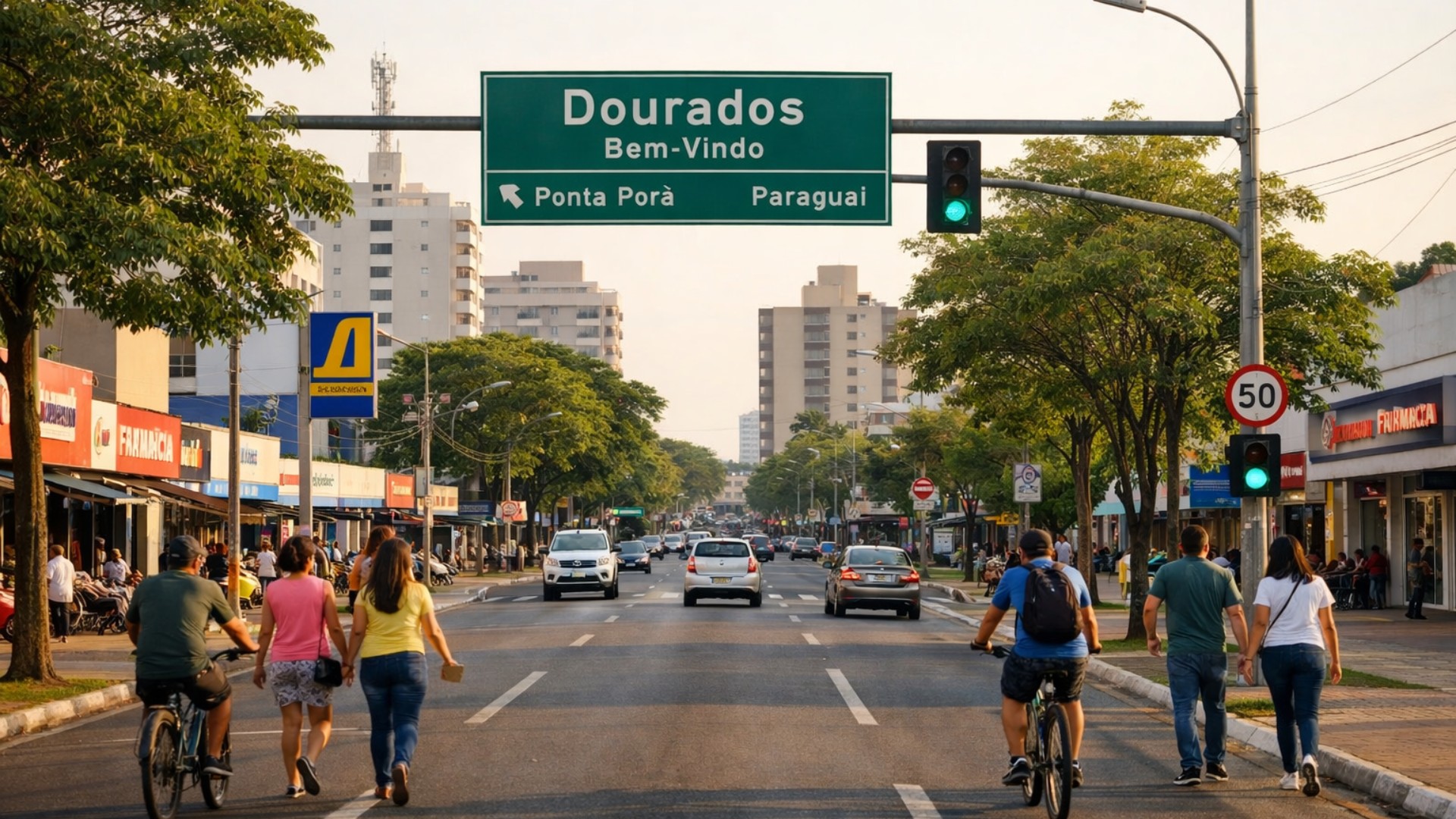
Accelerated growth in the interior of Mato Grosso do Sul transforms Dourados into an attraction pole with high population, consolidated urban structure, influential universities, and a strategic role on the border with Paraguay, combining economic dynamism, regional services, and a less congested routine.
Dourados, in the south of Mato Grosso do Sul, has established itself as one of the main urban poles in the interior of the Midwest by combining demographic expansion, a diversified economic base, and a strong presence of public higher education institutions.
Between the 2010 Census and the 2022 Census, the population jumped from 196,035 to 243,367 inhabitants, an increase of about 24.1%, according to IBGE.
By 2025, the official estimate already pointed to 264,017 residents in the municipality.
-
A rare storm transformed part of the Gulf into an unlikely scene of hail, extreme rain, and tornado risk in the middle of the desert, with volumes that exceeded the annual average in a single day.

-
Brazil catches the world’s attention with ships powered by ethanol and biodiesel that have lower emissions, an unprecedented certification with advantages in chartering, and a revolution in cabotage.

-
A couple who only has Sundays free has built a hand-dug pool, a hamburger joint, a dance hall, and a playground in their own home without hiring a mason, and even with breaks due to accidents and the pandemic, the work has never truly stopped.

-
Furniture made with aluminum and glass does not warp and has become an alternative to replace MDF in Brazil.


Population growth and regional role
This advancement helps explain why the city has begun to attract new residents seeking a less congested routine than that of the capitals, without giving up on services, commerce, education, and regional care.
The geographical position also weighs in on this dynamic.
Dourados is located in the border strip and maintains proximity to Paraguay, a condition that reinforces its logistical and economic relevance in the south of the state.


IBGE numbers show that the municipality has ceased to be merely a local reference to more clearly assume the role of regional centrality.
In addition to the population volume, Dourados gathers services and structures that radiate influence over neighboring cities, especially in the areas of commerce, health, education, and goods circulation.
In practice, this role translates into a city that concentrates jobs, institutions, and services capable of attracting both permanent residents and a floating population.
The economic profile of Dourados, historically linked to agriculture, has been expanded by retail, agribusiness, and the service sector.
Higher education and local economic impact
One of the most visible factors of this transformation is the educational vocation.
Dourados is home to the Federal University of Grande Dourados, the State University of Mato Grosso do Sul, and units of the Federal Institute of Mato Grosso do Sul, a set that helps sustain the nickname of university city.
This structure reinforces the circulation of students, teachers, researchers, and workers from various regions.
The presence of these institutions expands the rental market, stimulates commerce, and gives the municipality a more diverse profile throughout the academic year.
This academic environment also impacts workforce training and the supply of specialized services.
Undergraduate, graduate, research, and extension courses increase the capacity to retain talent in the interior.
Social indicators and urban infrastructure
In terms of indicators, the municipality recorded an HDI of 0.747 in the Atlas of Human Development.
This index signals relevant performance in dimensions such as income, education, and longevity.
The urban infrastructure has accompanied part of this expansion process, albeit at an uneven pace, as occurs in medium-sized Brazilian cities.
The municipality has a schooling rate of 98.12% among children aged 6 to 14, according to IBGE.
In health, the presence of the Regional Hospital of Dourados expands the reach of care and reinforces the city’s role as a reference for dozens of municipalities.
The attraction exerted by Dourados also lies in the possibility of reconciling service offerings with less complex urban displacements than those observed in metropolises.
History, border, and cultural diversity
The historical formation of Dourados helps to understand its current identity. The origin of the municipality dates back to the 19th century and is linked to the occupation of the border region.
The city developed close to Paraguay, which contributed to its economic and social importance. The indigenous presence remains a central part of this reality. The Dourados Indigenous Land is associated with the Guarani, Guarani Kaiowá, and Terena peoples.
In everyday life, the municipality gathers characteristics that often weigh in on the choice of those leaving large centers.
Intermediate urban scale, diversified economic base, university presence, and regional public services compose this scenario.
Therefore, the growth observed in recent statistics does not result from a single factor, but from a combination of elements that reinforce Dourados’ strategic position in the state.






Seja o primeiro a reagir!