





 English
  Francês
  Alemão
  Italiano
  Japonês
  Norueguês
  Portuguese
  Spanish
  6 min of reading
  0 comments



The Brazilian state-owned company identified a new oil discovery during the drilling of the Pituau well, located in the Marlim Sul field, reinforcing the productive potential of the Campos Basin and the longevity of national reserves.
Petrobras informed the market and regulatory bodies that it has made a new oil discovery in a high-quality reservoir in the pre-salt of the Marlim Sul field, in the Campos Basin.
The discovery occurred at a water depth of approximately 2,300 meters, demonstrating the company’s technical capability to operate in high-complexity environments. Thus, preliminary data indicate the presence of hydrocarbons in carbonate rocks, characteristic of the giant accumulations of Brazilian pre-salt.
This finding represents a strategic milestone for the oil company, which seeks to replenish its reserves and extend the lifespan of mature fields through new exploration technologies.
-
Alert in the global energy market: Severe tropical cyclone hits the coast and disrupts gas production at major plants in Australia, threatening global supply.

-
Petrobras finds high-quality oil in the pre-salt at 113 km from RJ and reignites expectations about strategic reserves in the Campos Basin.

-
Ocyan opens registrations for startups focused on innovation in the oil and gas sector and will select projects for Innovation Day with the support of Nexio.

-
Petrobras announces new oil discovery in the pre-salt of the Campos Basin and reinforces Brazil’s prominence with high-quality reserves that can increase production and energy revenues.
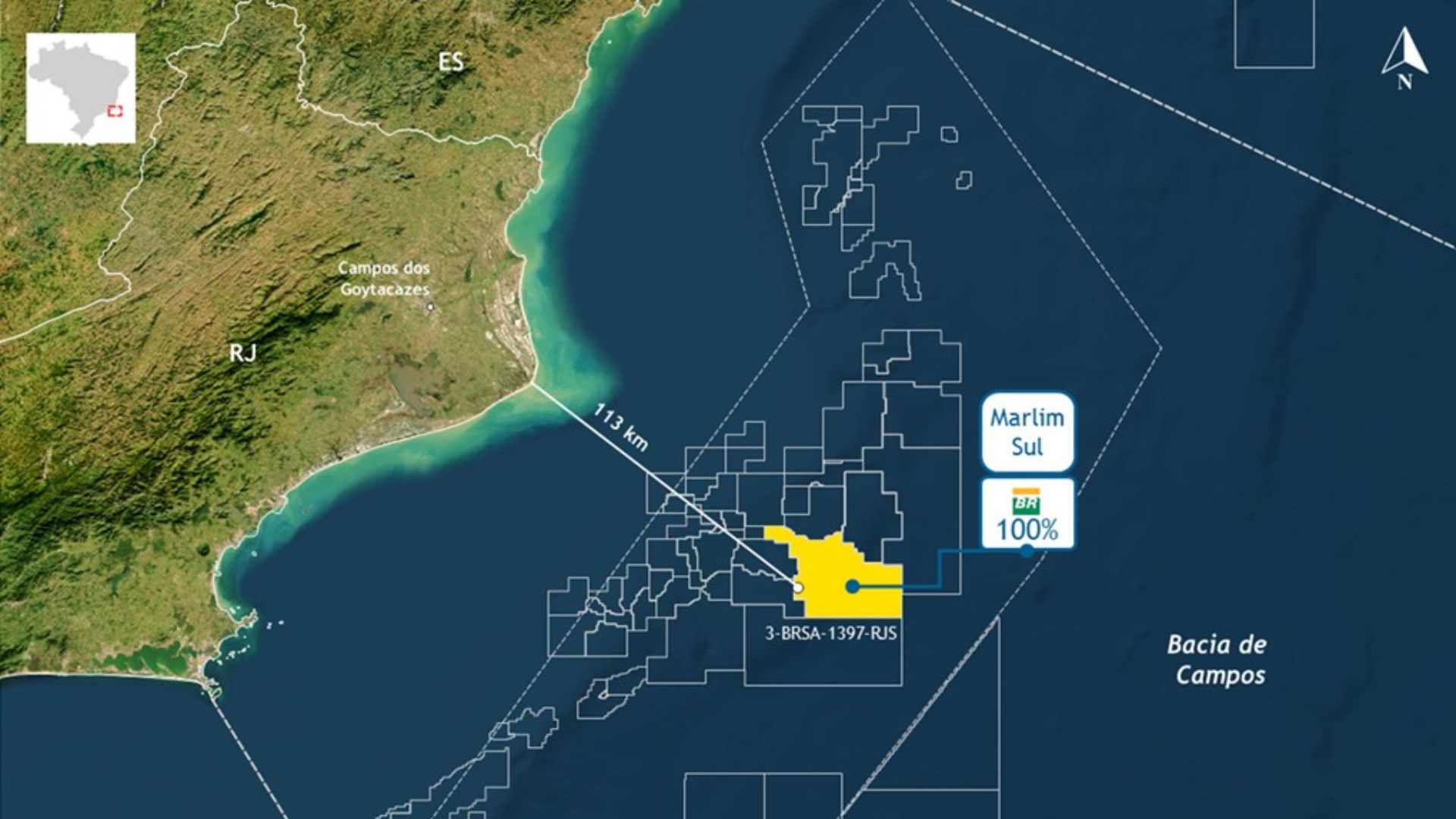

The company is now entering a phase of detailed analysis of the collected data to determine the extent of the deposit and the marketable volume of oil and gas. This movement in the energy sector signals a new cycle of investments in maritime infrastructure and promises to boost the economy of coastal cities that support offshore operations.
The strategic impact of the new oil discovery for the Campos Basin
The Campos Basin, historically known as the cradle of deep-water oil production in Brazil, reaffirms its importance with this new oil discovery. For decades, experts believed that the region had already reached its peak production.
However, the application of new seismic and drilling technologies in deeper layers, below the salt layer, reveals a horizon of still unexplored possibilities. Petrobras uses state-of-the-art drill ships to reach depths that were previously inaccessible, proving that Marlim Sul still holds valuable secrets.
This discovery strengthens the state-owned company’s strategy of “revitalizing” its assets. By finding new reservoirs close to already installed infrastructures, such as existing platforms and pipelines, the company drastically reduces development costs.

Instead of building entirely new systems from scratch, Petrobras can connect these new wells to the production units already operating in the Marlim Sul field. This tactic thus optimizes the invested capital and ensures a quicker financial return for shareholders and the federal government, which receives royalties on production.
Technology and exploration in ultra-deep waters
Brazilian engineering overcomes extreme challenges to achieve a new oil discovery in the pre-salt. The exploratory well Pituau required the use of diamond drill bits and special drilling fluids to penetrate kilometers of rock and the thick salt layer.
The pressure and temperature at these depths require equipment with superior resistance, made from special metal alloys to prevent corrosion and structural failures. The success of the operation demonstrates the maturation of the oil and gas sector in Brazil, which today exports exploration technology worldwide.
In addition to drilling, Petrobras uses supercomputers to process the geological data collected during the operation. These artificial intelligence algorithms create three-dimensional models of the reservoir, allowing geologists to accurately identify areas with higher oil concentrations.
This level of precision reduces exploratory risk, meaning the chance of drilling dry wells. Each success like that of Marlim Sul saves millions of dollars and directs the company’s efforts toward assets that will truly bring profit and energy security to the country in the future.
Real impact on the economy and job creation in Rio de Janeiro
Whenever Petrobras confirms a new oil discovery, the supply chain reacts immediately. Cities like Macaé, Rio das Ostras, and Niterói serve as the logistical heart of operations in the Campos Basin.
The need for new wells and collection systems demands support services, maintenance of rigs, supply of pipelines, and air logistics for transporting oil workers and technicians. This movement heats up the local job market, generating thousands of vacancies for welders, engineers, safety technicians, and underwater robotics specialists.
The para-oil services sector also receives a new boost. International and national engineering companies compete for contracts to supply subsea trees, for example, with equipment that controls flow on the seabed.
The discovery in the pre-salt of Marlim Sul ensures that the Brazilian offshore sector remains vibrant for the next 20 to 30 years. For the state of Rio de Janeiro, this means stable revenue from ICMS and royalties, which finance urban infrastructure, health, and education for the population of Rio de Janeiro.

The relevance of the pre-salt in the Brazilian energy matrix
The new oil discovery in the pre-salt reinforces Brazil’s position as one of the largest energy producers on the planet. The oil found in these layers tends to have low sulfur content and high quality (light oil), which facilitates refining and increases market value abroad.
In a global scenario of energy transition, the oil from Marlim Sul stands out for having a lower carbon footprint during extraction, as the high productivity of pre-salt wells allows for more oil to be produced with fewer emissions per barrel.
Many question whether Brazil should continue investing in oil amid the climate crisis. However, infrastructure experts remind us that oil still serves as the main source of revenue to finance the transition to clean sources, such as wind and solar.
The profits obtained from the pre-salt sustain Petrobras’s research in green hydrogen and biofuels. Thus, Marlim Sul not only provides fuel for the present; it finances the innovation needed for Brazil to lead the energy of the future, ensuring a fair and economically viable transition.
Next steps: From exploratory well to commercial production
After announcing the new oil discovery, Petrobras follows a strict schedule before extracting the first commercial barrel. The company will conduct formation tests to assess the productivity of the reservoir.
These tests measure the pressure and flow of the oil, vital information for sizing the equipment that will remain on the seabed. If the results confirm economic viability, the state-owned company will present a Development Plan to the National Agency of Petroleum (ANP), detailing how many wells it will drill and which platform it will use.
The market speculates whether the state-owned company will deploy a new FPSO (floating production, storage, and offloading unit) to the area or if it will utilize the idle capacity of nearby platforms.
The technical decision will impact the production start schedule. If it opts for interconnection with existing systems, oil from Pituau could reach Brazilian refineries in record time. This operational dynamism is what keeps Petrobras competitive against international giants operating in the Gulf of Mexico and the North Sea.

Operational safety and environmental preservation in Marlim Sul
The exploration that resulted in the new oil discovery meets rigorous safety and environmental protection standards.
Petrobras uses real-time monitoring systems to prevent leaks and ensure the integrity of the well during all phases of operation. Submarine robots (ROVs) constantly inspect valves and connections on the ocean floor, operating where humans cannot reach.
The preservation of marine biodiversity in the Campos Basin is a priority, with monitoring programs for cetaceans and water quality coordinated by IBAMA.
Technological advancements have also allowed for a reduction in the use of chemical materials and improvements in waste treatment aboard the platforms.
The modern oil industry focuses on maximum operational efficiency, understanding that environmental protection is inseparable from business continuity. Each new discovery in the pre-salt undergoes exhaustive environmental licensing, ensuring that the wealth generated by oil does not compromise the health of Brazil’s coastal ecosystems.
The Brazilian pre-salt still has much to offer with this new oil discovery
The confirmation of this new oil discovery in Marlim Sul proves that the Brazilian pre-salt continues to be the most promising exploratory frontier in the world. Petrobras demonstrates resilience and innovation capability by finding oil in a mature area, challenging pessimistic forecasts about the end of reserves in the Campos Basin.
Brazil consolidates itself as a safe harbor for energy investments, combining privileged geology with world-class technical expertise.
The future of the oil and gas sector in the country looks solid, supported by successive discoveries that ensure national energy sovereignty. As the world moves toward new energy sources, the pre-salt provides the financial and technological support for this journey.
Petrobras, through Marlim Sul, writes another successful chapter in the history of Brazilian engineering, transforming natural resources into progress, technology, and development for all of society.







Seja o primeiro a reagir!