





 Portuguese
  English
  Spanish
  5 min of reading
  0 comments


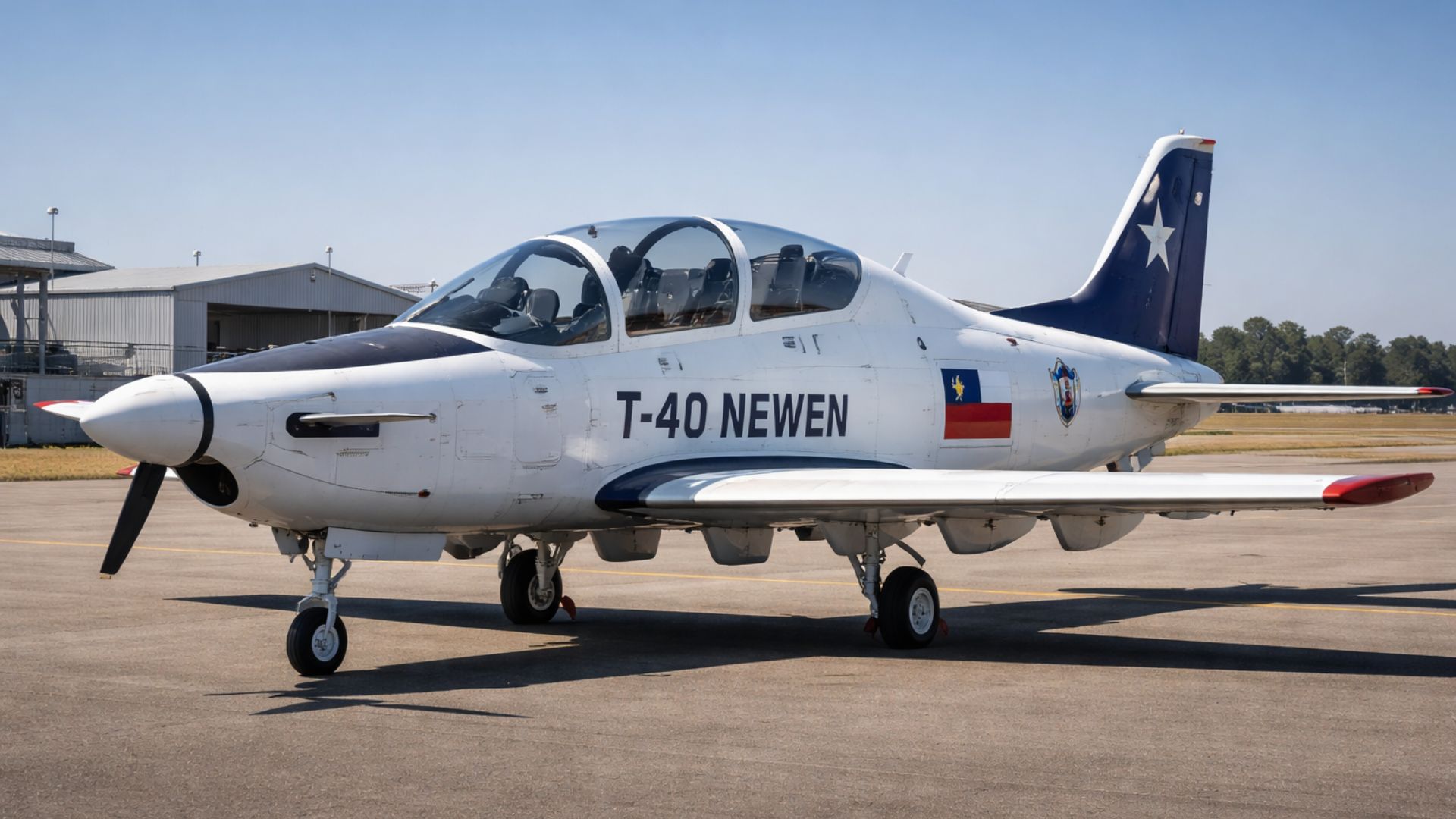
Chilean project bets on national technology to replace historical military training aircraft, focusing on defense modernization, reducing external dependence, and strengthening the local aerospace industry over the next decade.
Chile officially presented the T-40 Newen, a new military training aircraft developed by the National Aeronautics Company of Chile, Enaer, in an initiative that combines the renewal of the Air Force fleet with the direct strengthening of the national defense industry.
During the ceremony, President José Antonio Kast, Defense Minister Fernando Barros Tocornal, and the Commander-in-Chief of the FACH, Air General Hugo Rodríguez González, were present, reinforcing the institutional weight attributed to the project.
According to the schedule released by the authorities, flight tests are expected to begin in 2027, while serial production is planned for 2030, within a timeline that still depends on the technical development and certification stages.
-
The 3rd best city in Brazil is located in the interior of São Paulo and impresses by reaching 12th place among 5,570 cities in the IPS 2025, with highlights in 57 indicators and a strong university hub.

-
Peru is determined to break the rules of the game by planting 1 million trees in Machu Picchu to curb erosion, restore Andean ecosystems, and protect one of the planet’s most fragile heritage sites.

-
In Brazil, there is a historic city where the sea intentionally floods the streets to wash the pavement, and this unique scenery helped the place become a UNESCO World Heritage Site with over 65 islands and about 90 beaches.

-
Beijing reduced air pollution by 70% in just 12 years and recorded 311 days of good air in 2025, but scientists have discovered a new invisible threat looming over the city: a cloud of 180,000 microplastics per cubic meter.

The presentation took place on April 6, 2026, within the context of FIDAE 2026, the main aerospace fair in the region, held in Santiago from April 8 to 12, bringing together companies, governments, and armed forces from different countries.
In this context, the program was presented as a direct response to the need to replace the T-35 Pillán, an aircraft that supported the training of military pilots in Chile and also in other countries that adopted the model for over four decades.
Integrated military pilot training system
More than just a simple aircraft, the T-40 Newen was conceived as part of an integrated training system, which includes simulators, planning and flight evaluation tools, as well as complete ground training solutions for pilots and technical teams.
According to Enaer, this structure allows students, from the early stages of training, to engage with technologies and operational routines similar to those found in more advanced aircraft, reducing the traditional gap between basic education and the combat environment.
With this, the Chilean Air Force assesses that the new platform will facilitate the transition to aircraft like the F-16, decreasing the technological and operational difference that has historically separated initial training from high-performance aviation.
T-40 Newen technology and flight capabilities
In technical terms, the T-40 Newen incorporates a digital glass cockpit, associated with an integrated flight management system and tactical navigation resources, composing an architecture aimed at contemporary military training standards.
Additionally, the FACH detailed that the model will feature a Head-Up Display and controls in the HOTAS concept, allowing the pilot to operate essential functions without removing their hands from the main controls, which increases efficiency and safety during flight.
Another relevant point involves the use of composite materials, such as carbon fiber, combined with a new wing design and the presence of removable winglets, elements that contribute to improving aerodynamic efficiency and the overall performance of the aircraft.
The engine has also been updated, seeking a more balanced relationship between power and weight, while the manufacturer describes the project as a direct evolution of the T-35 Pillán, now adapted to the demands of a more modern training system.
Among the operational capabilities, the certification for full military aerobatics of +6G/-3G stands out, a feature that expands the range of training and allows for the execution of demanding maneuvers within the structural limits set in the project.
At the same time, the versatile design of the platform allows the aircraft to be configured for both intensive aerobatic training and long-duration surveillance and reconnaissance missions, according to operational needs.
Replacement of the Pillán and Chilean industrial strategy
With the replacement of the T-35 Pillán, the Chilean government, Enaer, and the Air Force associated the launch of the Newen with a broader strategy for recovering industrial capabilities considered strategic for the country.
In this context, the official discourse highlights the reduction of external dependence in defense, the strengthening of the local production chain, and the encouragement of the generation of qualified jobs, aligning the program with economic and technological objectives.
Henry Cleveland, executive director of Enaer, stated that the company decided to move forward with a project based on current technology, describing the T-40 as an aircraft “100 percent designed and manufactured here in Chile.”
The statement reinforces the positioning of the model as a domestic solution and, at the same time, as a showcase of Chile’s ability to develop and produce complete aeronautical systems with its own resources.
Within this planning, the FACH reported that the program foresees the manufacture of 33 aircraft, a number that highlights the scale of the industrial effort involved and the commitment to renewing the training fleet.
In the assessment of the force, the project combines operational modernization, encouragement of the national aerospace industry, and reduction of dependence on foreign suppliers, especially in a sector considered sensitive for sovereignty.
Timeline and new aerospace projects in Chile
The disclosed planning indicates the start of flight tests in 2027 and establishes serial production starting in 2030 as a goal, although these dates depend on the advancement of technical stages and certification processes.
In parallel, Cleveland announced that Enaer will begin studying a new turboprop aircraft with greater operational capabilities, a project that will be developed in conjunction with the subsidiary DTS, specialized in technologies and systems.
Shortly after the presentation of the T-40, the Chilean Air Force reported the existence of an agreement with the Navy and Enaer itself to advance in the development of a future national multipurpose aircraft.
During the ceremony, Kast stated that the T-40 represents a modern, efficient, and safe aircraft, associating the project with the work of hundreds of professionals involved in the protection of airspace and the strengthening of the Chilean industry.
For his part, the commander of the FACH emphasized that each takeoff of the Newen symbolizes investment in operational capacity, training of new generations of aviators, and international projection of the technology developed in the country.






Seja o primeiro a reagir!