





 Portuguese
  English
  Spanish
  5 min of reading
  1 comment


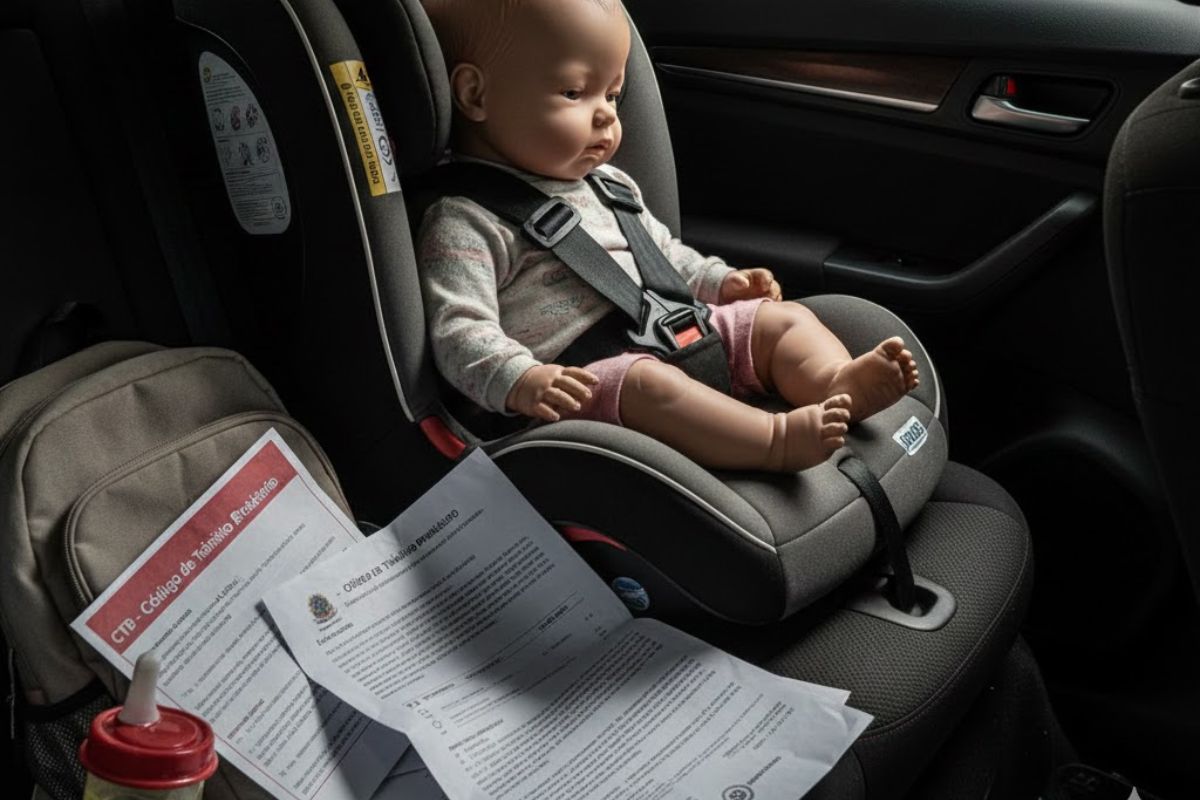


While the CTB Focuses on Age, Weight, and Height, Child Safety Experts Warn That Using the Car Seat According to the Law Is Not Enough: Outdated Parameters, Premature Changes, and Incorrect Use Leave Babies and Children Exposed Even with Inmetro Seal on Devices in Today’s Brazilian Traffic.
Amid the constant updating of traffic rules, the debate about car seats has come back to the center of discussions among doctors and traffic safety experts. On one side, the Brazilian Traffic Code (CTB) and the resolutions of Contran define age, weight, and height ranges; on the other, medical societies point out that these criteria are below what science has already demonstrated about real protection in collisions.
The result is a scenario where many parents believe they are doing everything right simply by following the law, while babies and children remain vulnerable even when strapped into devices certified by Inmetro, due to changes made too early, improper installation, and legal criteria that do not fully align with the recommendations from the Brazilian Society of Pediatrics (SBP).
What the CTB Currently Determines About Car Seats
Article 168 of the CTB mandates the transportation of children in the back seat with appropriate restraint devices, under penalty of a severe offense, 7 points on the driver’s license, and a fine of R$ 293.47.
-
The Senate approves a bill that criminalizes misogyny, hatred, or aversion towards women, and includes the crime in the Racism Law with a penalty of up to 5 years.

-
Chamber Approves Bill That Allows Pepper Spray for Women Over 16 and Imposes Strict Rules for Purchase, Possession, and Use as Self-Defense

-
Chamber Approves Law to Combat Leucaena, Fast-Growing Plant That Dominates Land and Threatens Native Species in Various Regions of the Country

-
Asset Division: Know What Cannot Be Divided in Case of Divorce


Resolution 819 of 2021 from Contran details this obligation in well-defined ranges:
Infant car seat up to 1 year and maximum weight of 13 kg
Child seat between 1 and 4 years, with weight between 9 and 18 kg
Booster seat from 4 to 7.5 years, weight from 15 to 36 kg, and height up to 1.45 m
Seatbelt for children over 7 years or 1.45 m, always in the back seat until 13 years
In practice, the legislation was built to provide a minimum standardization for the use of car seats, ensuring that authorities have an objective criterion to penalize drivers who transport children unsecured or improperly restrained.
The problem is that this “legal minimum” is far from representing the “maximum safety” recommended by medicine.
Why Following Only the Law Does Not Protect Your Child as It Could
The Brazilian Society of Pediatrics itself considers the legal parameters outdated.
According to the entity, switching from an infant car seat to a child seat or a booster seat just because the minimum age has been reached can increase the risk of injury in a collision, especially when the child does not yet have the height and bone development compatible with the next device.
Studies cited by the SBP indicate that correct use of restraint devices reduces the risk of death by up to 70 percent in infants under 1 year and by around 54 percent in children aged 1 to 4 years.
The gain in protection is directly linked to two factors: keeping the child in the most secure position and device for as long as possible and avoiding premature transitions motivated solely by age.
Therefore, the pediatrics recommendation is clear: the infant car seat facing the rear should be used for at least until 2 years, preferably up to 3, as long as the manufacturer’s weight and height limits are observed.
Only after this, transitioning to other configurations of the car seat starts to make biomechanical sense, especially in frontal impacts, which are the most common and severe.
Practical Guidelines for Using the Car Seat with Maximum Safety
In the view of experts, the central point is to transform the car seat from a formal obligation into a real barrier against serious injuries.
Some technical guidelines help bridge the gap between everyday use and scientific evidence:
Prioritize infant car seats or convertible car seats facing rearward, installed in the center of the back seat whenever possible, respecting the weight limits defined by the manufacturer
Keep the child in a car seat with a five-point harness until clearly exceeding the weight and height limits of the equipment, which in many cases occurs between 3 and 7 years
Use the booster seat until the child reaches 1.45 m in height, a range that usually varies between 9 and 13 years, ensuring that the car seatbelt rests on the correct bone structure
Adjust the seatbelt with the lap belt resting on the thighs and the shoulder belt crossing the chest and shoulder, never passing over the neck or abdomen
These choices mean, in practice, keeping the child longer in devices considered “infant”, even if the law already allows earlier transition, precisely to take full advantage of the ability to absorb and distribute forces in the event of a collision.
Inmetro Certification Alone Does Not Resolve Real Usage Risks
The Inmetro certification guarantees that infant car seats, child seats, and booster seats meet minimum performance requirements in standardized tests.
Today, the agency lists over 600 authorized models, providing a wide range of options for caregivers.
However, having an Inmetro seal on the car seat does not mean that the child is automatically protected. Real performance depends on variables that are beyond the scope of certification, such as:
Compatibility between the device and the vehicle’s seat
Correct routing of the seatbelt or proper use of the anchorage points
Effective tightening of the straps over the child’s body, with no excessive slack
Compliance with the height and weight limits specified in the manufacturer’s manual
When these steps fail, babies and children can suffer serious injuries even within certified devices.
Inmetro validates the product, but not the usage habit, which remains the direct responsibility of parents and caregivers, requiring reading the manual, careful installation, and regular adjustments checks.
What Still Needs Alignment Between Law, Pediatrics, and Parent Behavior
The contrast between what the CTB requires and what the Brazilian Society of Pediatrics recommends highlights a mismatch that directly impacts child safety.
On one side, the law organizes enforcement and sets fine amounts; on the other, experts insist that the minimum legal standard does not keep pace with the most up-to-date child protection in traffic.
Until there is a deeper review of the CTB rules and Contran resolutions to incorporate medical recommendations, effective protection will depend on each family’s individual decision to go beyond the law when using the car seat.
This means keeping the child rear-facing for longer, delaying the transition to the booster, strictly adhering to weight and height requirements, and not neglecting the manual or proper installation on every trip.
Knowing this, in your family routine do you only follow what the law says or have you already adapted the use of the car seat to the pediatrics recommendations to feel truly safe with your child strapped in the back seat?










Minha filha vomita quando usamos a cadeirinha virada de costas, complicado usar assim até os 3 anos