





 Portuguese
  English
  Spanish
  6 min of reading
  0 comments


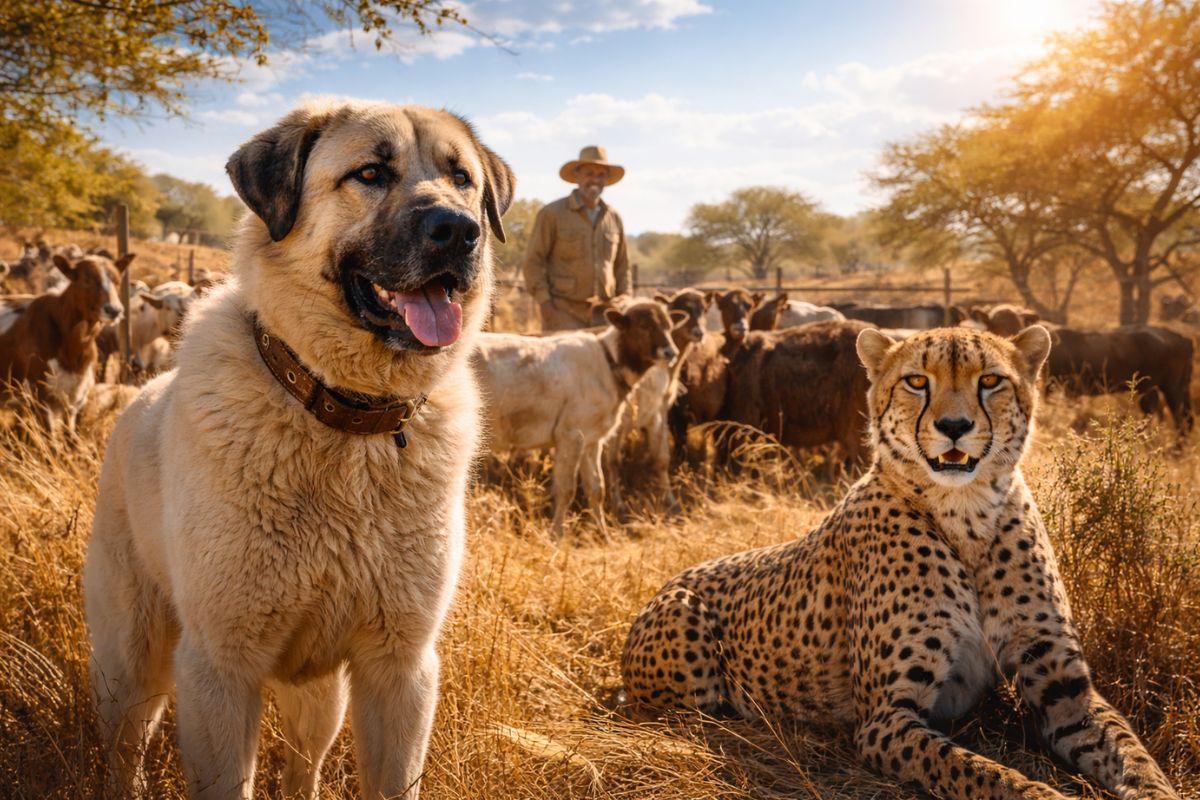
In Namibia, Guard Dogs and Livestock Guard Dogs with Anatolian Shepherds Protect Cattle and Cheetahs in Namibia and Become an Example of Cheetah Conservation.
A conservation program in Namibia shows that guard dogs can protect livestock and save cheetahs at the same time, reducing conflict between farmers and big cats without bullets or poison. With Anatolian Shepherds trained to live with the cattle, farmers are discovering that it is possible to defend the herd while becoming direct allies of conservation.
Twenty-five years ago, the Cheetah Conservation Fund decided to bet on guard dogs as a practical solution to a historical problem. Today, the results are clear to researchers and rural producers: livestock losses have decreased by around 91%, farmers have come to trust the protection of the dogs, and cheetahs are no longer seen solely as a threat that needs to be eliminated.
Guard Dogs at the Center of the Conflict Between Farming and Nature

In Namibia, about ninety percent of cheetahs live outside protected areas, exactly in the zones where herds of cattle, sheep, and goats are concentrated.
-
Samsung launches cordless vertical vacuum cleaner with up to 400W of suction and relies on AI to automatically recognize corners, carpets, and different surfaces.

-
The lost continent beneath Europe: separated from North Africa about 240 million years ago, comparable in size to Greenland, Greater Adria was crushed over 40 million years and left geological marks from the Alps to the Balkans.

-
A cold front advances through the South this Saturday and reaches the Southeast on Easter Sunday with heavy rain and a drop in temperature, while the North and Northeast face the risk of storms and flooding throughout the holiday.

-
Brazil is about to inaugurate the largest maritime surveillance system in its history, with radars, infrared cameras, and autonomous sensors installed on Ilha Grande to monitor the entire Brazilian coast in real time.


In this scenario, any attack on domestic animals tends to generate retaliation, creating a cycle that places the felines at constant risk.
To break this cycle, the Livestock Guard Dog Program of the Cheetah Conservation Fund was created with a very direct objective.
To use guard dogs to keep predators away from the herds, thus preventing the farmer from resorting to killing cheetahs in response to the losses.
The dogs monitor the herd at all times, mark territory, and bark whenever they detect the approach of predators.
With this firm presence, cheetahs prefer to avoid the area and look for easier prey, which reduces the number of livestock attacked and protects farmers’ business.
Why the Anatolian Shepherd Breed Was Chosen
The Namibian program does not use just any guard dog. The choice was for Anatolian Shepherds, a breed originating from Turkey, bred thousands of years ago to accompany herds in open plains and rural areas with harsh climates.
These dogs are large, sturdy, and have a naturally intimidating appearance, which greatly helps in their function of deterring predators.
They have an independent temperament, something essential for guard dogs that spend long periods alone with the herd, away from the farmer’s home. They also tolerate intense heat, cold, and rough terrain well, typical conditions of the Namibian landscape.
Puppies are born and socialized on a farm of the Cheetah Conservation Fund. When they reach about ten to twelve weeks, they are handed over to farmers and placed directly with the cattle.
The idea is that the guard dog forms a bond with the herd, seeing the group of sheep or goats as its “pack” and defending these animals with the same protective instinct it would have with another dog.
How the Program Works with Guard Dogs on Farms

The delivery of a puppy does not end the work. The Cheetah Conservation Fund monitors the lives of these guard dogs from the moment they arrive at the farm until adulthood, providing technical and veterinary support.
The animals receive careful training, from behavior with the herd to the proper way to react to the presence of predators.
The program team visits the properties, monitors the health of the dogs, advises producers, and helps correct any management flaws that could hinder the animals’ performance.
Over the years, the Cheetah Conservation Fund has also conducted periodic research with farmers to measure the effectiveness of the guard dogs, understand if livestock losses have truly decreased, and, primarily, assess whether farmers’ perceptions of cheetahs have changed.
Between 1994 and 2018, more than fifteen hundred interviews were conducted, and over six hundred dogs were distributed to herds on different farms.
Results in Numbers of Guard Dogs in Namibia
The data from the program forms the longest and most detailed study on livestock guard dogs in all of Africa. The main results indicate a very consistent impact.
Producers reported an average reduction of ninety-one percent in livestock losses caused by predators after the arrival of the guard dogs.
The vast majority of farmers rated performance extremely positively, attracting the attention of researchers and other conservation organizations.
Nearly all said that the dogs were clearly attached to the herd and submissive to livestock, behavior essential to avoid attacks on the cattle itself.
About ninety percent of respondents considered that the guard dogs effectively protected the herd, and the same proportion stated that the presence of the animals was economically advantageous, as fewer attacks mean less loss and less pressure to cull predators.
What the Study Reveals About Age, Health, and Behavior of Guard Dogs

An interesting detail observed in the study is that the age of the dog did not significantly change the actual rate of livestock losses.
In other words, even younger dogs were already providing effective protection. However, farmers’ perceptions were different.
Animals under twelve months were seen as less efficient, even though the numbers of attacks were already well below the period before the program.
Researchers also analyzed the body condition and behavior of the guard dogs. On farms reporting low performance, the animals had a much higher chance of presenting poor physical condition, a sign of inadequate feeding, lack of care, or untreated illnesses.
When a dog is not healthy, it naturally protects the herd less and gives a poor impression to the farmer.
Some behavioral problems were observed, such as difficulty staying with the herd, a tendency to excessively chase wild animals, and rough play with livestock, especially among puppies.
Over time, adjustments in breeding, selection of dogs, and field monitoring significantly reduced these challenges. The combination of improved training and continuous technical support was essential for keeping the strategy running well.
Guard Dogs as Conservation Technology and Income
Beyond the numbers, the Namibian program shows a central point. When farmers trust guard dogs and see the herd protected, the willingness to kill cheetahs decreases significantly.
Thus, a tool that was born to protect livestock transforms, in practice, into one of the best allies of big cat conservation in the region.
Instead of simply asking producers to “tolerate” the presence of predators due to tourism or biodiversity, the program offers a concrete solution that works in the daily life of the farm. The result is a real change in behavior.
The cheetah ceases to be seen solely as a direct threat to the farmer’s wallet and becomes part of a balance that benefits the country, tourism, and Namibia’s image as the world capital of the cheetah.
A Replicable Model Beyond Namibia
The success of guard dogs in Namibia has drawn the attention of other initiatives across the African continent. The Cheetah Conservation Fund has already supported the launch of similar programs in countries like South Africa, Botswana, and Tanzania, always with the same logic.
Replacing direct confrontation between producers and predators with a form of non-lethal protection that is simple to understand and aligned with rural reality.
With fewer than seven thousand five hundred cheetahs remaining in the wild, every preserved feline makes a difference.
Well-trained, healthy guard dogs integrated with the herd become a kind of bridge between the world of agriculture and conservation, proving that with creativity and technical support, it is possible to protect livestock and large predators at the same time.
Information and data adapted from a report by Africa Geographic.
Knowing all this, do you believe that programs with guard dogs could be adapted for Brazil to protect livestock and large felines like jaguars, or do you think our reality is too different from that faced by farmers in Namibia?







-

-

-

-

-

-

25 pessoas reagiram a isso.