





 English
  Francês
  Alemão
  Italiano
  Japonês
  Norueguês
  Portuguese
  Spanish
  4 min of reading
  0 comments


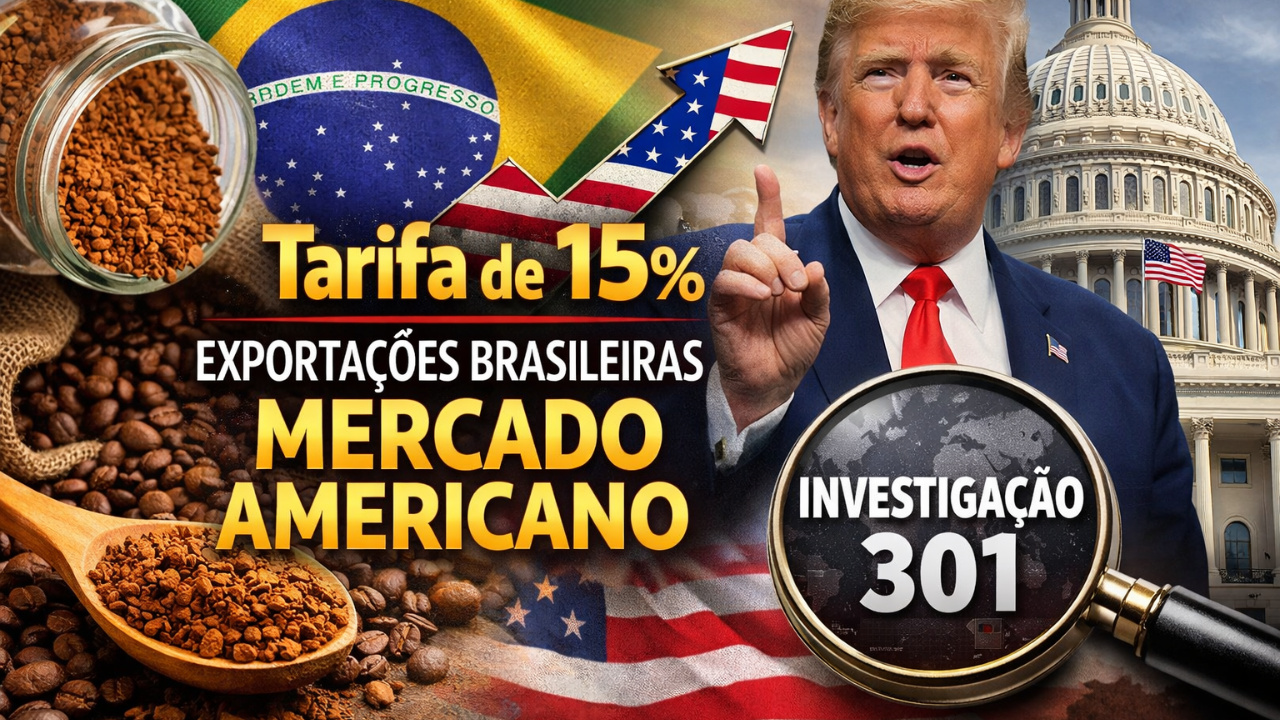
The Reduction of the Tariff to 15% Opens New Opportunity for Instant Coffee in Brazilian Exports Amid the Analysis of Investigation 301.
The Brazilian Instant Coffee sector may regain competitiveness in the American Market with the new 15% Tariff announced by the United States.
The measure was confirmed after President Donald Trump’s decision last Saturday (21) and will take effect at 2:01 AM (Brasília time) this Tuesday (24).
The change reduces the previous rate of 50% that applied to the product since August 2025 and led to a sharp decline in Brazilian Exports.
-
Middle East War Hits Fertilizers and Transportation and May Strain Brazilian Wallets
-
Russia Considers Suspending Gas to Europe After Surge in Energy Prices
-
How A War Thousands of Miles From Brazil Started Disrupting Global Shipping Routes, Raising Container Costs, and Putting Up to 40% of Brazilian Beef Exports at Risk
-
Iran-U.S. War Drives Up Oil Prices and Pressures Global Financial Markets

The new percentage, as outlined in Section 122 of the Trade Act of 1974, will be initially valid for up to 150 days.
The sector’s expectation is to recover lost ground and restore international competitiveness.
Instant Coffee and Tariff 15%: What Changes in Practice
The implementation of the 15% Tariff replaces the so-called “super tariff” of 50%, which had been imposed previously and directly impacted Brazilian Instant Coffee.
In practice, this places Brazil in conditions similar to other exporting countries.
Additionally, green coffee and roasted coffee should remain untaxed, although official confirmation still depends on the publication of the measure’s annexes.
Therefore, the change represents a relief, particularly for the instant coffee industry.
The adjustment occurred after the United States Supreme Court overturned the previous taxation.
Immediate Impact on Brazilian Exports
The decline in Brazilian Exports was significant during the period the 50% tariff was in effect.
Between August 2025 and January 2026, shipments to the American Market shrank drastically.
Data from the Brazilian Association of Instant Coffee Industry (Abics) show that, in 2025, Brazil exported 3.7 million bags of the product, a reduction of 10.6% compared to the previous year.
For the United States alone, the drop was 28% year-to-date.
Between August and December, the most critical period, the decline reached 40%.
The executive director of Abics, Aguinaldo Lima, emphasized the historical importance of the trading partner:
“The United States has been our largest customer for over 60 years. Nearly 20% of what we exported went to the U.S., a market of over US$ 250 million, and it would be a terrible loss for the sector.
There was a great concern, and there was a sense of discouragement regarding the maintenance of these tariffs. Now, we move from a situation where we had a 50% tariff to a new level, whether it’s 10% or 15%.
This puts everyone in equal circumstances. So, when you have equal competitive circumstances, the market becomes much fairer,” he explains.
At another moment, he reinforced:
“During the tariff period, which was from August to January of this year, we had a decline of nearly 50%, and the situation worsened each month in what was our largest market.”
The American Market Remains Strategic for Instant Coffee
The American Market continues to be a key player for Brazilian Instant Coffee.
Historically, about 20% of the sector’s exports were destined for the United States.
With the new 15% Tariff, the industry believes it will be possible to recover contracts and restore shipped volumes.
However, experts caution that the international scenario remains unstable.
Investigation 301 and Risk of New Tariffs
Despite the momentary relief, there is a factor of concern: the so-called Investigation 301, conducted by the United States Trade Representative (USTR).
The procedure is exclusive to Brazil and investigates alleged issues related to deforestation and social aspects.
The director-general of the Council of Coffee Exporters of Brazil (Cecafé), Marcos Matos, emphasizes that predictability is essential for international trade.
<p"In light of all the developments, we are seeing changes in the tariffs of products globally for the North American market.
For the market to function well, it needs predictability regarding current operations, future operations, and global exchanges. What we have seen is a lack of predictability,” he points out.
According to him, there is a risk that Brazil could lose parity if the Investigation 301 results in additional tariffs.
<p"We risk Brazil having higher tariffs, and this risk is complicated because we lose parity. Therefore, special attention must be given to Investigation 301.
Considering the political content of all this, because technically, the arguments do not hold, it is crucial for the relationship between the two countries to be good to mitigate the political issue, and thus the conclusion of Investigation 301 can be beneficial for Brazil,” he said.
Thus, the conclusion of the process is expected between May and June of this year.
Bilateral Agreements May Strengthen Brazilian Exports
In light of the situation, Cecafé advocates for strengthening diplomatic relations between Brazil and the United States.
An eventual meeting between the presidents could pave the way for bilateral agreements.
“Brazil needs to find ways to establish bilateral agreements and maintain a good relationship, which could happen at the meeting between the presidents of Brazil and the U.S., Lula and Trump, in March of this year.”
Meanwhile, the sector is closely monitoring each development. The 15% Tariff brings immediate relief to Instant Coffee, but the combination of trade policy, Investigation 301, and the dynamics of the American Market will continue to determine the pace of Brazilian Exports in the coming months.
Read more at: Instant Coffee: 15% Tariff from the U.S. Favors Brazilian Export









Seja o primeiro a reagir!