





 Portuguese
  English
  Spanish
  3 min of reading
  0 comments


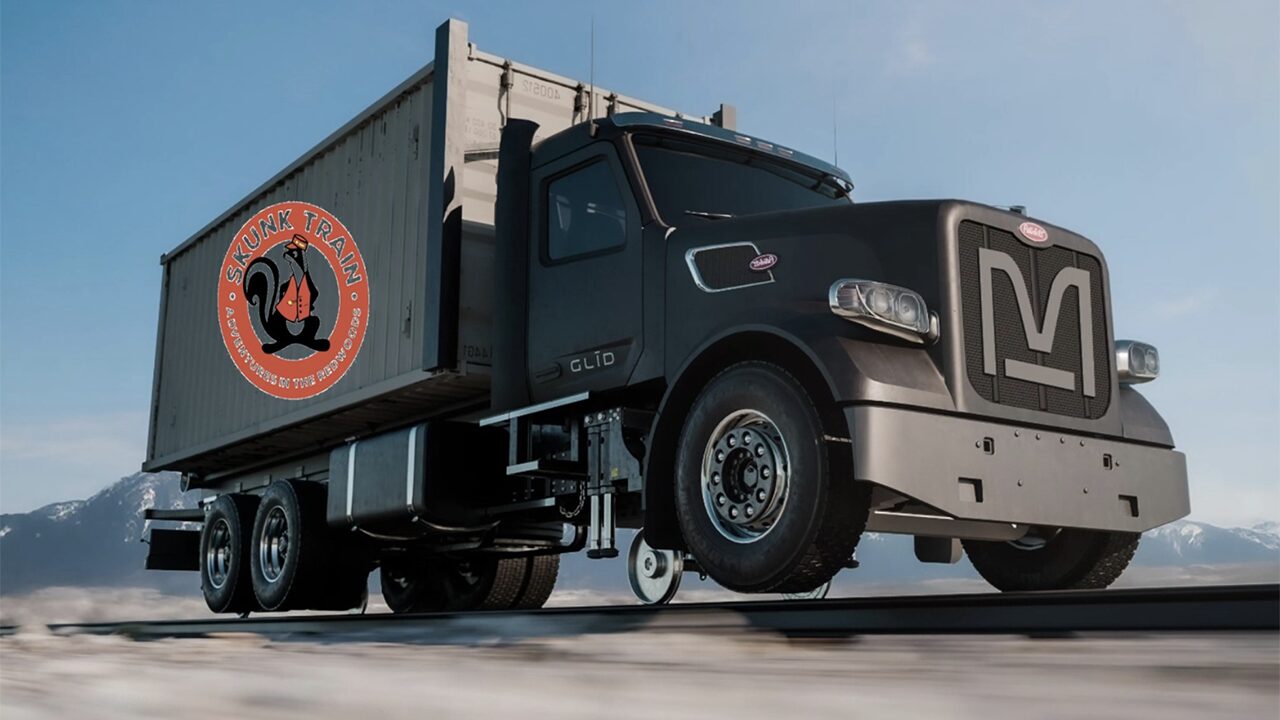
With a Forecasted Debut in 2025, Railway Project in California Tests Hybrid and Autonomous Vehicles on Century-Old Line to Modernize Freight Logistics, Reduce Emissions, and Empower Rural Communities
A new railway project in California promises to transform freight logistics in rural areas. Glīd Technologies and Mendocino Railway have formed a strategic alliance to test vehicles that are hybrid and autonomous along the historic railway line between Willits and Fort Bragg. The initiative begins in 2025 and aims to reduce the carbon footprint of the local supply chain.
Pilot Project on the Willits-Fort Bragg Line
The plan involves the use of two innovative models. The Glider M, a hybrid vehicle with a driver, and the AR2RV, a fully autonomous model. Both will operate on a 64.4-kilometer railway. This will be the first application of this technology worldwide.
The chosen route has underutilized infrastructure. The goal is to transform this scenario into a model of efficient, clean, and smart mobility. The project aims to serve as a laboratory for future similar deployments in other regions.
-
Motorola launched the Signature with a gold seal from DxOMark, tying with the iPhone 17 Pro in camera performance, Snapdragon 8 Gen 5 that surpassed 3 million in benchmarks, and a zoom that impresses even at night.

-
Satellites reveal beneath the Sahara a giant river buried for thousands of kilometers: study shows that the largest hot desert on the planet was once traversed by a river system comparable to the largest on Earth.

-
Scientists have captured something never seen in space: newly born stars are creating gigantic rings of light a thousand times larger than the distance between the Earth and the Sun, and this changes everything we knew about stellar birth.

-
Geologists find traces of a continent that disappeared 155 million years ago after separating from Australia and reveal that it did not sink, but broke into fragments scattered across Southeast Asia.

Solutions for Marginalized Areas
More than just transportation, the project focuses on social inclusion. There will be professional training programs and engagement with local communities. The intention is to ensure support from state and federal governments to expand the initiative’s reach.
The railway infrastructure will be modernized while maintaining its historical heritage. This includes the reactivation of existing structures without the need to build new tracks. Transportation will be more accessible, benefiting areas that have long been excluded from logistical advancements.
Reduction of Carbon Footprint
The developed system eliminates inefficient points in freight logistics. It will no longer be necessary to use cranes, chassis, or other heavy machinery for transfers. As a result, the project promises to significantly reduce CO₂ emissions and other pollutants.
The vehicles will use biodiesel as part of the hybrid system. This solution represents an advance in the decarbonization of logistics in sectors such as agriculture, mining, and energy.
Replicable Model in Other Regions
The expectation is that this initiative will serve as a model for short-distance rail transport across the country. Glīd and Mendocino Railway believe that other regional railways can benefit from the same approach.
The project relies on reusing existing infrastructure as a sustainability strategy. This reduces resource consumption and avoids the environmental impact that large-scale construction projects typically generate.
Circular Economy and Decentralization
Another strong point of the plan is decentralization. The technology could bring sustainable logistics solutions to remote areas, connecting communities to the market more efficiently.
Moreover, by eliminating intermediate steps, such as transfer platforms, the project reduces waste of energy and time. This makes the operation more economical and aligned with the principles of the circular economy.
The project implementation is expected in 2025. The century-old road linking Willits to Fort Bragg will be the stage for this new phase of railway mobility.
Information from Ecoinventos.







Seja o primeiro a reagir!