





 Portuguese
  English
  Spanish
  7 min of reading
  0 comments


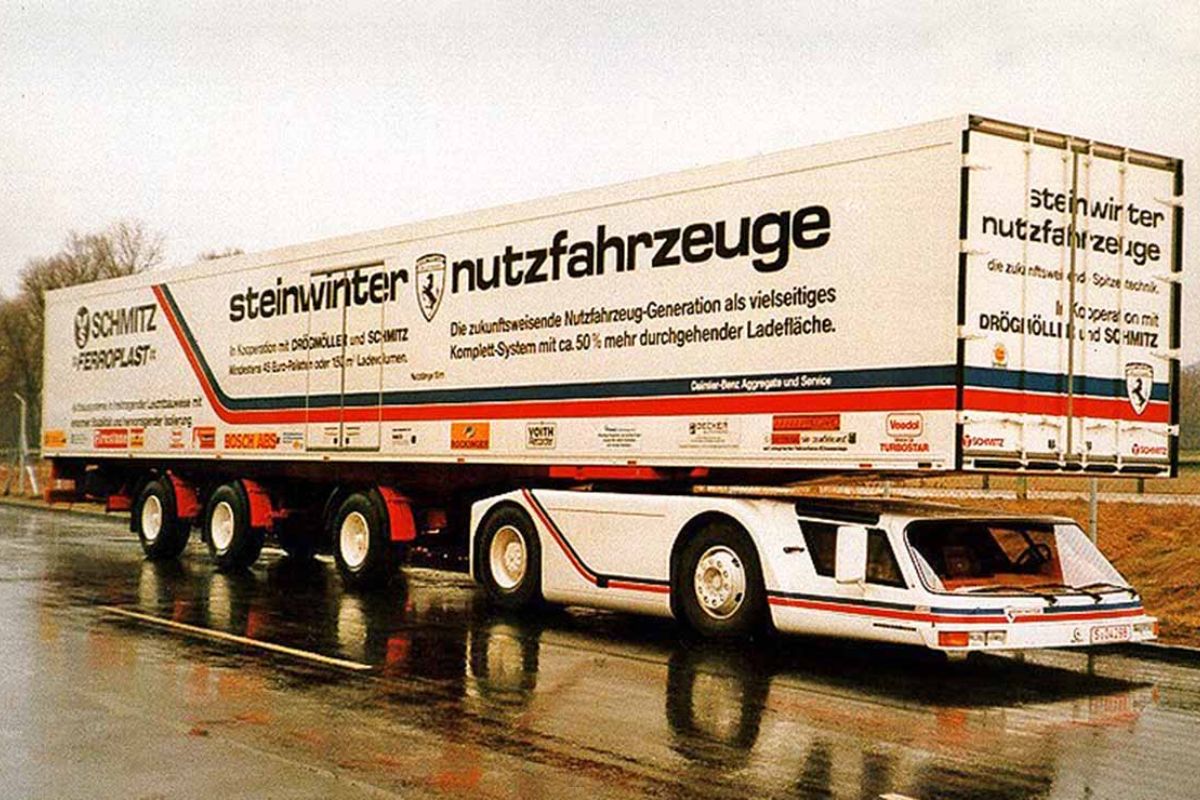
Presented In 1983, The Strangest Truck In History, The Super Cargo 2040 By Manfred St. Winter, Combined V8 Mercedes Engine, Ultra-Low Cab, Promised Perfect Aerodynamics And More Cargo, But Died After 3 Thousand Kilometers, New European Law And Total Rejection From Truck Drivers On European Roads Of The Time.
In 1983, at the height of the race for efficiency on European highways, the strangest truck in history appeared as a radical response to diesel consumption and cargo space limits. Named Super Cargo 2040, the prototype created by German engineer Manfred St. Winter was exhibited at that year’s Frankfurt Auto Show as a low-cab mechanical horse, with the driver practically lying beneath the trailer and a V8 Mercedes engine mounted behind the cab to free up headroom for cargo.
Decades later, the idea resurfaced in 2018 and 2019 in electric and autonomous versions with the Volvo Vera, operating on controlled routes in Sweden. The comparison shows why the concept of the Super Cargo 2040 was too advanced for the 80s and how the strangest truck in history became a forgotten legend while similar solutions only gained real viability when technology and legislation changed.
How The Strangest Truck In History Was Born

In the 80s, the European truck industry was undergoing a slow transition.
-
5 cheapest used cars than a Honda CG 160 Titan 0 km, with options starting at R$ 13,000 for those who want to trade their motorcycle for a car and escape the rain, sun, and risks of riding.

-
Around R$ 24,000: 4 used Ford SUVs with up to 253 hp, V6 engine, all-wheel drive, 7 airbags, panoramic sunroof, and a complete package that surprises with its price and performance in Brazil.
-
A brand new car starts at around R$ 75,000 in Brazil, but what stands out the most is seeing streets filled with SUVs and expensive sedans in a country where millions remain in debt.

-
For R$ 32,000, a brand new Hyundai car is a rival to the Kwid with a 1.2 engine producing 82 hp, 6 airbags as standard, multimedia with wireless Android Auto, up to 391 liters in the trunk, and a refreshed look for 2026 in India.

The classic high-cab shape over the engine still dominated the roads, even with advances in comfort and fuel consumption.
It was in this scenario that Manfred St. Winter decided to redesign the mechanical horse from scratch.
The proposal was to create a cab so low that the trailer could extend over it, forming a more aerodynamic unit with the potential for more cargo space.
This configuration, called cab-under, broke with the traditional flat-nosed truck standard, where the cab is above the engine and front axle.
In practice, the strangest truck in history placed the driver almost at pavement level, in a position reminiscent of a sports car lying beneath the semi-trailer.
Super Cargo 2040, V8 Mercedes And Ultra-Low Cab


The project was named Super Cargo 2040, referencing its 20-ton capacity and the 400 horsepower promised for the unit.
Mercedes-Benz provided technical support and supplied the OM442 engine, a V8 diesel with 12.8 liters and 214 kgf.m of torque at 1100 rpm, coupled with a ZF 16-speed transmission and mounted behind the cab on a 4×2 chassis from Mercedes itself.
The mechanics also included adjustable air suspension, ABS brakes, and a locking differential, an advanced package for the standards of the 80s.
The result was a compact horse with extremely low lines, reduced frontal profile, and a design clearly aimed at minimizing aerodynamic drag.
In theory, the strangest truck in history could consume less diesel, run more stably, and still tow sets of up to 18 meters, with variations of two to five axles planned in the study.
Sportscar Interior In 1.17-Meter Cab
The cab was designed with only 1.17 meters in height and about 6.5 meters in length. Inside, however, the environment deviated from the spartan standard of heavy-duty trucks of the time.
Recaro seats with multiple adjustments, a dashboard inspired by sports cars, and a more refined finish brought the truck closer to the world of supercars, to the point of resembling models like a Lamborghini from the 80s.
The steering wheel came from Mercedes, there were three seats, with the center one folding down for rest, and a small built-in cabinet for clothes and personal items.
The idea was to show that the strangest truck in history could be both an ergonomics laboratory and a modular platform.
The same horse could act as a motorhome, tow heavy loads, receive passenger modules, or even serve as a lightweight passenger vehicle.
Practical Tests Reveal Poor Visibility And Discomfort
If at the Frankfurt Auto Show the visual impact was immediate, the first road tests began to reveal the problems.
The extremely low driving position left the driver almost at the level of other vehicles’ bumpers, with a reduced glazed area.
Reading the traffic ahead was compromised, and lateral visibility was partially blocked by the trailer structure, requiring constant attention during maneuvers and lane changes.
In practice, many drivers reported a feeling of confinement and isolation from the highway flow.
The almost lying position was uncomfortable on long journeys and made entering and exiting the cab difficult.
During maneuvers, the rear axle reacted more abruptly and the trailer coupling required fine control, something far from the familiarity of conventional trucks.
For professionals used to high cabs with a dominant view of the road, the strangest truck in history offered exactly the opposite.
Overheating, Turbulence, And Aerodynamics That Did Not Close
Another critical point was the engine cooling.
The compact body and very low height restricted airflow to the cooling system.
In road tests, the V8 Mercedes engine showed high temperatures even under normal conditions, and the unit required extra care to avoid entering a risk zone.
Furthermore, the aerodynamics that seemed perfect in theory revealed zones of turbulence under the trailer and on the sides of the unit.
Instead of solid fuel consumption gains in all situations, part of the expected advantage was lost in flow instabilities and side effects on stability at certain speeds.
The strangest truck in history showed that a radical low-profile solution was not enough without a complete package of long-term testing and fine engineering adjustments.
European Law Of 1990 Destroys The Cargo Advantage
From a regulatory point of view, the blow came from the European standardization of maximum lengths.
Shortly after the prototype presentation, it was announced that, starting in 1990, sets with semi-trailers would be limited to 18.75 meters, of which only 15.65 meters could be used for cargo and 3.1 meters would necessarily be reserved for the cab and the articulation space between the mechanical horse and the trailer.
In practice, this nullified Manfred St. Winter’s main promise.
Even with the lowered cab positioned beneath the trailer, the Super Cargo 2040 could not carry more than a conventional truck, as the law came to define exactly how much space would be reserved for cargo.
Without the volume advantage, the strangest truck in history was left with only project complexity and ergonomic issues, completely losing its economic sense for fleet owners.
Few Kilometers, Mercedes Abandonment, And Disappearance Of The Prototype
To be approved, a heavy truck needs to cover hundreds of thousands of kilometers in endurance tests, often exceeding 1 million kilometers before approval for production.
The Super Cargo 2040 traveled about 3,000 kilometers in the initial evaluations.
It was enough time to expose visibility limitations, heating, stability, and acceptance issues among drivers.
With the new legislation removing the cargo advantage and ergonomics working against it, Mercedes-Benz distanced itself from the project a few years after its debut at the show.
The functional prototype ended up stored in Manfred’s own facilities, away from the spotlight.
Recent images show the truck still exists, but its exact whereabouts and current owner remain unconfirmed, reinforcing its status as a forgotten automotive relic.
From TV Star To Reference For Other Projects
Even off the roads, the appearance of the strangest truck in history caught the attention of American television.
In 1988, a model inspired by the Super Cargo appeared in an NBC science fiction series, presented as a futuristic patrol vehicle.
In practice, it was a modified truck, mounted on a chassis of another brand just to imitate the original design created in 1983.
The idea of a low-profile horse, however, did not begin or end with Manfred St. Winter.
Since the 60s, similar projects have emerged in different countries, such as Büsing’s model in Germany in 1967 and adaptations of bus chassis in New Zealand and Australia.
In 1977, Street Corporation even manufactured units of the Kabunder in the United States, also abandoned due to lack of acceptance.
The Super Cargo 2040 became the most famous example of a concept that has always stumbled over a combination of ergonomics, legislation, and market conservatism.
Volvo Vera, Port Of Gothenburg, And The Return Of The Buried Cab
In 2018, Volvo introduced the Vera, an electric and autonomous prototype with the same general design logic: a very low platform, practically without a cab, in which the trailer sits on top of the tractor unit.
In 2019, the Vera went into real operation in a pilot project at the Port of Gothenburg, Sweden, in partnership with logistics company DFDS, transporting containers on short and repetitive routes, monitored by a remote control center.
In a closed and controlled environment, without a driver on board and without the need to “see” traffic as on a highway, the low-horse architecture began to make sense.
What seemed madness in the strangest truck in history became an experimental solution for autonomous port logistics, showing that the idea was not entirely wrong, just ahead of a technological scenario that still did not exist in the 80s.
Given the trajectory of this project that combined extreme innovation, rejection by truck drivers, legal change, and partial rebirth in autonomous vehicles, do you think the strangest truck in history died at the wrong time or simply never made sense on the normal roads we use every day?







-

-

-

-

-

-

27 pessoas reagiram a isso.