





 Portuguese
  English
  Spanish
 5 min of reading
  0 comments


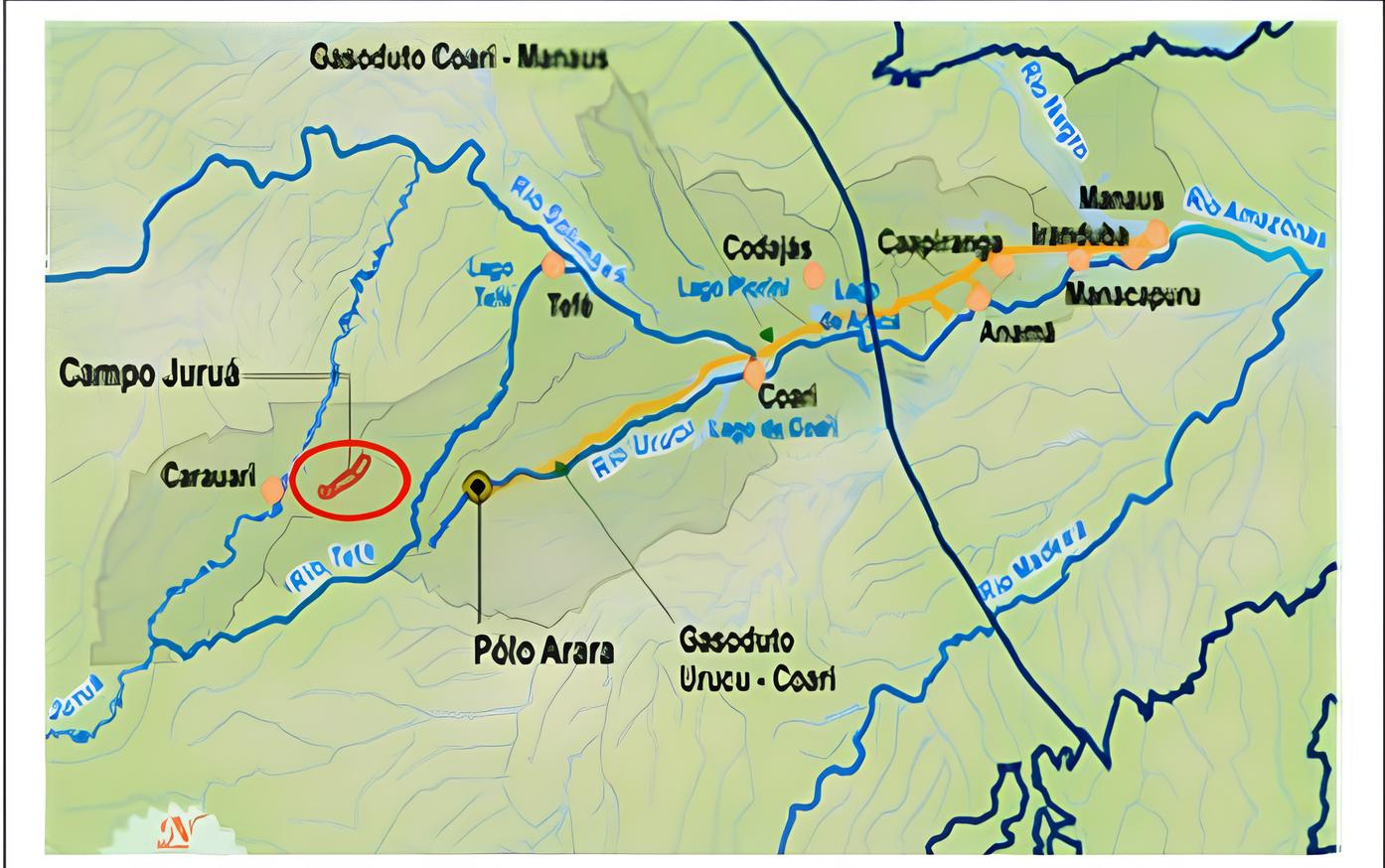
After Being Sold by Petrobras, the Jurua Field Became a Bet for Eneva to Deliver Clean and Remote Energy to the North of the Country with Amazonian Natural Gas.
In the heart of the Amazon rainforest, a natural gas field forgotten for years is starting to gain prominence as a central piece of a new energy plan. The Jurua Amazonas Field – located in the municipality of Carauari (AM), was long considered unviable for commercial exploration. But after being sold by Petrobras to Eneva in 2020, the asset became part of a national strategy for decentralized energy generation. Inspired by the success of the Azulao Field, which already supplies Roraima through an integrated operation of extraction, liquefaction, and transportation of gas, Eneva now bets on Jurua to repeat the feat.
Still in the licensing phase, the field is being prepared to enable a new model of remote generation, with the potential to ensure clean and stable energy for regions historically isolated from the Brazilian electrical system.
From Idle Asset to Key Piece in Energy Planning: Jurua Amazonas Field
The Jurua Field was discovered by Petrobras in the 1970s. Located in a remote area of the Solimões Basin, the asset remained untouched for decades due to its distance from major consuming centers and the lack of adequate logistical infrastructure.
-
Petrobras evaluates suspension of sales to distributors and considers canceling the cooking gas auction following guidelines from the Federal Government.
-
Lula reveals a masterstroke by Petrobras to undo a deal made by Bolsonaro, which involves the return of an important refinery that currently produces less than half of what was expected and makes Brazil dependent on international diesel.
-
A study confirms that the natural gas sector will reduce greenhouse gas emissions in Brazil by 0.5% and accelerate the energy transition by 2026.

-
Petrobras implements a severe adjustment and confirms a 55% increase in the price of aviation kerosene with a proposal for installment payments for the companies.


Even with an estimated potential of up to 5 billion cubic meters of gas, the field never entered production under Petrobras’s management.
This changed in 2020 when Eneva acquired Jurua for R$ 50 million, as part of the state-owned company’s divestment process. The company had already proven its ability to transform forgotten fields into profitable and sustainable operations — as it did with the Azulao Field, also in the Amazon.

With this experience, Eneva incorporated Jurua into its expansion plan, aiming to apply the same model: natural gas production, liquefaction at the origin, and transportation to thermal power plants in isolated regions.
The Azulao Model as a Reference
Eneva’s strategy became nationally known after the inauguration of the UTE Jaguatirica II, in 2021. With a capacity of 141 MW, the plant is powered by gas extracted from the Azulao field, also located in Amazonas. The gas is liquefied and transported by trucks over a distance of about 1,000 km to Boa Vista (RR), where it supplies the local power grid.
This operation was pioneering in Brazil and showed that it is possible to bring natural gas to distant regions even without pipelines — simply by integrating technology, efficient logistics, and regulatory planning.
Now, Eneva aims to replicate this model with the Jurua Field. The idea is to supply natural gas for the future Boa Vista II Thermal Power Plant, a project in the early stages of development but already mapped by the Ministry of Mines and Energy as a viable solution to reduce dependence on diesel oil and imported energy from Venezuela.
Licensing Progress and Projections
In April 2024, Eneva submitted a request for environmental licensing for the exploration of the Jurua Field to Ibama. The documents include technical studies, environmental impact assessment, and damage mitigation plans, considering the ecological sensitivity of the region.
The project envisions the installation of a gas liquefaction plant near the field and a road loading base for the transportation of LNG (liquefied natural gas) to Roraima. The operation would be similar to that already used in Azulao, but with infrastructure adjusted to the logistical peculiarities of the Jurua River and the surrounding forest.

Although the field is not yet in production, the first concrete steps have already been taken. The company’s expectation is to begin the implementation phase between 2025 and 2026, depending on the approval from regulatory agencies.
Potential Impact on the Northern Electricity System
The inclusion of Jurua in Eneva’s portfolio is strategic not only for the company but for the entire energy system in Northern Brazil. Roraima is the only state in the country that is still not connected to the National Interconnected System (SIN). Its energy comes mainly from diesel thermal plants — expensive and highly polluting — or from unstable imports from Venezuela.
With the commissioning of the UTE Jaguatirica II and the future reinforcement of the UTE Boa Vista II, the expectation is that the state will achieve energy self-sufficiency in the coming years, based on national natural gas.
Moreover, the use of LNG transported by road shows that it is possible to supply other remote regions of the Legal Amazon without relying on large infrastructure works. It is a modular, scalable, and adaptable approach to the characteristics of the territory.
A New Energy Frontier in Brazil
The case of the Jurua Field reveals a new frontier for energy generation in Brazil: leveraging fossil resources with lower environmental impact, in a localized and sustainable way, to serve historically underserved populations.
In addition to energy security, this type of operation brings local jobs, tax revenue, and logistical development to municipalities like Carauari, where the field is located.
The success of Azulao validated the model. Now, Jurua promises to expand it — and make Eneva one of the leaders in integrated energy solutions for isolated regions.
The Jurua Field, once forgotten by Petrobras and considered unviable, now represents one of Eneva’s most strategic bets to consolidate a new model of remote generation in Brazil. Still in the licensing phase, the project advances with the support of the successful experience at the Azulao field and with a clear focus: to bring Brazilian natural gas to where it has never reached — with efficiency, sustainability, and social impact.
If successful, the operation will not only strengthen the energy supply of the North of the country but also pave the way for new initiatives in other remote areas of the Amazon and Brazil’s interior.










-

Uma pessoa reagiu a isso.