





 English
  Francês
  Alemão
  Italiano
  Japonês
  Norueguês
  Portuguese
  Spanish
  4 min of reading


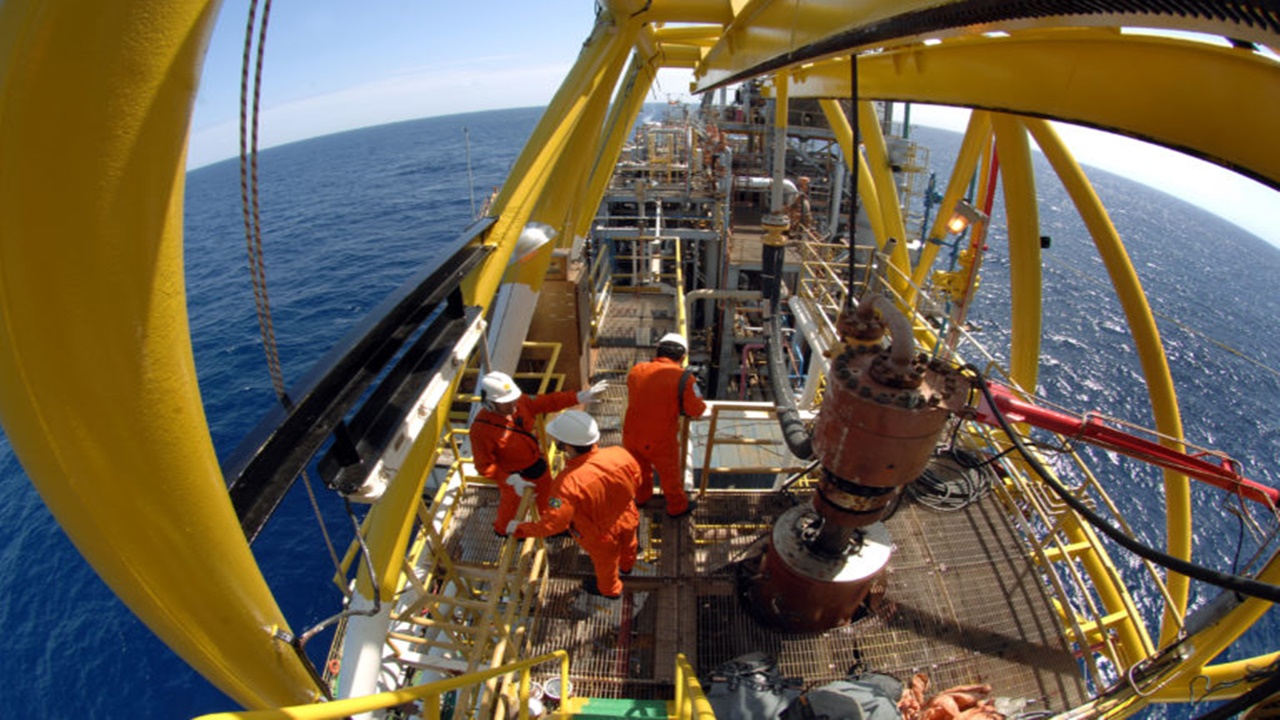
National Production in August Totaled 3.9 Million Barrels of Oil and 137 Million Cubic Meters per Day of Natural Gas
In August, the Búzios, Atapu, and Sul de Tupi fields, all producing under the onerous assignment regime in the pre-salt of the Santos Basin, were among the largest national producers. Búzios, with 669.3 thousand boe/d (barrels of oil equivalent per day) ranked second, only behind the Tupi field, which produced 1.2 million boe/d. Atapu was sixth, producing 158.1 thousand boe/d, while Sul de Tupi ranked 11th, producing 69.1 thousand boe/d.
Read Also
- New Bem Brasil Alimentos Factory Will Open 300 Job Vacancies in Technical, Management, and Operational Areas in the State of Minas Gerais
- Rise in Gasoline, Ethanol, Diesel, and CNG Prices Forces Consumers to Abandon Combustion Engines, Shift to Electric Cars, and Electrifed Vehicle Sales Surge in Brazil
- Shipyard Ecovix Announces It Is About to Secure Major Ship Repair and Maintenance Contracts for Vessels Servicing Petrobras, Generating and Preserving Many Jobs
- Multinational MODEC Is Recruiting Candidates Without Experience for Onshore Activity in Macaé (RJ); Job Openings Today (29/09) Are for Recently Graduated Engineers
This month marked the start of production at Sépia, also under the onerous assignment regime in the pre-salt of the Santos Basin, recording 8.6 thousand boe/d. The excess volumes from Sépia and Atapu will be offered in the Second Round of Auctions for Excess Volumes of the Onerous Assignment, scheduled to be held on December 17 this year.
More information about production in August is available in the Monthly Oil and Natural Gas Production Bulletin for August 2021, published today (29/9) on the page, which provides consolidated data on national production. It is also available, interactively, in the Dynamic Panels for Oil and Natural Gas Production.
-
Brazilian giant expands borders in the Southeast: Petrobras confirms new oil discovery in ultra-deep waters in the pre-salt of the Campos Basin.

-
Alert in the global energy market: Severe tropical cyclone hits the coast and disrupts gas production at major plants in Australia, threatening global supply.

-
Petrobras finds high-quality oil in the pre-salt at 113 km from RJ and reignites expectations about strategic reserves in the Campos Basin.

-
Ocyan opens registrations for startups focused on innovation in the oil and gas sector and will select projects for Innovation Day with the support of Nexio.


Pre-salt and National Oil Production in August
National production in August totaled 3.856 MMboe/d (million barrels of oil equivalent per day), with 2.997 MMbbl/d (million daily barrels) of oil and 137 MMm3/d (million cubic meters per day) of natural gas. There was a reduction of 1.6% in oil production compared to the previous month and a 2.9% decrease compared to August 2020. In natural gas, there was a reduction of 1.9% compared to the previous month and an increase of 2.3% compared to August 2020.
Pre-salt production in August totaled 2.764 MMboe/d (million barrels of oil equivalent), with 2.193 MMbbl/d (million barrels per day) of oil and 90.8 MMm³/d (million cubic meters daily) of natural gas.
There was a reduction of 1.5% compared to the previous month and 0.4% compared to the same month in 2020. Pre-salt production originated from 131 wells and accounted for 71.7% of the total produced in Brazil.
Natural Gas Utilization
In August, the utilization of natural gas was 97.7%. 55.3 MMm³/day were made available to the market. The gas flaring for the month was 3.1 MMm³/d, a reduction of 11.8% compared to the previous month and 22.4% compared to the same month in 2020.
Production Origin: In August, offshore fields produced 97.2% of the oil and 81.9% of the natural gas. Fields operated by Petrobras accounted for 92.5% of the oil and natural gas produced in Brazil.
In August, the highlight was the Tupi field, in the pre-salt of the Santos Basin, which was the largest producer of oil and natural gas, recording 922 Mbbl/d of oil and 41.9 MMm3/d of natural gas.
The Petrobras 70 platform, producing in the Atapu field through four interconnected wells, was the installation with the highest oil production, with 159,200 bbl/d.
The Polo Arara installation, producing in the Arara Azul, Carapaúna, Cupiúba, Rio Urucu, and Sudoeste Urucu fields, through 29 interconnected wells, was the installation with the highest natural gas production, producing 6.800 MMm³/d.
Estreito, in the Potiguar Basin, had the highest number of onshore producing wells: 992.
Tupi, in the Santos Basin, was the offshore field with the highest number of producing wells: 63.
Marginal Accumulation Fields
These fields produced 366.9 boe/d, with 93.3 bbl/d of oil and 43.5 Mm³/d of natural gas. The Iraí field, operated by Petroborn, was the largest producer, with 267.2 boe/d.
Other Information
In August 2021, 259 granted areas, four of onerous assignment, and four of sharing, operated by 36 companies, were responsible for national production. Of these, 57 are offshore and 210 onshore, with 11 related to contracts for areas containing marginal accumulations. Production occurred in 6,272 wells, with 495 offshore and 5,777 onshore.
The average API gravity of oil extracted in Brazil was 28.0, with 2.3% of the production considered light oil (>=31°API), 91.2% medium oil (>=22 API and <31 API), and 6.5% heavy oil (<22 API).
The mature onshore basins (long-term field/testing areas in the Espírito Santo, Potiguar, Recôncavo, Sergipe, and Alagoas basins) produced 91.897 Mboe/d, consisting of 71.2 thousand bbl/d of oil and 3.3 MMm³/d of natural gas. Of this total, 67.5 thousand boe/d were produced by Petrobras, and 24.4 thousand boe/d were produced by concessions not operated by Petrobras, of which: 15,339 boe/d in Rio Grande do Norte, 8,140 boe/d in Bahia, 481 boe/d in Espírito Santo, 235 boe/d in Alagoas, and 184 boe/d in Sergipe.








Seja o primeiro a reagir!