





 Portuguese
  English
  Spanish
 6 min of reading
  0 comments


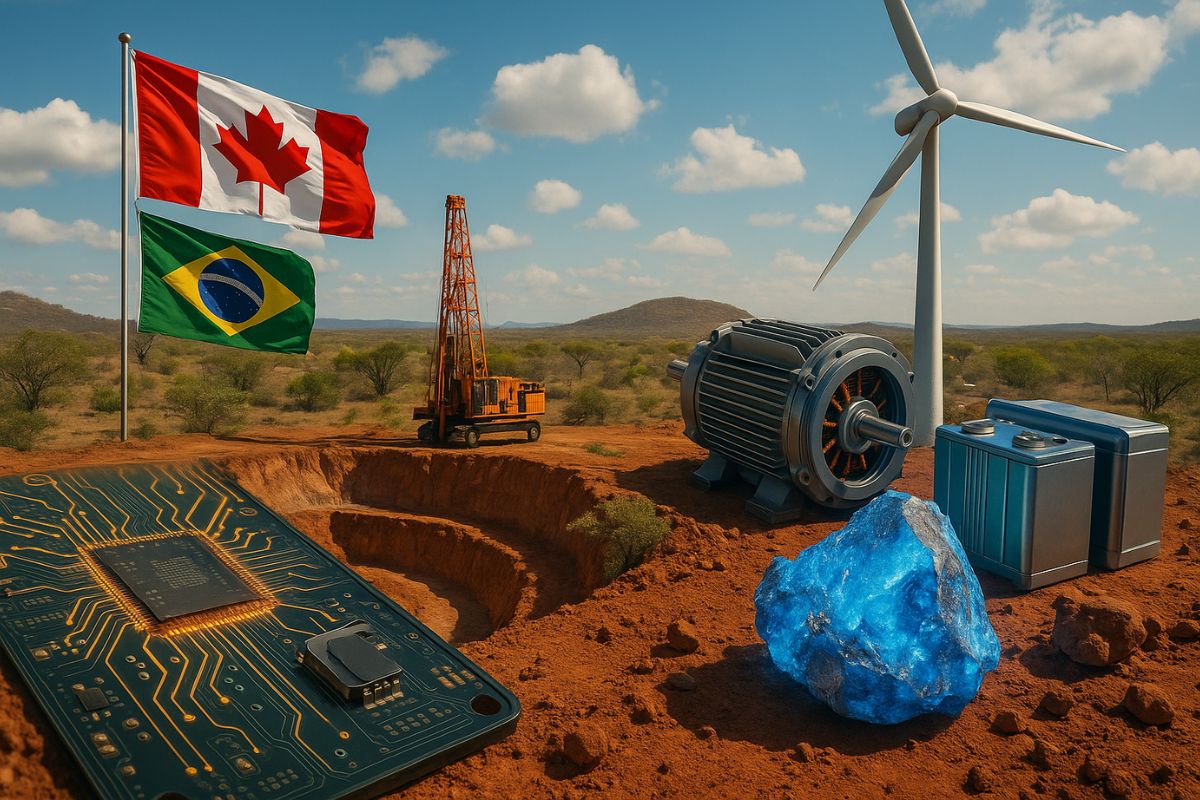
With The Exploration of Rare Earths in Ionic Adsorption Clays, Rare Earths in Piauí Gain Weight as Critical Minerals and Can Reposition the Brazilian Technology Sector in The Global Chain
The exploration of rare earths in Piauí, led by the Canadian company Origen Resources, marks a shift in how the country handles strategic minerals. In an area of nearly 4,000 hectares, divided into two blocks with preferential rights over five additional areas, the project is based on preliminary grades of rare earth oxides considered significant for surface samples and targets a highly concentrated and geopolitically sensitive market.
At the same time, the initiative occurs alongside the government’s efforts to accelerate geological mapping in the region, which could transform an asset still little known into a vector for regional development. If the economic viability of rare earth exploration on an industrial scale is confirmed, Piauí is likely to assume a strategic role in supplying essential inputs for the production of electronics, electric vehicles, and renewable energy solutions in Brazil.
Why The Exploration of Rare Earths Is Strategic for Technology and Energy
The relevance of rare earth exploration stems from the nature of these 17 chemical elements, indispensable for high value-added technologies.
-
Brazilian city bets on the business environment to generate jobs and attract investments in the energy sector — secretary reveals strategy at Macaé Energy 2026.

-
50 viaducts, 4 tunnels, 28 bridges, and 40 kilometers of bike paths: BR-262 in Espírito Santo will receive 8.6 billion reais for the largest engineering project in the state’s history, inspired by the Immigrant Highway in São Paulo.

-
Brazil produces too much clean energy and doesn’t know what to do with it: over 20% of solar and wind capacity was wasted in 2025 while investors flee and 509 renewable generation projects were abandoned in the last year.

-
Piauí will produce a new fuel that replaces diesel without needing to change anything in the truck’s engine and reduces pollutant gas emissions by half: truck drivers from all over the Northeast are already celebrating the news that will arrive later this decade.


High-performance permanent magnets, electric vehicle motors, wind turbines, smartphone components, and defense systems largely depend on specific combinations of these elements.
In a scenario of energy transition and accelerated digitalization, countries that dominate the production and refinement of rare earths gain weight in the global supply chain.
The exploration of rare earths in new territories, such as Piauí, is seen as an opportunity to reduce supply concentration and mitigate geopolitical risks, while opening up space for more ambitious industrial policies in producing countries.
The Canadian Project in Piauí and The Potential for A Mining District
Origen Resources’ movement in Piauí is not exploratory in a generic sense.
The company secured access to two blocks totaling 3,978 hectares, with preferential rights over five extra areas, configuring the possibility of forming a rare earth mining district in the Northeast.
Initial analyses indicated grades of up to 1.61 percent total rare earth oxides in surface samples, reinforcing investor interest.
The company has a period of 150 days to complete due diligence on the asset, a stage where the geological potential, operational risks, and economic conditions of rare earth exploration in the region will be assessed in more detail.
If the results are positive, the plan foresees the acquisition of 90 percent of the project, with an initial commitment of exploratory investment of 1 million dollars over the first two years.
This design indicates a long-term horizon, in which the research phase is treated as a central stage and not just a regulatory formality.
Ionic Adsorption Clays and The Environmental Differential of Piauí
One of the most striking points in the exploration of rare earths in Piauí is the possibility of the occurrence of ionic adsorption clay deposits.
This geological model is especially valued because it concentrates heavy rare earths, used in even more sophisticated technological applications, and allows potentially less aggressive extraction methods than in traditional hard rock deposits.
In environmental terms, the exploration of ionic adsorption clays can, in theory, reduce intensive crushing and grinding steps, in addition to enabling more controlled leaching processes.
Although any mining brings risks to the environment and requires strict licensing and control, the combination of heavy rare earths and a more favorable geological model places Piauí at another strategic interest level, especially in a world that increasingly demands commitments to sustainability from the mineral chain.
Geological Mapping, Infrastructure, and The Role of Government
Despite the potential, the state government itself acknowledges there is a significant deficit in detailed geological knowledge about Piauí.
Accelerating partnerships with the Geological Service of Brazil and other technical bodies is viewed as a condition for the exploration of rare earths to progress based on robust data, and not just on sporadic surveys.
More accurate maps allow for better planning of infrastructure, logistics, and land use policies.
Another critical axis is infrastructure. The economic viability of a rare earth mining district depends on adequate access to highways, ports, energy, and specialized services.
Without a coordinated effort in public and private planning, there is a risk the project will remain restricted to the exploratory phase, without developments in value chain and broader regional development, limiting the impact for Piauí and the Brazilian technology industry.
Exploration of Rare Earths, Governance, and Socio-Environmental Responsibility
International experience shows that projects of this type are only sustainable in the long run when they combine economic return with high governance standards.
The exploration of rare earths in Piauí will have to deal with issues such as waste management, the use of chemicals in the extraction process, water consumption, and impacts on local communities.
The promise of reduced environmental aggressiveness in clay deposits does not eliminate the need for rigorous monitoring and transparency.
At the same time, the relationship with surrounding communities will be decisive.
Models that only extract wealth without counterbalances in qualified jobs, local training, and improvement of public services tend to generate resistance and conflict, compromising the stability of the enterprise.
For the Canadian project to become a positive reference, it will be necessary to articulate clear standards of socio-environmental responsibility, with measurable performance indicators.
Potential Impacts on The Brazilian Technology Sector
If the exploration of rare earths in Piauí evolves from the exploratory phase to production scale, Brazil gains the opportunity to reduce its dependence on imports of a central input for high-tech supply chains.
This does not automatically mean establishing the entire refining and manufacturing chain within the national territory, but it opens up space for more robust industrial policies and strategic agreements.
For the electronics, wind energy, and electric vehicle industries, the existence of an internal source of rare earths can serve as an additional argument for investments in research, development, and local production.
By aligning the exploration of rare earths with innovation and technological development policies, the country can capture more value than in traditional cycles, where the export of raw ore takes precedence over technology aggregation.
Exploration of Rare Earths and The Future of Piauí in The Global Value Chain
The entry of Canadian capital into the exploration of rare earths in Piauí comes at a time when the debate over critical minerals is gaining traction worldwide.
For the state, this represents a rare opportunity to combine economic development, productive diversification, and integration into a global high-value added chain, provided that environmental and social risks are addressed with the same seriousness as financial return indicators.
The next cycle of decisions will involve not only the completion of Origen Resources’ due diligence but also the ability of government, companies, and local society to define what mining and development model they want for the region.
Between repeating a purely extractive logic and building an emblematic case of responsible mining in rare earths, there is a broad spectrum of choices that is still open.
In light of this scenario, do you believe that the exploration of rare earths in Piauí will be conducted in a way that can combine technological competitiveness, regional development, and environmental protection, or does the country risk wasting yet another strategic resource for short-term gains?







-

-

-

-

-

-

10 pessoas reagiram a isso.