





 Portuguese
  English
  Spanish
  4 min of reading
  14 comments


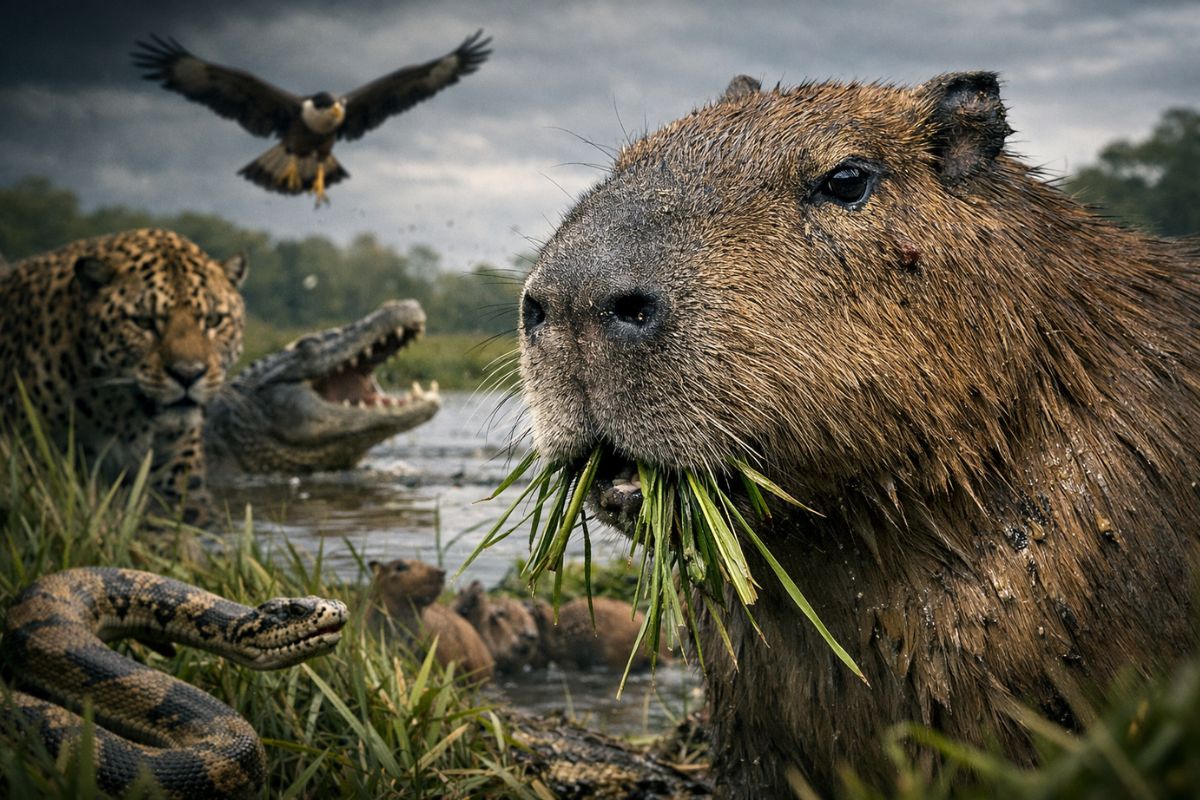


The Capybara Dominates Social Media, But Behind Its Tranquil Way Lies a Giant Rodent with Extreme Digestion, Rare Evolutionary Strategy, and Central Ecological Role. It Survives Only on Grass, Recycles Nutrients, Coexists with Predators, and Still Challenges Science in Explaining Its Size and Adaptive Success.
The capybara has become a pop culture icon, a symbol of tranquility and a walking meme, but behind the fame lies an animal with an out-of-the-ordinary biology. This giant rodent combines digestive, behavioral, and evolutionary adaptations that help explain how it survives, grows so much, and occupies so many different environments.
The capybara is both charismatic and extremely efficient from a biological standpoint. It lives nearly only on grass, recycles nutrients that other animals would waste, and still plays a central role in the ecosystems where it appears, even when sharing space with humans.
The Capybara is the Largest Rodent on the Planet

The capybara is the largest rodent in the world and belongs to the Caviidae family, the same as guinea pigs, geladas, and cavies.
-
After decades of failed attempts, Brazil is once again looking to space with an orbital rocket measuring 12 meters, weighing 12 tons, costing R$ 189 million, and scheduled for launch in 2026, in a new race to finally achieve autonomous access to orbit.

-
The Earth will plunge into a few minutes of darkness in broad daylight in August 2026, when a total solar eclipse transforms the sky into one of the most impressive astronomical phenomena in recent years.

-
How the terraforming of Mars can transform the planet: artificial aerosols can increase the temperature by up to 35°C in 15 years, creating conditions for liquid water.

-
Scientists drilled nearly 8,000 meters into the ocean floor above the fault that caused the 2011 tsunami in Japan and discovered that a layer of clay 130 million years old was responsible for making the wave much worse than any model had predicted.


Despite its calm appearance, it represents the pinnacle of a lineage of South American rodents that has undergone impressive body growth over time.
This relationship is so close that the capybara can be seen as a giant version of a guinea pig.
The current species, Hydrochoerus hydrochaeris, lives throughout most of South America, always associated with watery environments, such as rivers, lakes, swamps, and even heavily altered urban areas.
Large Body Powered by Grass

The name capybara comes from Tupi and means grass-eater, and that’s not an exaggeration.
This animal’s digestive system is extremely specialized to extract energy from fibrous plants.
The capybara has a highly developed cecum, which acts as a natural fermentation chamber. Microorganisms break down plant fibers that the animal couldn’t digest on its own, releasing important nutrients.
It is this efficiency that allows it to sustain a body that can weigh close to 90 kilograms on a plant-based diet.
The Strategy That Seems Strange But Is Genius

The capybara practices coprophagy, meaning it eats a specific type of its own feces.
These cecotropes are rich in vitamins and nutrients produced during fermentation in the cecum.
Since this part of the intestine has a low absorption capacity, the capybara needs to ingest this material again to make the most of what has been produced.
Rabbits do something similar, but in the case of this giant rodent, this strategy is an essential part of the animal’s energy success.
The Mystery of Capybara Gigantism
Growing so much is not simple for a mammal.
Large animals tend to have slower metabolisms and fewer offspring, making it difficult for populations to expand.
Nevertheless, the capybara represents one of the most extreme cases of size increase among rodents.
Studies suggest that the capybara exhibits modifications in insulin hormone, with different physiological properties that may have favored this growth.
At the same time, the animal has developed a type of cellular brake, with very low telomerase activity in tissues, limiting excessive cell divisions and helping reduce damage and mutations.
Ancient Evolution and Semi-Aquatic Life
The oldest fossils linked to the capybara lineage appeared in the Miocene, between 7 and 9 million years ago, in the region of Argentina.
Over time, various similar species existed, some even larger than the current one.
A constant characteristic is the semi-aquatic lifestyle.
The capybara spends a lot of time in the water, feeding on vegetation near water bodies and using rivers and lakes as refuge.
It can even sleep while floating, keeping almost only its snout above the water.
Coexistence with Predators and Other Animals

The image of a zen animal does not mean absence of risk. The capybara shares its habitat with caimans and other predators, and this coexistence is not friendship, but overlapping space.
Living in groups and being agile helps reduce the chances of becoming prey.
The capybara also interacts with birds that take advantage of insects startled by the group and even remove ticks from the bodies of these rodents.
These ticks are part of the natural parasite cycle that can transmit diseases, but the problem worsens when altered environments favor population explosions of these organisms.
Ecological Role That Goes Beyond Fame


Even surrounded by memes, the capybara has an important ecological function.
By consuming large amounts of plants near water, it helps keep vegetation lower and creates spaces used by birds, fish, and amphibians.
The feces of the capybara fertilize the environment and feed insects and decomposers, while the animal itself serves as prey for jaguars, anacondas, and other predators.
This places this rodent as a key piece in the food chain of various South American ecosystems.
Do you still see the capybara as just a cute animal, or have you started to see this creature as one of nature’s most efficient biological machines?










Cumprimentos pela interessante abordagem a respeito desse roedor, revelando uma faceta pouco conhecida, a Estratégia Genial.
Há entretanto um tópico não apreciado. A sua condição de roedor, quando no meio rural, acaba por dizimar lavouras de pastagens gerando prejuízos com diversas consequências, detalhe não atentado pelos organismos ambientais. Essa outra característica de converter matéria orgânica em proteína, carne outrora tida como apreciada e ora geradora de crime, elimina a alternativa de ser criada para a devida exploração em abate industrial como bovinos, equinos e ovinos, onde também o couro representaria outra matéria prima a diferentes propósitos. Ainda deve ser considerada as suas características reprodutivas em ciclo curto, fator a assegurar a manutenção da espécie, sem riscos de eliminação desses fofos, nem sempre tão, quando em rodovias são, involuntariamente, causantes de acidentes de transito, inclusive com mortes.
Em quem e onde está faltando visão mais ampla e adequada para haver mudança de conceito e regulamentações? Os organismos de governo e representantes de classe rural, confederação, federações e sindicatos, não deveriam atuar de forma conjunta e possibilitar mais uma fonte de alimento e de geração de riqueza em diferentes frentes?
Uma apreciação nessa linha bem complementaria essa diferenciada matéria!
São Animais lindos, assim como todos. Seres humanos **** que querem fama depreciando e instigando violência contra seres indefesos, porque não podem se defender contra a maldade humana, A única verdade é que é o ser humano o responsável por degradar e desgraçar todo o planeta terra aos poucos vai destruindo tudo como predadores famintos , é o único e verdadeiro cancer do planeta
Nao uma produto da evolução e criação de Deus nao como explicar de fato o processo evolutivo