





 Portuguese
  English
  Spanish
  6 min of reading
  0 comments


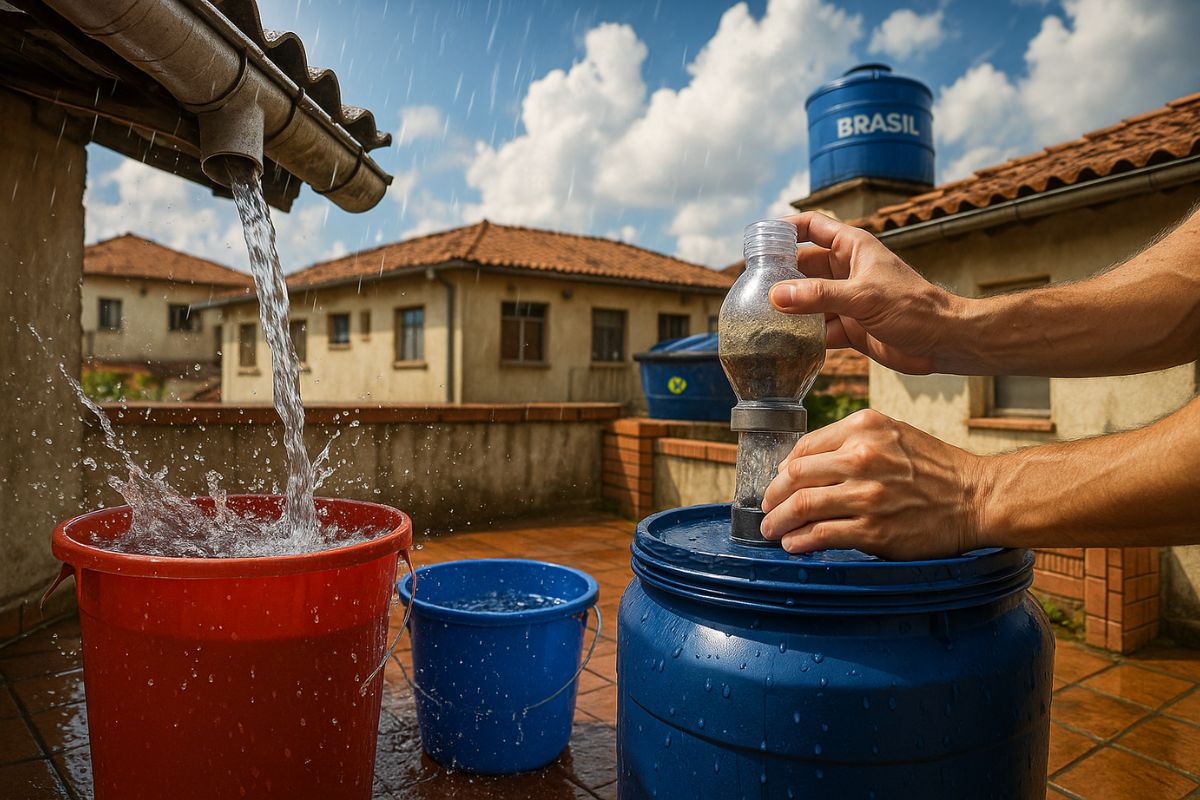
Capturing Rainwater with a Simple Collection System Allows for Water Reuse in Household Tasks, Helping to Reduce Water Bills with Continuous Rainwater Harvesting.
Capturing rainwater at home is a simple, low-cost solution with real potential to reduce water bills, especially in households that have high usage in tasks like washing outdoor areas, watering plants, and cleaning yards. With buckets, well-positioned gutters, homemade filters, and a basic maintenance routine, any resident can transform a resource that normally flows into the streets into an ally for household savings.
In a scenario of recurring water scarcity and rising tariffs, rainwater ceases to be just a climatic phenomenon and begins to be treated as a strategic resource. By capturing, storing, and using this volume responsibly, the consumer reduces pressure on the public supply system, mitigates flood risks, and incorporates into their daily life a concrete sustainability practice, with measurable environmental and financial impacts over time.
Why Rainwater Has Become an Ally in Household Savings
The conscious use of water resources is a central theme in cities that experience dry periods and high demand for supply.
-
Italian researchers have detected what appears to be a second Sphinx buried under the sands of Egypt, and satellite scans reveal a gigantic underground megastructure hidden beneath the Giza Plateau for over 3,000 years.

-
There are 4,223 drums and 1,343 metal boxes concreted with 50-centimeter walls that store the radioactive waste from Cesium-137 in the worst radiological accident in Brazil, just 23 kilometers from Goiânia, with environmental monitoring every three months.

-
Giant Roman treasure found at the bottom of Lake Neuchâtel in Switzerland reveals an advanced trade system, circulation of goods, and armed escort in the Roman Empire about two thousand years ago.

-
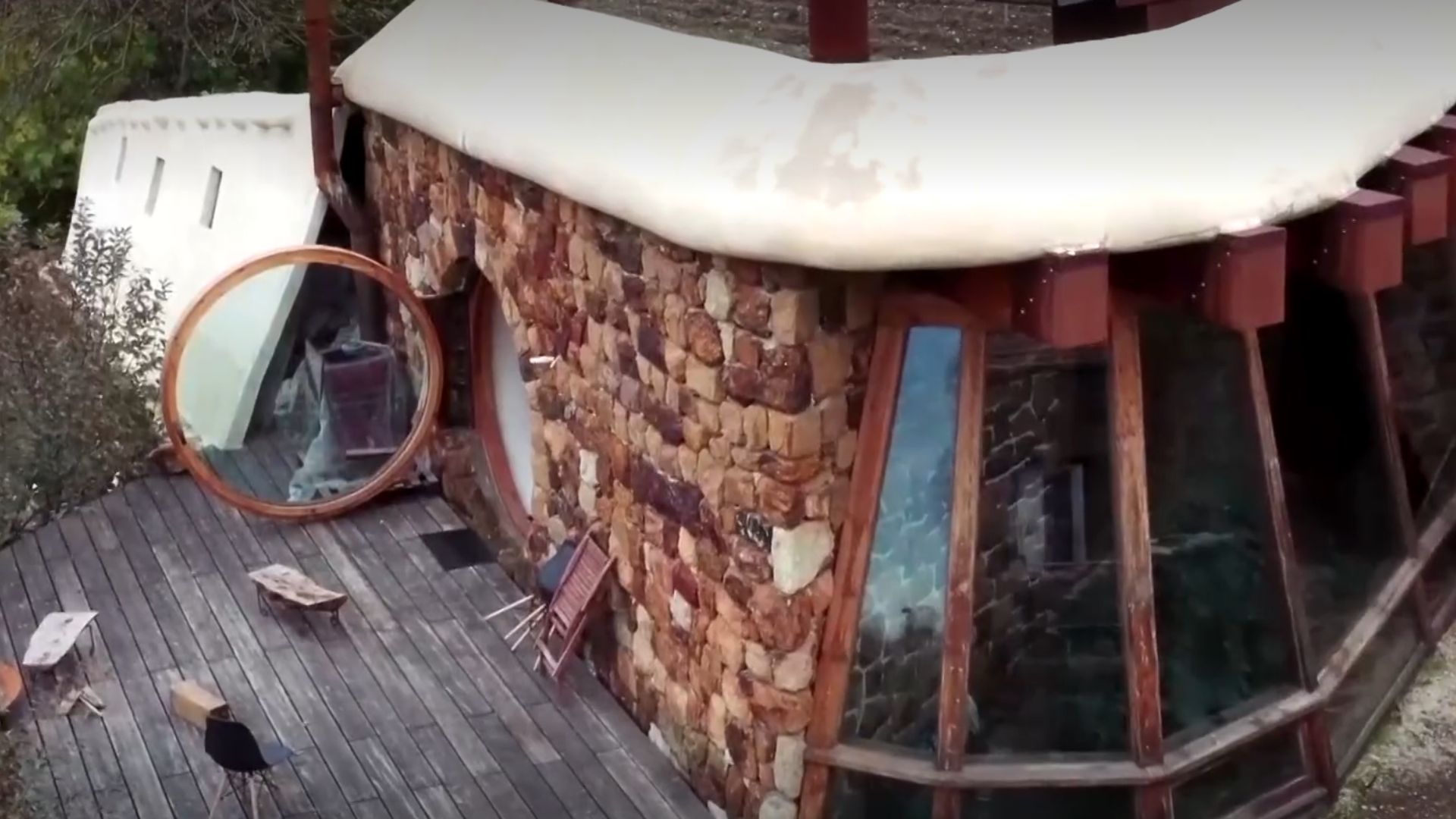
He buried 1,200 old tires in the walls to build his own self-sufficient house in the mountains with glass bottles, rainwater, and an integrated greenhouse.

In this reality, rainwater gains relevance as a complementary source, intended for activities that do not require potable water, such as cleaning floors, irrigating gardens, and washing vehicles.
Every bucket of rainwater used for these tasks represents fewer liters on the monthly bill, which reduces costs without compromising the comfort of daily routines.
In addition to the economic aspect, the adoption of rainwater as a household resource contributes to urban sustainability.
When rainwater is captured on roofs and stored in suitable containers, part of the volume that would flow directly into the streets is retained, which helps mitigate overloads in drainage systems and reduces the risk of flooding in certain areas of the city.
In this way, the resident collaborates with the preservation of natural resources and urban infrastructure while saving money.
How to Capture Rainwater with Buckets and Gutters
The most accessible way to take advantage of rainwater at home is to use the roof itself as a collection area.
The rain that falls on this surface can be directed by gutters to buckets or barrels positioned in strategic locations.
The principle is simple: increase the collection area with the roof and concentrate the flow into containers that can be used in daily life, such as large plastic buckets or sealed drums.
For the system to work well, it is important to check that the roof is clean, without an excess of leaves, branches, or debris.
Gutters and downspouts need to be unobstructed so that rainwater can flow freely into the containers.
The installation does not require complex equipment but does require attention to positioning and sealing of connections, avoiding leaks and ensuring that the maximum amount of collected water actually reaches storage.
Basic Safety Precautions for Storing Rainwater
After capturing rainwater, the focus shifts to safe storage. Open containers favor the proliferation of mosquitoes and other insects, in addition to allowing loose dirt carried by the wind to enter.
Therefore, it is essential to keep buckets and barrels sealed or covered with tightly fixed screens, allowing for minimal ventilation while blocking access to disease vectors.
Another important precaution is to clearly define the use of the stored rainwater.
In the absence of more sophisticated treatment systems, this water should be allocated only for non-potable purposes, such as washing outdoor areas, irrigating plants, and cleaning surfaces.
Visually separating these containers from the potable water network prevents confusion and reduces the risk of improper use for human consumption, food preparation, or personal hygiene.
Homemade Filtration of Rainwater with Simple Solutions
Even for non-potable uses, it is advisable to apply basic filtration to the captured rainwater, especially when it passes through roofs and gutters.
A simple solution is to install mosquito screens at the entries of buckets and barrels, which helps to retain leaves, insects, and other larger solid residues.
This first stage already significantly improves the quality of the collected water for external use, preventing clogs in hoses and watering cans.
To raise the filtration level a bit more, homemade filters composed of layers of materials such as activated carbon and synthetic fabrics can be used.
Activated carbon helps retain some smaller impurities and reduce odors, while filter fabrics help hold fine particles.
In somewhat more structured systems, rainwater can still pass through intermediate ceramic filters before being allocated for specific uses, always with the premise of not replacing the necessary treatment for direct consumption.
Where to Safely Use Rainwater at Home
The correct allocation of rainwater is what ensures safety and efficiency in the domestic routine. In outdoor environments, it can be used to water gardens, pots, and vegetable patches, provided that the characteristics of the plants are respected and waterlogging is avoided.
For cleaning sidewalks, garages, and service areas, the water captured in buckets and barrels directly replaces the water from the network, reducing the consumption of treated water in these intensive-use procedures.
Inside the home, rainwater can be used for indirect uses that do not involve prolonged contact with people or food, such as cleaning floors in technical areas, washing tools, or garden equipment.
When the resident has adequate plumbing, it is possible to dedicate this water to specific systems, always separate from the potable network.
In all cases, the principle is the same: preserve treated water for noble uses and leave supporting tasks for rainwater.
Economic and Environmental Benefits of Rainwater
From a financial perspective, the main benefit is the reduction of water bills over time.
The greater the share of rainwater in high-consumption tasks, the greater the impact on the monthly bill, especially during periods of regular rainfall.
In households with gardens, large areas of flooring, or an intense routine of external cleaning, the potential for savings is even more significant, as these activities consume large volumes of water.
From an environmental standpoint, the use of rainwater helps reduce the extraction of water from sources used for public supply and reduces the volume of rainwater that flows directly into storm drains and gutters.
This helps prevent flooding on days of heavy rain and reduces erosion processes in vulnerable urban sections.
By adopting large-scale collection systems, neighborhoods and communities can transform a source of problems into a partial solution for water resource management.
Maintenance and Optimization of the Rainwater Collection System
To ensure that the rainwater system remains efficient over the years, periodic maintenance is essential.
The cleaning of roofs, gutters, and filters should be done regularly, removing leaves, dust, and accumulated sediments.
Buckets, barrels, and other containers also need to be washed at defined intervals, preventing the formation of sludge on the inner walls and bad smell in the stored water.
Another essential point is the frequent visual inspection of the entry and exit points of rainwater in the system.
Checking if the screens are not torn, if the lids close properly, and if there are no cracks or leaks in the containers helps maintain the volume collected and the quality of the water for non-potable uses.
Small adjustments, such as repositioning buckets or enhancing the sealing of connections, can boost the system’s performance without the need for significant additional investments.
Is It Worth Investing in Rainwater at Home?
Considering the current scenario of water scarcity, rising tariffs, and the search for sustainable practices, capturing rainwater at home is a simple, low-cost measure with a high cumulative impact on household savings.
The use of buckets, gutters, homemade filters, and basic maintenance routines allows for turning rain into a useful resource for non-potable activities, preserving treated water for essential uses and reducing pressure on the public supply system.
The decision to implement a rainwater system involves assessing available space, family consumption habits, and the willingness to maintain a minimal care routine.
When these elements align, the result is a solid balance between savings, autonomy, and environmental responsibility.
And you, upon observing the structure of your house and your current water bill, have you ever considered setting up a simple rainwater collection system, or do you still have doubts about where to start this change in your routine?










-

Uma pessoa reagiu a isso.