





 English
  Francês
  Alemão
  Italiano
  Japonês
  Norueguês
  Portuguese
  Spanish
  4 min of reading
  50 comments


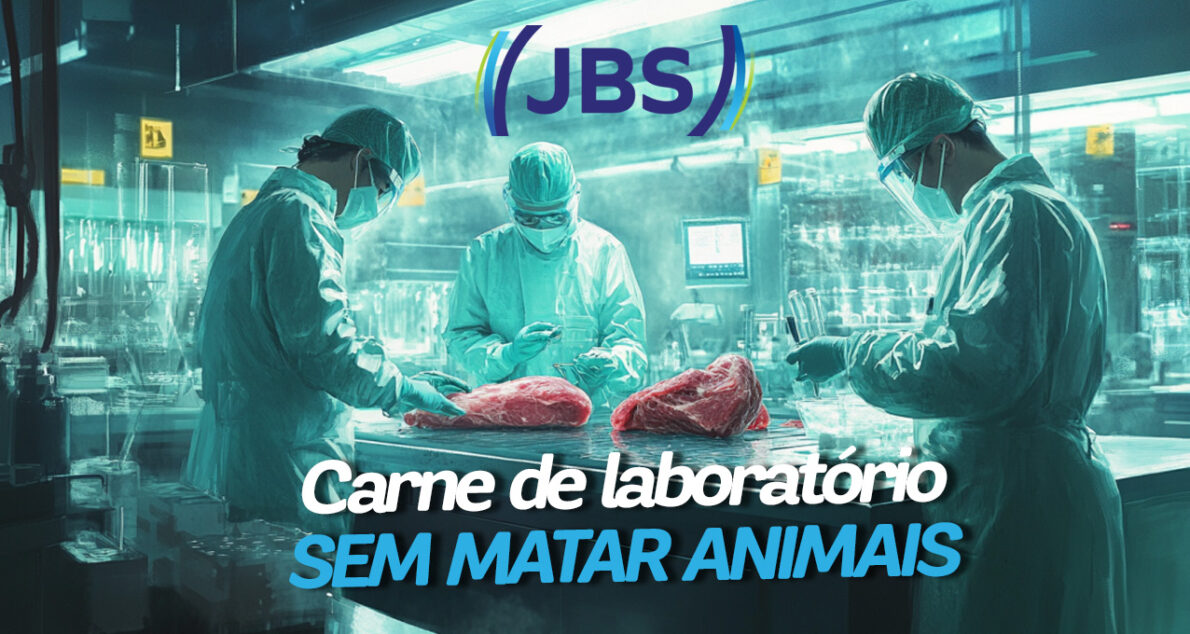


JBS Is About to Transform the Food Industry with Its New Cultivated Meat Factory. However, Environmental and Ethical Issues Raise Doubts About the True Sustainability of This Innovation. Is Lab-Grown Meat the Future or Just Another Technological Illusion?
Imagine being able to savor a juicy piece of meat without any animal having to be slaughtered. This idea, which seemed like something out of science fiction, is about to become a reality, and one of the largest food industries in the world, JBS, is at the forefront of this revolution.
While traditional meat production faces environmental and ethical challenges, lab-grown meat emerges as a futuristic solution that promises to transform the global food industry. But is this innovation truly the answer to the problems of the modern world?
JBS’s Leadership in the Cultivated Meat Market
JBS, a giant in the food sector, recently shook the industry by announcing the construction of the first commercial-scale cultivated meat factory of BioTech Foods in Spain, where the Brazilian company holds a 51% stake.
-
A “silent skill” is allowing Brazilians to earn up to R$ 22,000 per month without a degree and become indispensable for companies that rely on millions of data to survive.

-
Researchers at the Toyota Research Institute found that if a human uses robotic arms to flip a pancake 300 times in an afternoon, the robot learns to do it on its own the next morning, and this is currently the most promising method to solve the biggest bottleneck in modern robotics.

-
Goodbye iron: a common item in households is starting to lose space to technology that smooths clothes in minutes without an ironing board and with less energy consumption.

-
Antarctica reveals an unusual clue high in the Hudson Mountains, and what appeared to be just an isolated rock began to expose a secret hidden under the ice for ages.


This facility, which will be the largest in the world for cultivated meat production, is expected to start operations in 2024, with an initial production capacity of over one thousand tons of protein per year. The expectation is that this capacity could be expanded to 4,000 tons annually in the medium term, strengthening JBS’s position as a global leader in alternative proteins.
According to Eduardo Noronha, director of the Value-Added Business Unit at JBS USA and responsible for the company’s cultivated protein strategy, BioTech’s new plant puts JBS in a unique position to lead the segment and ride this wave of innovation.
The facility in San Sebastián will enable BioTech Foods to offer cultivated meat as an innovative product, meeting the growing demand from consumers for healthy, tasty, and sustainable food.
Global Expansion and Sustainable Commitments
The construction of the factory in Spain is just part of JBS’s ambitious plans. In addition to this venture, the company is planning to build a state-of-the-art center for biotechnology research and development and cultivated protein in Florianópolis, Brazil, with an estimated investment of US$ 60 million. The goal of this center is to develop cutting-edge technology that is 100% Brazilian for the production of alternative proteins, reinforcing JBS’s commitment to innovation and sustainability.
JBS also plans to gradually expand the production capacity of BioTech Foods to meet growing demand in key markets such as Australia, Brazil, the European Union, Japan, Singapore, and the United States.
With this initiative, the company not only reaffirms its commitment to sustainable production but also seeks to boost global food security by offering innovative protein options that align with consumer demands.


Challenges and Controversies of Cultivated Meat
Despite the optimism and promises of more sustainable production, lab-grown meat still faces significant challenges. A recent study pointed out that meat produced from animal cells can emit up to 25 times more greenhouse gases per kilogram compared to traditional meat. This calls into question one of the main environmental advantages that cultivated meat promised to offer.
Additionally, the production of cultivated meat still relies on animal serum for cell cultivation, raising ethical and practical issues. The use of this culture medium is a barrier that needs to be overcome for lab-grown meat to become truly sustainable and ethical. The study authors suggest that, for cultivated meat production bioreactors to be scaled up industrially, it is necessary to innovate and find alternatives to animal serum, such as a plant-derived base.
Even so, for those who consider it unethical to raise and kill animals for consumption, cultivated meat remains a more morally acceptable alternative than traditional livestock farming. However, the path to 100% ethical and sustainable meat production is still long and fraught with technological and economic challenges.
The Future of Food: Innovation or Illusion?
JBS and other companies in the food sector are betting big on cultivated meat as a solution to the challenges of food security and sustainability.
With significant investments and the promise of large-scale production, lab-grown meat may soon be on the plates of consumers around the world. However, environmental, ethical, and technological issues still need to be resolved for this innovation to fulfill all its promises.
Cultivated meat has the potential to transform the way the world produces and consumes food, but can the challenges be overcome in time to meet the growing global demand for protein?
And you, would you be willing to try lab-grown meat knowing the challenges and controversies behind this technology?






Terá as mesmas propriedades nutricionais da carne natural? (a bovina)
Parem de comer carne! Isso causa morte, sofrimento e dor aos animais. Toda a ação propõe-se diminuir a matança de animais eu apoio, mesmo que seja a maior empresa de proteína **** do mundo.
Grande iniciativa