





 English
  Francês
  Alemão
  Italiano
  Japonês
  Norueguês
  Portuguese
  Spanish
  3 min of reading


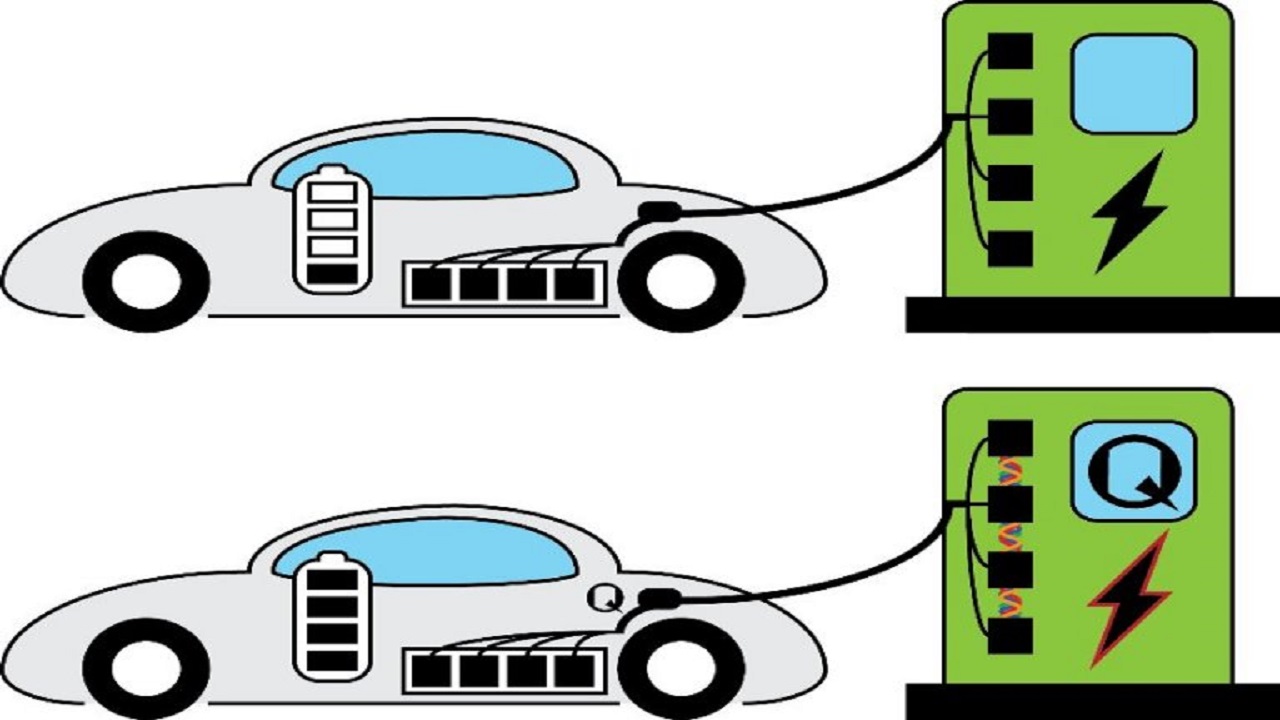
Could Quantum Batteries Be an Innovation in the Electric Car Universe As Fast As Filling a Gas Tank? Learn More Below About This New Technology and Its Future Application.
Over the past few years, various groups of scientists and physicists have conducted studies to demonstrate that a quantum battery can recharge almost instantaneously, putting an end to one of the major bottlenecks in the electrification of automobiles, which keeps electric cars plugged in for a long time until they are fully recharged. By leveraging phenomena such as quantum entanglement, it is possible to accelerate the battery recharging process, in a process where all cells are charged simultaneously, collectively. The topic related to quantum batteries and quantum charging was first discussed on August 5 of last year (2021) through the article: Quantum Charging Advantage Cannot Be Extensive Without Global Operations.
Quantum Batteries: A Possible Innovation in the World of Electric Cars
Quantum charging is very interesting, considering that the most modern batteries have many cells. However, collective quantum charging is not possible in classic batteries, as the cells in this type of battery are charged in parallel.
According to a deeper study of the subject, physicists noted that there may be two sources behind this advantage of quantum batteries, called “global operation,” where all cells interact simultaneously.
-
After launching the new GS3 with a 1.5 turbo engine producing 170 hp, GAC partners with Flamengo, enters the field with the largest fan base in Brazil, and accelerates an ambitious offensive to gain scale and confidence in the national market.
-
The Corolla from 2015 to 2019 depreciates so little that a 10-year-old model is still worth over 76 thousand reais, and owners treat this sedan as a safe investment thanks to its reputation for durability that no competitor has been able to match.
-
Is it worth considering a financed 2025 HB20 Comfort? A simulation with R$ 50,000 in the bank shows installments ranging from R$ 5,687 to R$ 2,365.

-
Road surveillance in Rio de Janeiro enters a new phase with the installation of more than 140 speed cameras on highways RJ-106 and RJ-104, and DER-RJ expands speed control in high-traffic areas.


However, it was still not entirely clear whether the two sources are indeed necessary or if there is a specific limit to the charging speed that can be achieved. Not satisfied with the results obtained, three physicists from the Basic Sciences Institute of South Korea set out to solve this issue, and succeeded!
Almost Instantaneous Recharging Through Quantum Batteries
Physicist Juyeon Kim and his colleagues showed that “all-to-all” coupling is completely irrelevant in the charging of quantum batteries and also demonstrated that the presence of global operations is the only main criterion in the advantage of quantum charging. The physicists also went beyond to identify the exact source of the quantum charging advantage in order to dismiss other possibilities and provide a clear projection of these batteries.
From an important practical perspective, the three physicists were able to accurately report the level of charging speed that can be achieved in the following scheme: as the maximum charging speed increases linearly due to the number of cells in conventional electric car batteries, quantum batteries are capable of employing global operation, achieving a quadratic scale over the recharging speed.
For example, in conventional electric cars, a battery with around 200 cells employing quantum charging would lead to an acceleration of about 200 times in the recharging process compared to classic batteries, meaning that home charging time could be reduced from 10 hours down to a maximum of 3 minutes. At high-speed charging stations, the time would be reduced from 30 minutes to just a few seconds.
Quantum Charging Goes Beyond Recharging Electric Cars
According to some researchers, quantum charging could go far beyond merely recharging electric cars and other electronic devices, as its use could be very important in the future for nuclear fusion power plants, where large amounts of energy are required to charge and discharge almost instantaneously.
Obviously, quantum battery technologies are just ’emerging’, and a long way lies ahead before the methods used can be properly implemented. Some results from other research similar to that of the trio of physicists may encourage funding agencies and companies to invest in these technologies.
Credits: Article – Quantum Charging Advantage Cannot Be Extensive Without Global Operations









Seja o primeiro a reagir!