Portuguese
  Spanish


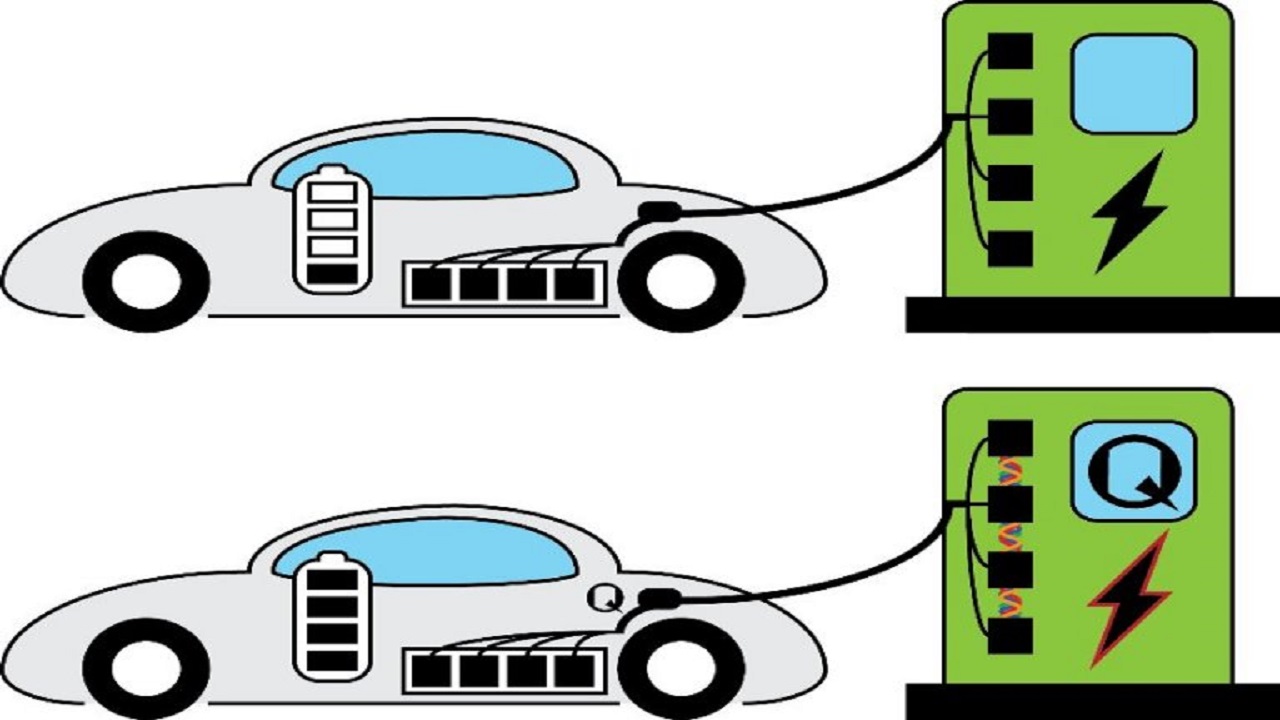

Could Quantum Batteries Be an Innovation in the Electric Car Universe As Fast As Filling a Gas Tank? Learn More Below About This New Technology and Its Future Application.
Over the past few years, various groups of scientists and physicists have conducted studies to demonstrate that a quantum battery can recharge almost instantaneously, putting an end to one of the major bottlenecks in the electrification of automobiles, which keeps electric cars plugged in for a long time until they are fully recharged. By leveraging phenomena such as quantum entanglement, it is possible to accelerate the battery recharging process, in a process where all cells are charged simultaneously, collectively. The topic related to quantum batteries and quantum charging was first discussed on August 5 of last year (2021) through the article: Quantum Charging Advantage Cannot Be Extensive Without Global Operations.
Quantum Batteries: A Possible Innovation in the World of Electric Cars
Quantum charging is very interesting, considering that the most modern batteries have many cells. However, collective quantum charging is not possible in classic batteries, as the cells in this type of battery are charged in parallel.
According to a deeper study of the subject, physicists noted that there may be two sources behind this advantage of quantum batteries, called “global operation,” where all cells interact simultaneously.
-
Suitcase-sized hydrogen engine spins at 25,000 rpm, nearly doubling the efficiency of conventional cars and replacing exhaust smoke with water vapor

-
1983 Chevrolet Runs Over 100,000 km Without Gasoline, Powered by Wood Chips, Reaches 125 km/h in Airport Test

-
Workshop Converts Giant Tractor Tire Tricycle into a Three-Wheel Drive Hybrid with 36,000-Watt Electric Motor Capable of Climbing Hills

-
Chery Offers Lifetime Battery Warranty and Car Replacement for Major Failures Under New Chinese Regulations



However, it was still not entirely clear whether the two sources are indeed necessary or if there is a specific limit to the charging speed that can be achieved. Not satisfied with the results obtained, three physicists from the Basic Sciences Institute of South Korea set out to solve this issue, and succeeded!
Almost Instantaneous Recharging Through Quantum Batteries
Physicist Juyeon Kim and his colleagues showed that “all-to-all” coupling is completely irrelevant in the charging of quantum batteries and also demonstrated that the presence of global operations is the only main criterion in the advantage of quantum charging. The physicists also went beyond to identify the exact source of the quantum charging advantage in order to dismiss other possibilities and provide a clear projection of these batteries.
From an important practical perspective, the three physicists were able to accurately report the level of charging speed that can be achieved in the following scheme: as the maximum charging speed increases linearly due to the number of cells in conventional electric car batteries, quantum batteries are capable of employing global operation, achieving a quadratic scale over the recharging speed.
For example, in conventional electric cars, a battery with around 200 cells employing quantum charging would lead to an acceleration of about 200 times in the recharging process compared to classic batteries, meaning that home charging time could be reduced from 10 hours down to a maximum of 3 minutes. At high-speed charging stations, the time would be reduced from 30 minutes to just a few seconds.
Quantum Charging Goes Beyond Recharging Electric Cars
According to some researchers, quantum charging could go far beyond merely recharging electric cars and other electronic devices, as its use could be very important in the future for nuclear fusion power plants, where large amounts of energy are required to charge and discharge almost instantaneously.
Obviously, quantum battery technologies are just ’emerging’, and a long way lies ahead before the methods used can be properly implemented. Some results from other research similar to that of the trio of physicists may encourage funding agencies and companies to invest in these technologies.
Credits: Article – Quantum Charging Advantage Cannot Be Extensive Without Global Operations