





 Portuguese
  English
  Spanish
  5 min of reading
  0 comments


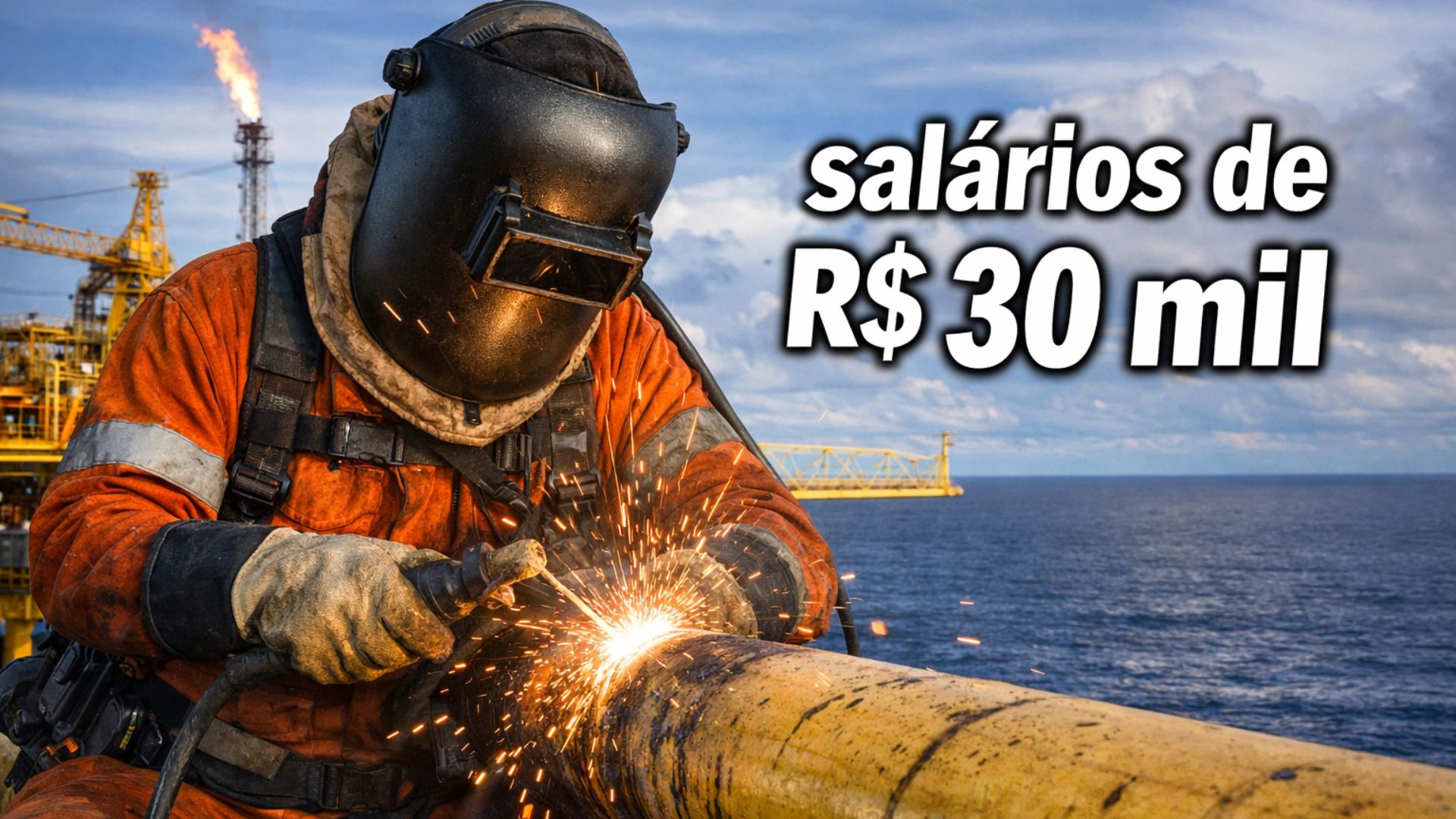
Discover Why the Offshore Career Remains Valued in 2026, with High Demand for Offshore Welders, High Salaries in the Oil and Gas Sector, and Real Opportunities for Professional Growth
On December 23, 2025, in a context of resuming investments in the oil and gas sector and intensifying operations in deep waters in Brazil, analyses published by specialized outlets, such as the Market Monitor, indicate that the offshore career remains one of the most promising in the country for 2026. Among the most valued technical roles is that of the offshore welder, an essential professional for the structural integrity of platforms, FPSOs, and drill ships.
Even starting with an average salary, the profession allows for rapid advancement, driven by mandatory bonuses, high-risk specializations, and technical certifications. In certain scenarios, monthly salaries can exceed R$ 30 thousand, consolidating the segment as a high-profile career in the Brazilian market.
Offshore Career on the Rise Driven by the Oil and Gas Sector
The growth of the offshore career is directly linked to the strategic relevance of the oil and gas sector in Brazil. According to data from the National Oil Agency (ANP), more than 90% of national production occurs in maritime environments, especially in deep and ultra-deep waters.
-
Lula reveals a masterstroke by Petrobras to undo a deal made by Bolsonaro, which involves the return of an important refinery that currently produces less than half of what was expected and makes Brazil dependent on international diesel.
-
A study confirms that the natural gas sector will reduce greenhouse gas emissions in Brazil by 0.5% and accelerate the energy transition by 2026.

-
Petrobras implements a severe adjustment and confirms a 55% increase in the price of aviation kerosene with a proposal for installment payments for the companies.

-
Gran Services announces offshore job openings for various positions in the oil and gas sector.

This scenario requires constant maintenance, structural repairs, and rigorous inspections. Every unplanned shutdown can represent million-dollar losses, which enhances the value of qualified technical professionals. Therefore, the on-board welder occupies a central position in the operational chain.
Moreover, older platforms continue to operate while new units come online, increasing the demand for specialized labor and sustaining the high-profile career throughout the decade.
The Role of the Offshore Welder on Oil and Gas Platforms
The offshore welder is responsible for performing welding and metal assembly services in extreme conditions, often under confinement, height, or corrosive environments. Their work ensures the structural safety of critical equipment.
Among the main activities are repairs on pipelines, metal supports, hulls, and support structures. A poorly executed weld can compromise the entire unit, which explains the high level of technical demand for the role.
Therefore, the offshore career requires professionals who are physically prepared, emotionally balanced, and skilled in various welding processes, always following strict safety and quality standards.
Initial Salaries in the Offshore Career: How Much Does an Offshore Welder Earn
At the beginning of the offshore career, the offshore welder receives a base salary ranging from R$ 4,000 to R$ 6,000, according to market data and collective agreements in the oil and gas sector.
However, this amount does not reflect the actual earnings. On-board remuneration includes mandatory bonuses that significantly raise monthly salaries. Among the main ones are the hazardous duty pay, equivalent to 30% of the base salary, and the confinement pay, which can vary between 20% and 30%.
Additional night shifts, on-call duty, and, in large operators like Petrobras and multinational companies in the sector, profit-sharing are also included. With these additions, the gross monthly income typically ranges from R$ 7,500 to R$ 12,000, even for professionals just starting in the high-profile career offshore.
Specializations That Increase Salaries in the Offshore Career
The difference in the offshore career lies in specialization. Roles that require higher operational risk and advanced certifications offer salaries far above average.
The underwater welder is considered the pinnacle of the profession. Working on submerged structures, these professionals can earn between R$ 15,000 and R$ 30,000 per month, especially in complex projects in the oil and gas sector.
Another valued role is that of the climbing welder, certified by IRATA. By combining technical welding and industrial climbing, the professional can work in suspended locations on platforms, with earnings ranging from R$ 10,000 to R$ 16,000 monthly.
The welding inspector, responsible for validating procedures and ensuring quality, has salaries between R$ 9,000 and R$ 18,000, depending on the certification level. These pathways explain how the high-profile career allows surpassing the threshold of R$ 30 thousand monthly.
Qualifications and Certifications Required for the Offshore Career
To enter and progress in the offshore career, the offshore welder must meet strict technical and legal requirements. In Brazil, the CBSP and HUET courses are mandatory prerequisites for any embarkation.
Furthermore, mastery of NR-34 and NR-37 standards is essential for safely operating in offshore environments. Strict adherence to these standards is a competitive advantage, especially in large oil and gas contracts.
The more qualifications and certifications, the higher the pay level tends to be, reinforcing the progressive nature of the high-profile career.
Technical Skills That Sustain the High-Profile Career
More than just performing welds, the professional needs to understand the entire operational context. This includes reading and interpreting technical drawings, correctly choosing consumables, and knowledge of special metal alloys such as duplex and super duplex steel, widely used in pre-salt operations.
Discipline in following safety protocols is absolute. A spark out of place can generate serious risks, reinforcing the importance of precision and emotional control in the offshore career. These skills explain why the market values experienced professionals with a solid track record of on-board performance.
Automation and the Future of the Offshore Welder in Oil and Gas
Automation is one of the main challenges of the offshore career. Welding robots are already being used for repetitive or high-risk tasks in the oil and gas sector. Still, experts point out that the welder will not be replaced but transformed.
The most valued professional will be one capable of supervising automated systems, adjusting digital parameters, and integrating technical knowledge with technology. This hybrid profile strengthens the high-profile career and contributes to maintaining high salaries over the next decade.
Why the Offshore Career Remains One of the Most Promising in Brazil
With aging platforms, new projects in pre-salt, and increasingly demanding safety and efficiency requirements, the demand for qualified maintenance will continue to grow. This keeps the offshore welder as a key player in the oil and gas sector.
The combination of on-board experience, multiple certifications, and technological adaptation defines who achieves the highest salaries. For those seeking stability, high compensation, and technical growth, the offshore career remains one of the most solid and strategic options in the Brazilian market in 2026 and beyond.








-

-

4 pessoas reagiram a isso.