





 English
  Francês
  Alemão
  Italiano
  Japonês
  Norueguês
  Portuguese
  Spanish
  5 min of reading
  0 comments


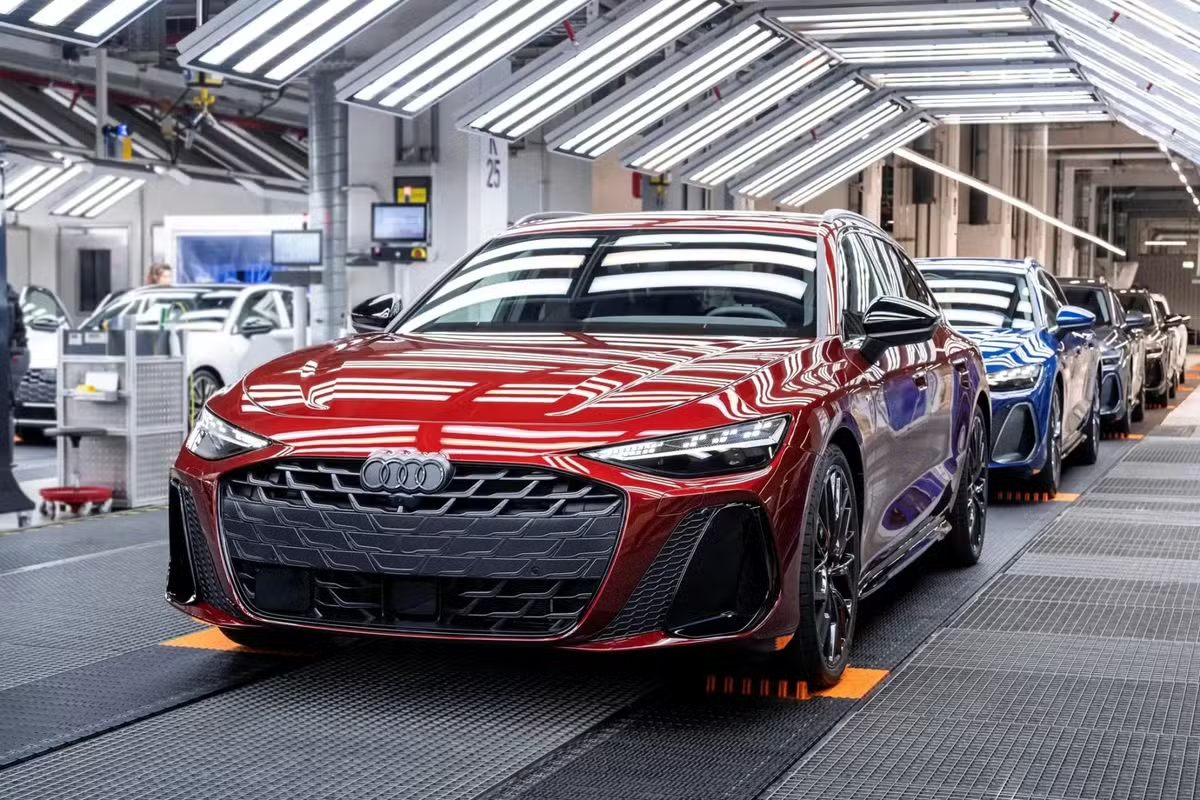
Historical Agreement Between Mercosur and European Union Establishes Rules for Automotive Tariffs, but Effects Depend on Ratification, Long Timeframes and Technical Requirements That Influence Prices, Industrial Strategies and the Pace of Opening the Brazilian Market in the Coming Years.
The free trade agreement between Mercosur and the European Union, signed on January 17, 2026, establishes a schedule for tariff reduction that may, over the coming years, decrease the cost of importing European vehicles into Brazil.
However, the agreement does not produce immediate effects in the national automotive market, as it depends on internal ratification and sets long timeframes for the implementation of changes.
Currently, the Brazilian tariff for the import of automobiles from Europe is 35%.
-
Middle East War Hits Fertilizers and Transportation and May Strain Brazilian Wallets

-
Russia Considers Suspending Gas to Europe After Surge in Energy Prices

-
How A War Thousands of Miles From Brazil Started Disrupting Global Shipping Routes, Raising Container Costs, and Putting Up to 40% of Brazilian Beef Exports at Risk

-
Iran-U.S. War Drives Up Oil Prices and Pressures Global Financial Markets

According to the portal Motor1, this rate will only begin to be reduced after the agreement comes into effect and follows a staggered schedule that extends over more than a decade.
Moreover, access to preferential tariffs is conditioned on compliance with rules of origin, which require minimum percentage of content produced within the involved blocs.
Ratification of the EU-Mercosur Agreement Still Defines the Start of Changes
The signing of the agreement does not imply automatic application.
The text needs to be internally approved by the Mercosur countries and, in the European case, goes through additional institutional analyses.
On January 21, 2026, the European Parliament forwarded the agreement for evaluation by the European Court of Justice, a procedure that may prolong the validation process.
At the same time, European authorities have publicly indicated the possibility of discussing provisional application measures for the treaty, provided there is legal backing and approval in at least one of the Mercosur countries.
This movement, however, depends on political and legal decisions that have yet to be concluded.
In Brazil, as long as these steps are not overcome, the current rules remain in effect.
This means that vehicles imported from the European Union continue to be subject to the 35% Import Tax, in addition to other taxes and costs that influence the final price to the consumer.
Timetable for Tax Reduction for Imported Cars
The agreement establishes distinct timelines for different types of vehicles.
In the case of light combustion automobiles, the tariff remains at 35% during the early years of validity, with no initial reduction.
Starting from the so-called seventh year, the rate would gradually decrease, starting from 28.3% until reaching full exemption in the 15th year.
For electric and hybrid vehicles, the timeline is longer and starts from a lower tariff.
Disclosed information indicates an initial rate of 25%, with progressive reductions over the subsequent years, moving through intermediate ranges until reaching 0% only from the 18th year of the agreement’s validity.
Technologies classified as more advanced, such as hydrogen-powered vehicles, are subject to an even longer timeline.
According to the negotiated text, these models may take up to 35 years to achieve total exemption from import tax.
Regardless of category, access to reduced tariffs depends on compliance with the rules of origin.
The agreement requires that at least 55% of the vehicle’s value be produced within Mercosur or the European Union, aiming to prevent products from third countries from benefiting from preferential conditions without effective productive integration.
Potential Impacts on Car Prices in Brazil
Industry experts assess that, in the long term, the gradual reduction of tariffs may expand the supply of European vehicles in Brazil and potentially influence prices in certain segments.
Still, the final impact on the consumer depends on other factors, such as exchange rate variation, automotive manufacturers’ trade policies, logistics costs, and internal tax burden, which are not altered by the agreement.
In practice, the most noticeable effects are likely to occur only when rates approach zero.
Until then, partial reductions may favor specific import operations without necessarily provoking broad and immediate changes in prices practiced at dealerships.
Evaluation of the Brazilian Automotive Industry
From the perspective of the Brazilian industry, the agreement is analyzed from different angles.
Sector representatives point out that regulatory predictability and market opening may favor investments and exports.
According to Milad Kalume Neto, executive director of K.Lume Automotive Consulting, “the reduction of import and export tariffs for vehicles and auto parts tends to increase the competitiveness of products manufactured in both blocs.”
Kalume also emphasizes that manufacturers established in Mercosur already produce models with potential acceptance in the European market, provided they meet the technical and regulatory requirements of that bloc.
In this evaluation, the agreement may create conditions to enhance bilateral trade flow, especially in a context of reorganization of global production chains.
Auto Parts and Flex Technology in the EU-Mercosur Agreement
Another point mentioned by analysts is the impact on the auto parts sector.
The reduction of tariff barriers may facilitate the integration between suppliers from Mercosur and the European Union, with gains in scale and increased exports of components.
The flex technology, widely used in Brazil, also appears in sector discussions.
Experts point out that this type of solution may align with energy transition strategies, especially in hybrid applications.
However, large-scale adoption in Europe depends on environmental policies, industrial decisions, and acceptance by the local market.
Competition, Safeguards and Protection of National Industry

While creating opportunities, the agreement imposes challenges to the industry established in Brazil.
The gradual entry of European vehicles with reduced tariffs is likely to increase competition in certain segments, requiring adjustments in production strategies, innovation, and costs.
To address potential negative impacts, the treaty provides for safeguard mechanisms.
If it is proven that the increase in imports causes significant harm to the domestic industry, the Brazilian government may temporarily suspend the reduction of tariffs and restore higher rates, according to the rules established in the agreement itself.
With long timeframes, technical requirements, and the possibility of applying safeguards, the EU-Mercosur agreement outlines a process of gradual changes in the automotive sector.










Seja o primeiro a reagir!