





 Portuguese
  English
  Spanish
  4 min of reading
  0 comments


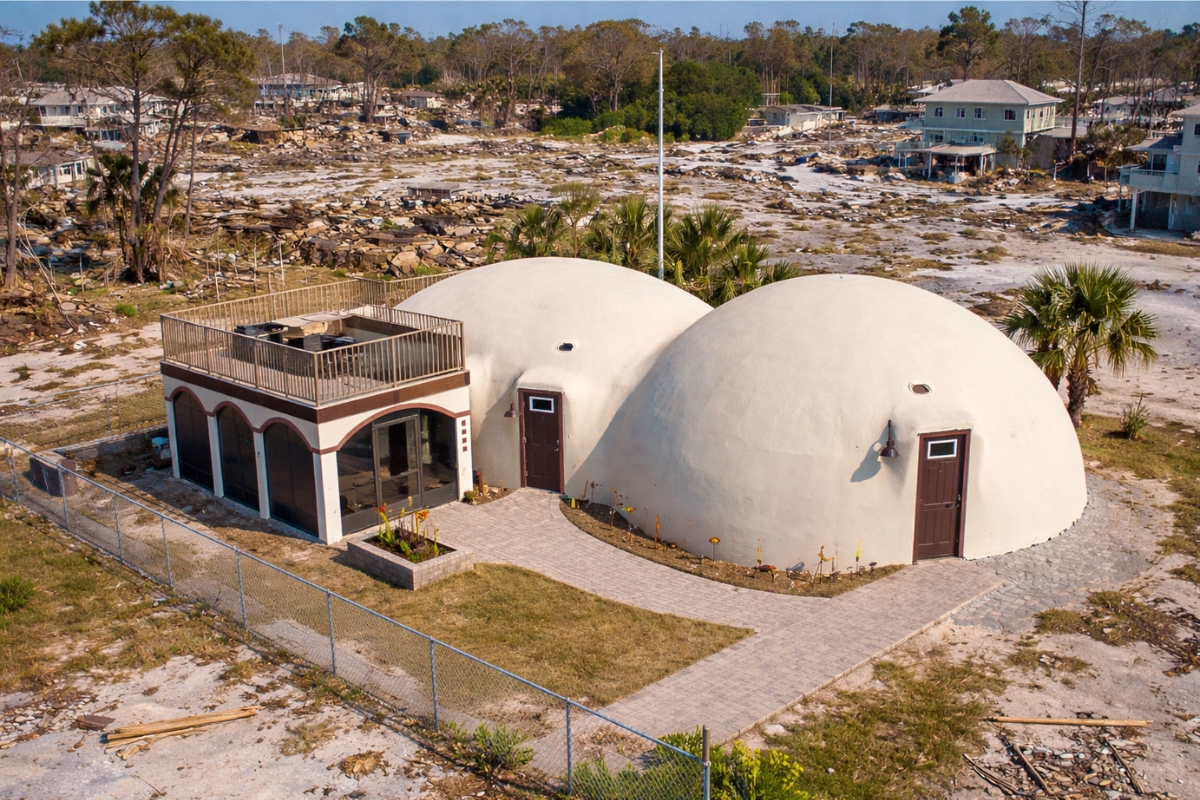
In Mexico Beach, Florida, Margaret Clayton built a dome-shaped house in 2015 capable of withstanding winds of up to 160 mph, and during Hurricane Michael in 2018, the structure remained intact, surprising experts and residents amid mass destruction all around.
In 2018, Hurricane Michael made history by becoming the first Category 5 hurricane to hit the Florida Panhandle. Winds reached 160 mph, about 260 km/h, and the scene was devastating.
Whole buildings were ripped from their foundations. Nearly 50,000 structures suffered direct impact. Entire neighborhoods became unrecognizable.
But amidst the chaos, one construction caught attention. A rounded house, similar to an elongated dome, remained practically intact while neighboring properties simply disappeared.
-
Friends have been building a small “town” for 30 years to grow old together, with compact houses, a common area, nature surrounding it, and a collective life project designed for friendship, coexistence, and simplicity.

-
This small town in Germany created its own currency 24 years ago, today it circulates millions per year, is accepted in over 300 stores, and the German government allowed all of this to happen under one condition.

-
Curitiba is shrinking and is expected to lose 97,000 residents by 2050, while inland cities in Paraná such as Sarandi, Araucária, and Toledo are experiencing accelerated growth that is changing the entire state’s map.

-
Tourists were poisoned on Everest in a million-dollar fraud scheme involving helicopters that diverted over $19 million and shocked international authorities.


What Happened in Mexico Beach and Why the Golden Eye House Became a Highlight
The residence known as Golden Eye belongs to Margaret Clayton and was designed in 2015 with the company Monolithic Domes.
While the house next door “exploded” with the impact of the wind, launching even a transformer against the wall of Golden Eye, the structure resisted.
The contrast was striking. Destroyed or uninhabitable houses all around and a dome practically intact in the center of the devastation.
Aerial images of the neighborhood reinforced the visual impact. The structural difference became evident and sparked debate about hurricane-resistant architecture.

Why Round Houses Handle Extreme Winds Better
Experts explain that the circular shape is more aerodynamic. Unlike traditional houses with corners and flat roofs, the dome allows the wind to circulate around the structure.
With less frontal resistance, external pressure decreases. Wind energy is distributed more evenly, regardless of the gust direction.
Companies like Deltec have been betting on this concept for over three decades. According to records from the company itself, of the 5,500 rounded houses built, only one suffered significant damage from strong winds.
These constructions have already faced historic hurricanes such as Hurricane Katrina, Hurricane Irma, Hurricane Dorian, and more recently Hurricane Milton.
The result caught attention: dozens of homeowners reported not suffering structural damage even after severe storms.

Engineering, Materials, and Numbers That Explain the Resistance
Deltec has developed models designed to withstand winds of up to 190 mph, equivalent to 307 km/h.
The houses utilize Southern yellow pine, wood considered more resistant than other common materials in construction, like Douglas fir. Additionally, manufacturing occurs in a controlled environment, which increases structural quality standards.
Costs vary. The base structure, called shell, represents about one-third of the total house cost. Prices start at $45,900 for a model of 517 square feet and can reach $132,500 for versions with 2,066 square feet.
The Monolithic domes are built with concrete and steel. The technique includes an inflatable membrane, closed-cell foam application, and layers of shotcrete. According to company representatives, initial costs may be similar to those of a traditional customized house, but maintenance, insurance, and energy efficiency can lead to long-term savings.
Hurricanes Getting More Intense and the Adaptation Challenge
In the United States, hurricanes are the extreme weather event that causes the most deaths and damages.
Since 1980, the country has recorded 363 billion-dollar weather disasters. Hurricanes account for over $1.3 trillion in damages, averaging $22.8 billion per event and 6,890 deaths by 2023.
And the events continue. In 2024, Hurricane Helene left 780,000 people without power, while Hurricane Milton caused flooding, torrential rains, and billions in damages.
Experts warn that storms are becoming more intense due to climate change. Even Category 1 hurricanes can now generate severe destruction.
The Detail That Many Ignore: Water Can Be More Dangerous Than the Wind
Although the rounded shape helps against extreme winds, the biggest risk during hurricanes tends to be water.
Flooding and storm surges are the leading causes of death. A house built at ground level can be destroyed by flooding, regardless of its shape.
Therefore, properties in coastal areas like Florida, Louisiana, and Texas need to be elevated and have reinforced foundations.
Another crucial point is the integrity of the exterior structure. If there is an opening, the wind enters, increases internal pressure, and can tear off the roof.
Strict building codes make a difference. Florida has some of the most stringent regulations in the United States, and houses that followed those standards showed greater resistance even outside the state.
What Explains the Low Adoption of Dome-Shaped Houses
If the technology exists, why isn’t it standard?
Experts point to two main factors: culture and cost. Most people are used to the traditional rectangular house model.
Moreover, financing can be a challenge. Banks do not always offer credit easily for unconventional constructions.
From a technical perspective, engineering already allows for the creation of highly resistant properties. The central issue is how much it costs and who can afford it.
The case of Golden Eye shows that it is possible to withstand winds of 160 mph with minimal damage. In a scenario of climate change and increasingly frequent extreme events, this type of architecture draws attention and may indicate a path for the future of construction in vulnerable areas.
Would you live in a dome-shaped house to face hurricanes? Do you believe this model could be applied in Brazil? Share your opinion in the comments.










Seja o primeiro a reagir!