





 Portuguese
  English
  Spanish
  3 min of reading
  0 comments


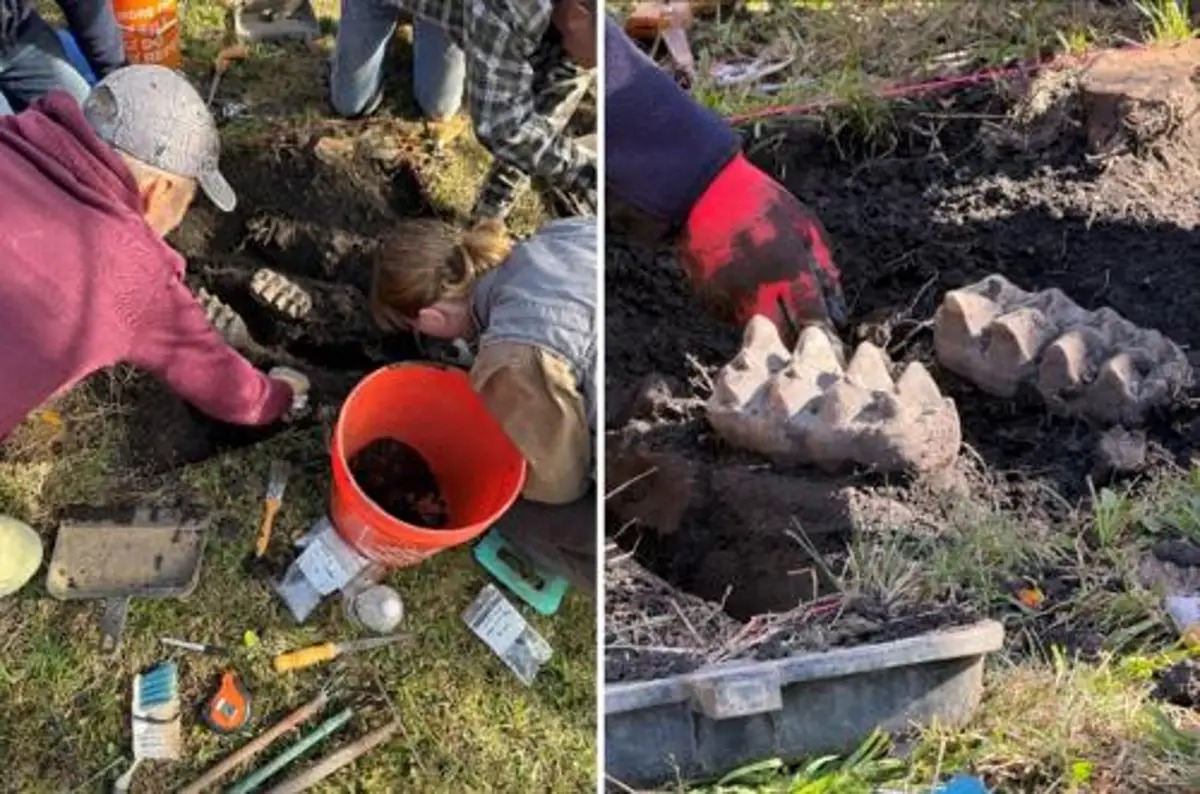
Discovery In A Couple’s Backyard In New York Reveals 13,000-Year-Old Mastodon Jaw And Drives New Paleontological Research In The State.
A couple had an unexpected surprise when they found giant teeth buried in their own backyard. What seemed to be just a stone turned out to be part of the jaw of a mastodon about 13,000 years old.
An unexpected discovery transformed the backyard of a couple in Scotchtown, New York into a true prehistoric site. In September 2024, two giant teeth emerging from the grass caught the attention of the locals.
At first, they thought it was a strange stone. But they were facing a relic of the Ice Age: the jaw of a mastodon about 13,000 years old.
-
Motorola launched the Signature with a gold seal from DxOMark, tying with the iPhone 17 Pro in camera performance, Snapdragon 8 Gen 5 that surpassed 3 million in benchmarks, and a zoom that impresses even at night.

-
Satellites reveal beneath the Sahara a giant river buried for thousands of kilometers: study shows that the largest hot desert on the planet was once traversed by a river system comparable to the largest on Earth.

-
Scientists have captured something never seen in space: newly born stars are creating gigantic rings of light a thousand times larger than the distance between the Earth and the Sun, and this changes everything we knew about stellar birth.

-
Geologists find traces of a continent that disappeared 155 million years ago after separating from Australia and reveal that it did not sink, but broke into fragments scattered across Southeast Asia.

An Encounter With The Past In Their Own Backyard
The couple decided to take the teeth to a specialist. They contacted Dr. Cory Harris, an archaeologist and head of the behavioral sciences department at SUNY Orange. Used to receiving rocks or items without archaeological value, he braced himself for yet another disappointment.
However, upon opening the cardboard box containing the yellowed teeth, his reaction was immediate. “I was wildly excited,” he told the New York Times. According to him, the thrill reignited the passion that led him to archaeology nearly three decades ago.
The teeth belonged to the well-preserved jaw of an adult mastodon. These animals, relatives of the woolly mammoth, lived in North America until about 10,000 years ago.
Excavation Reveals More Bones Of The Extinct Creature
Following the discovery, Dr. Harris contacted Dr. Robert Feranec, research director and collections manager at the New York State Museum. The two organized a careful excavation at the site.
In addition to the jaw, the team found fragments of a rib and a toe bone. “This mastodon jaw provides a unique opportunity to study the ecology of this magnificent species,” Feranec stated, who is dedicated to studying Ice Age ecosystems. According to him, every new fossil helps piece together the puzzle of the region’s history.
Region Is Already Known For Ice Age Fossils
Despite the surprise of the discovery, Orange County, where Scotchtown is located, has a rich history of fossil finds. It is estimated that over 150 mastodon fossils have been found throughout New York State. Approximately one-third of them came from this same region.
According to Dan Fisher, emeritus professor at the University of Michigan, mastodons arrived in the state about 14,500 years ago. They fed on vegetation such as pine and fir needles. However, the swampy areas that sustained them also served as natural traps. Many ended up stuck in these wet lands and died right there, which favored the preservation of their remains.
The newly discovered jaw will be sent to California, where it will undergo radiocarbon dating tests. The goal is to confirm the estimate of 13,000 years. The teeth will also be analyzed to identify traces of the animal’s diet and signs of its age at the time of death.
Public Exhibition Expected In 2025
The New York State Museum will preserve the fossils and conduct further studies. A public exhibition is scheduled for 2025. The discovery has already sparked great interest from scientists and the public alike.
“This discovery highlights the museum’s unwavering mission to drive vital scientific research,” stated Michael Mastroianni, the museum’s interim deputy commissioner for cultural education. For Dr. Feranec, this is concrete proof of New York State’s rich paleontological history.
Despite the excitement, Dr. Harris still does not have full access to the site. The mastodon’s remains are close to the surface, but he will only be able to continue work if the homeowners allow it. “I would need a lot of energy not to dig in my own backyard if I knew there was a mastodon right there,” he said, humorously.
Meanwhile, the locals are celebrating the find. In a statement, they expressed their excitement at contributing to science. “I am thrilled that our property has provided such an important discovery for the scientific community.”








Seja o primeiro a reagir!