





 Portuguese
  English
  Spanish
  9 min of reading
  0 comments


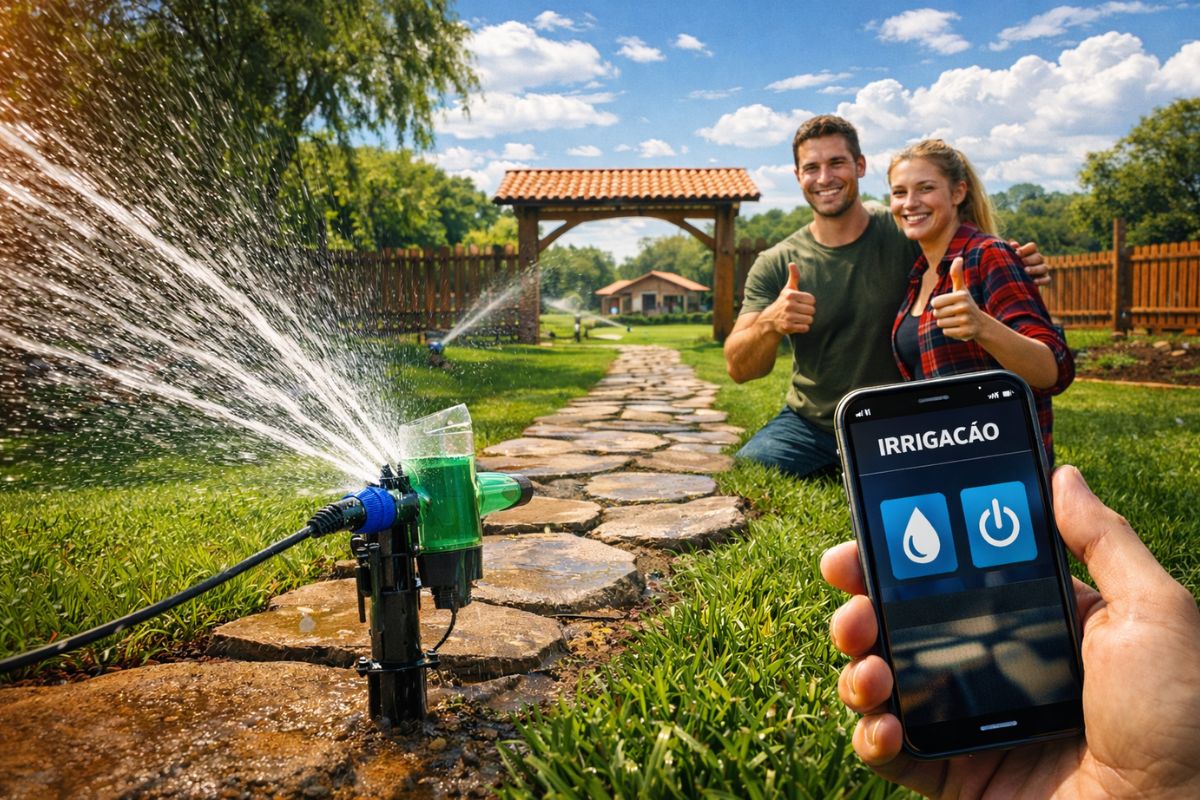
The Couple Shows How They Reorganized the Entrance of the Property with a Stone Path, Grass Plots, Rainwater Reuse, and an Automatic Irrigation System Made with Simple, Cheap Parts and Smartphone Control.
The couple decided to change the appearance of the property’s entrance without waiting for the end of the construction to start beautifying the outdoor area. Instead of leaving the access filled with exposed soil, mud, and an improvised look, they took advantage of the rainy season, the leveling already done by the tractor, and the materials they had available to create a stone path and start the lawn in strategic spots.
Throughout the process, the couple also solved an important maintenance challenge: how to keep the grass always watered without depending on manually turning the water on and off every day. The solution they found combined a cistern, automation, a washing machine solenoid, a smart switch with Wi-Fi, and smartphone control. The result merges aesthetics, functionality, and creativity in a project designed for the actual routine of the property.
Couple Took Advantage of the Construction Phase to Enhance the Entrance
Right at the beginning of the video, the couple makes it clear that the idea was to prove that a construction doesn’t have to remain ugly all the time. Even with the structure still in progress, they decided to view the property’s entrance as an area that could already begin to receive finishing touches and visual organization.
-
New CCR concrete paving technology promises roads up to 3x more durable, less maintenance, and cost reduction in Brazil.

-
Made from recycled plastic, plastic wood is gaining space in the construction industry because it does not rot, resists moisture, and reduces maintenance costs over the years.

-
Florianópolis will receive a million-dollar BRT that will begin construction in 2026 with nearly 400 million in funding from the federal government and the Inter-American Development Bank, and the map already shows the routes for the exclusive bus corridors.

-
Without a blueprint, without an engineer, and using scrap from the dump, a father spends 15 years building an 18-room castle for his daughter, featuring tram tracks, 13 fireplaces, and over 700 m², which may now be demolished.

This choice made sense for two reasons. First, the tractor had already completed the necessary leveling of the road. Second, the weather was favorable, with moist soil and good conditions for laying grass.
Instead of postponing landscaping to an indefinite future, the couple seized the right moment in the construction to also advance the aesthetic side.
This point is interesting because it demonstrates a very common practical logic in properties and farms: when the base of the land is ready, small interventions can significantly change the perception of the space.
Stone Path Was Designed for Real Use by Cars and Pickup Trucks
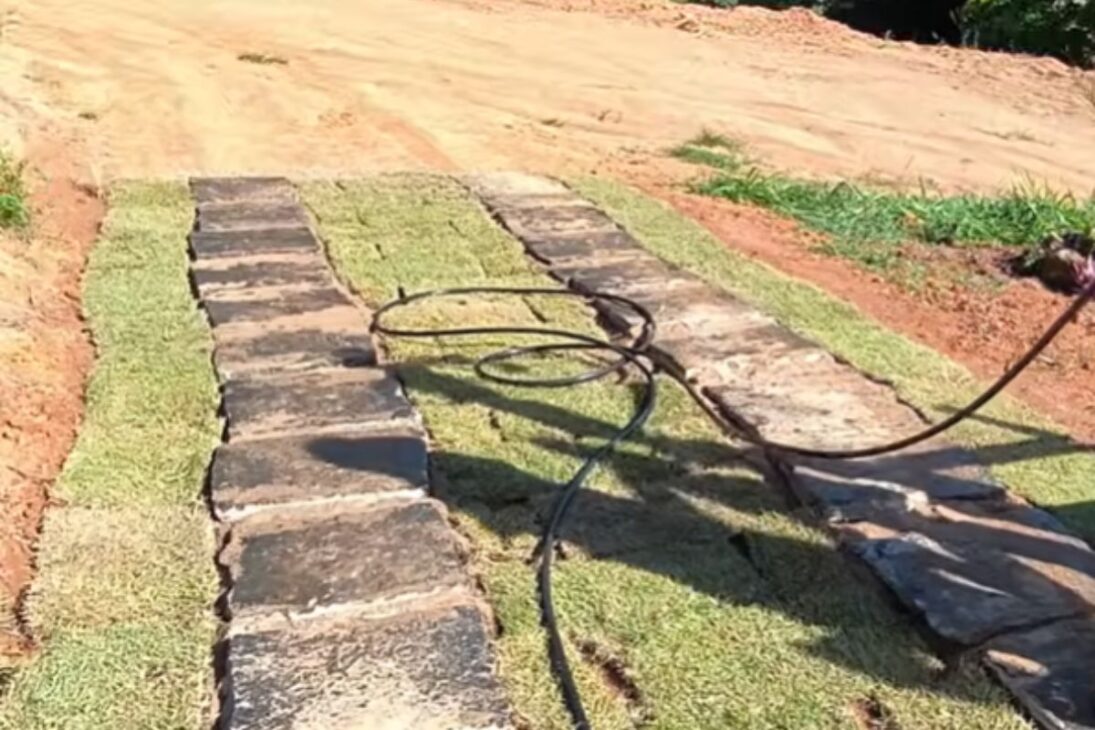
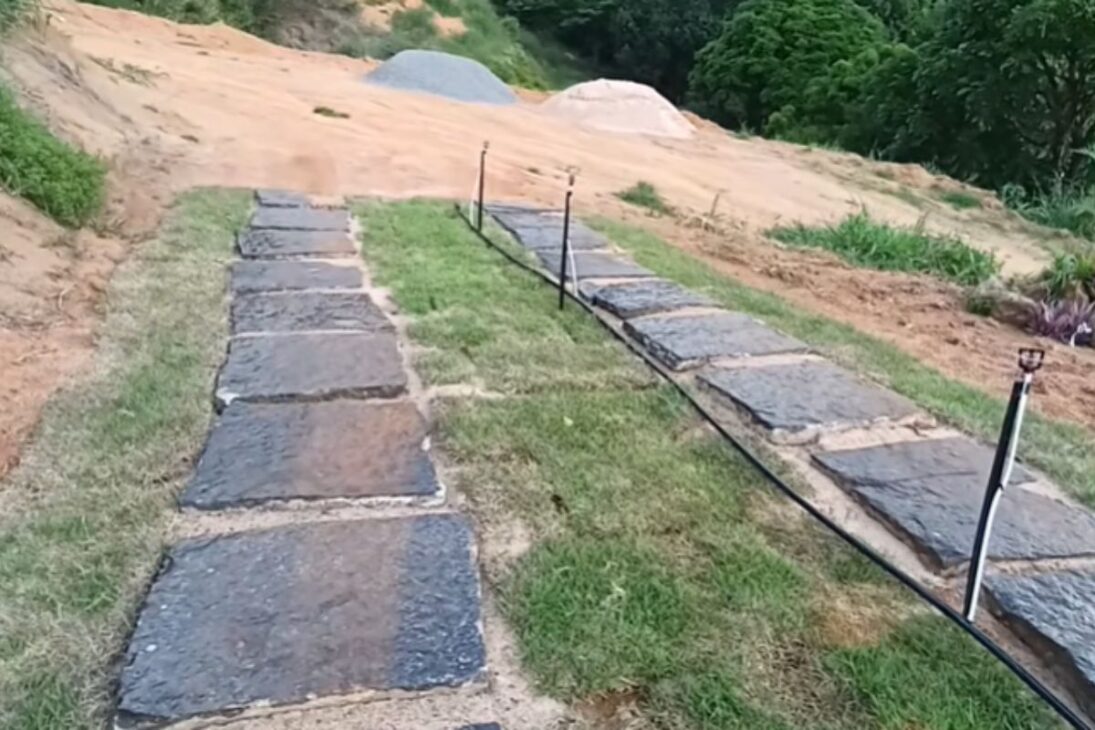
The first major intervention made by the couple was creating a stone path from the gate to the interior of the property. The aim was not just to decorate, but to allow cleaner and more functional circulation, especially during rainy periods.
The stones were placed with a calculated spacing to accommodate two types of vehicles. The pickup truck would drive along one edge of the path, while smaller cars could move further inside.
This care shows that the project was not improvised merely for appearance. The couple considered the daily use of the entrance, the necessary width, and the practicality for anyone arriving or leaving with a vehicle.
They also left a section just after the gate with enough space for a car to stop on the stones, allowing someone to get out, open the gate, and avoid stepping in the mud. This simple detail reinforces how the project was built around daily routines.
Couple Used About 80 Stones and Even Reused Broken Pieces
According to the report, the couple had about 80 stones to start the path. Since they were not exactly sure how far the material would go, the plan was to use what was available and then assess how to complete the rest of the entrance.
Even the broken stones were considered useful. Instead of discarding this material, they opted to repurpose it in parts of the composition, which helps reduce waste and maintain visual coherence at the access point.
This choice illustrates a type of creativity very present in property work, where the intelligent use of what already exists makes a difference in cost and results.
In addition to the stones, sand was used for the bedding. This leveling was necessary to ensure the pieces did not appear uneven or unstable, which could cause breakage when vehicles passed over them.
Grass Was Laid Next to Take Advantage of the Moist Soil
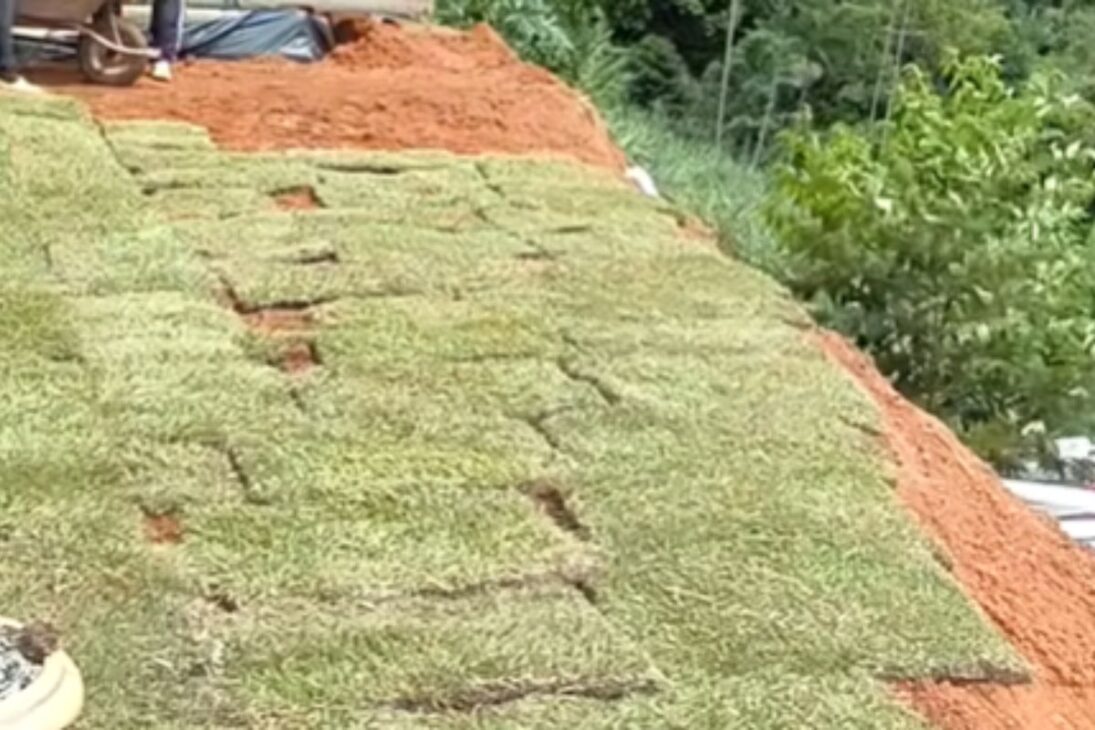
After the stone path, the couple proceeded to install the grass plots. The decision to do this right afterward had a practical reason: the soil was still moist, the weather was favorable, and the grass came pre-fertilized, which favored its rooting.
The installation began in a fill area at the back, where they wanted to achieve a tidy appearance quickly. Later, the rest was moved to the front, at the entrance area.
The couple understood that the grass couldn’t remain uninstalled for long, so the execution followed a priority and opportunity logic.
This care is important because it demonstrates how landscaping also depends on timing. It’s not enough to buy the grass. It must be laid at the right moment for it to truly thrive.
Couple Combined Stones and Grass to Balance Aesthetics and Circulation
One of the most interesting points of the project is precisely the combination of the stone path and the lawn. The couple did not try to cover the entire entrance with a single material. Instead, they distributed the functions: the stones were responsible for the passage of vehicles while the grass helped soften the look and integrate the access with the property environment.
This solution makes the entrance feel more natural and less harsh than it would be with just concrete, gravel, or exposed soil. At the same time, it prevents the grass alone from suffering excessive wear from traffic. The balance between circulation and landscaping is one of the main qualities of the transformation made by the couple.
It also became clear that not all areas were resolved at once. In some sections, they still intend to test other types of plants to understand if the grass will truly work or if another landscaping treatment will be necessary.
Rainwater Was Used in the Irrigation System
In the irrigation phase, the couple showed that the water used on the lawn comes from the cistern installed at a higher point on the property. This creates a more economical solution that is more aligned with the logic of a property, where the reuse of available resources makes a significant difference.
From this cistern, a new problem arose: how to know from a distance when the water barrel in the garden was full or empty. To solve this, Magno improvised a visual system using a lightweight pipe with Styrofoam inside and colored markings.
As the water rises or falls, the tube moves and indicates the water level even for those further away. The couple transformed a monitoring problem into a simple, cheap, and functional solution.
This part of the project reveals the spirit of the work well: it’s not just about buying ready-made equipment, but about adapting feasible solutions to the reality of the property.
Couple Created Automation with Simple and Low-Cost Parts
The most creative part of the project appears when the couple explains the irrigation automation system. For the main lawn area, they used a smart switch with Wi-Fi and a solenoid, a part typically used in washing machines.
The functionality is straightforward. The smart switch can be activated by smartphone or a virtual assistant and controls the opening of the solenoid, which releases or blocks the flow of water.
The cost, according to the report, is quite affordable: both the solenoid and the switch are priced between R$ 30 and R$ 40. In other words, the couple built an automatic irrigation system with simple and relatively cheap parts, without relying on a sophisticated and expensive kit.
The installation was protected with plastic to avoid direct contact with rain and splashes from the irrigation itself, showing a concern for increasing the system’s durability.
Irrigation Was Adjusted According to Each Area of the Property
The couple did not treat all areas the same way. In the lawn of the gourmet space, for example, there was a particularity: a tarp was placed underneath to prevent soil saturation with rain. This required shorter and more controlled irrigation to avoid too much water accumulation.
At this point, the programming was set for shorter times, precisely to preserve the grass without excess moisture.
At the gate, where this tarp does not exist, the system was adjusted to operate for longer, with daily irrigation of about 20 minutes at 5 PM.
The couple showed that automation does not just mean automatically turning on water, but adapting time and volume according to the real need of each area.
This type of adjustment is what makes the system more efficient. Instead of a one-size-fits-all rule for the entire property, the irrigation now responds to the specific characteristics of each section of the lawn.
Smartphone Became the Central Tool for Controlling Irrigation
One of the most practical points of the project is remote control. The couple can monitor and activate the system via smartphone, even interrupting irrigation when they observe through the cameras that the rain is strong enough that day.
This prevents water waste and helps keep the soil under control. In the case of the lawn near the gourmet area, where there’s a tarp beneath the soil, this precaution is even more critical to avoid over-saturating the base.
The automation created by the couple serves not only to facilitate daily routines but also to provide more precision in water management.
In practice, this means less manual work, fewer forgettings, and a quicker response to changes in the weather.
Results Were Visible in Just Fifteen Days


On the day the video was recorded, the couple reported that fifteen days had already passed since the installation of the grass plots, both in front of the gourmet space and at the entrance of the gate.
In this short period, the lawn was already looking quite green and beginning to fill in the gaps between the plots.
This indicates that the combination of moist soil, quick installation, and programmed irrigation worked well. In some areas, the grass was already growing enough to suggest future removal of seedlings for planting in other parts of the property.
The couple achieved quick visual results by combining timely execution with an irrigation system consistent with the terrain.
This kind of rapid response adds even more value to the project because it demonstrates that the intervention was not only creative but also efficient.
Couple Took Advantage of the Momentum to Organize Other Details of the Surroundings
In addition to the stone path and the lawn, the couple also showcased an arrangement with tires at one end of the lawn, utilizing help from Érica’s mother to better compose the space.
This reinforces the idea that the transformation of the entrance was not limited to circulation but also extended to decorative and finishing elements.
Another interesting detail is that the same type of automation used in irrigation was also applied to the electrical connection of lamps shown in previous videos.
According to them, the old solution with the virtual assistant was not working well, and the new system delivered more practicality. The couple used the entrance project as an extension of a larger logic of automation and functional improvement of the property.
Entrance of the Property Became More Beautiful Without Losing Practicality
Ultimately, the project shows that the couple did not aim just to beautify the property. The proposal was to improve the entrance practically, considering mud, vehicle passage, grass rooting, rainwater reuse, and ease of maintenance on a daily basis.
The stone path brought firmness for circulation, the lawn softened the look, and the automatic irrigation solved a problem that could require much manual labor. The transformation of the entrance happened because the couple managed to combine landscaping, creativity, and simple operational solutions.
This type of result stands out precisely because it seems possible to reproduce. There is no inaccessible project there, but a sequence of practical decisions, simple materials, and adaptation to what the terrain provided.
In your opinion, did the couple do better with the stone path or the automatic irrigation system that can be controlled by smartphone?







-

-

-

8 pessoas reagiram a isso.