





 Portuguese
  English
  Spanish
  5 min of reading
  0 comments


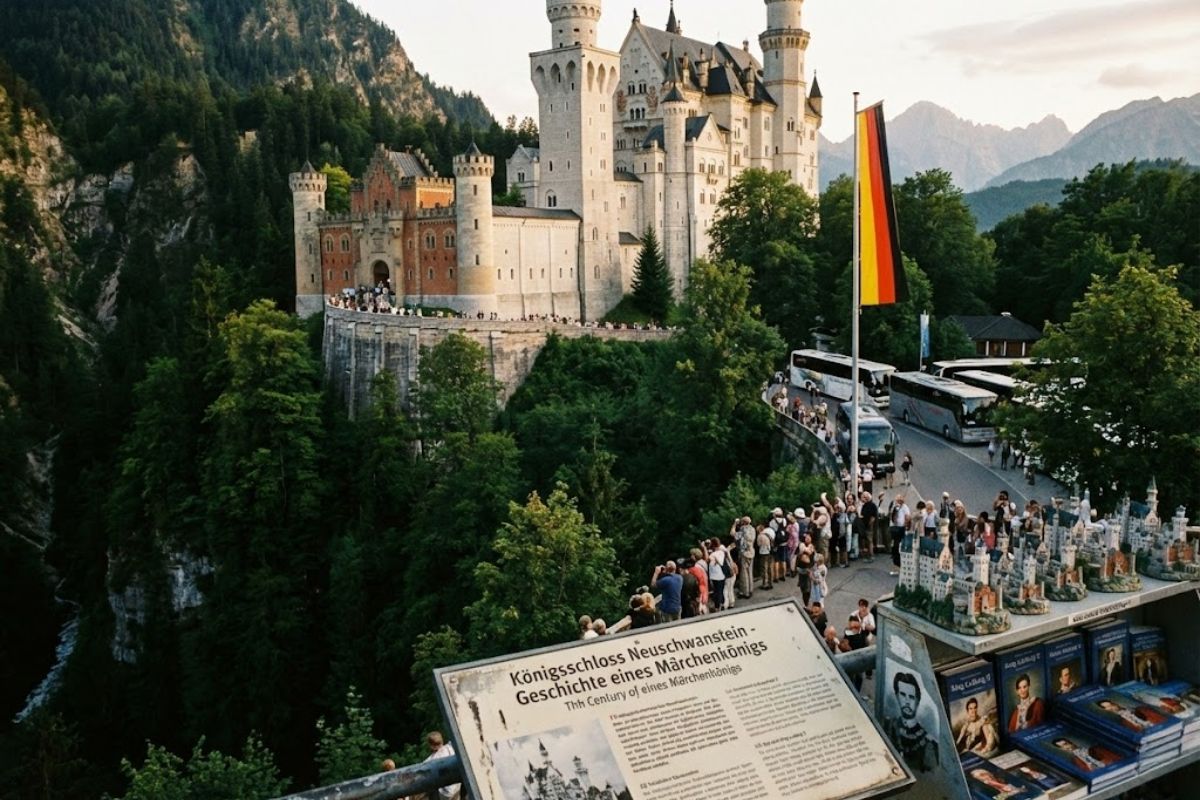
Erected As A Fairy Tale Castle On An Extreme Slope Of Bavaria, Neuschwanstein Condenses The Aesthetic Obsession Of King Ludwig II, The Growing Isolation Of The Monarch, The Border Between Genius And Kitsch And The Posthumous Transformation Into The Central Attraction Of German Tourist Identity In The Collective Imagination Of Contemporary Germany
Between 1845 and 1886, a period that marks the life of King Ludwig II of Bavaria, the construction of a fairy tale castle on a steep cliff crystallized the monarch’s attempt to escape the concrete pressures of royalty and take refuge in a carefully designed fantasy. The building came to symbolize, even at its inception, the distance between the actual exercise of power and the desire for a parallel world, controlled down to the last detail by an increasingly introspective sovereign.
Neuschwanstein was envisioned as a private refuge carved in stone, inspired by German folklore legends and the works of Richard Wagner, and eventually became the ultimate symbol of tourist Germany, condensing in the same structure architectural genius, kitsch extravagance, and the foreshadowing of the tragic fate of its creator, whose life and death between 1845 and 1886 remain linked to the castle.
The Vision Of Ludwig II And The Project Of A World In Flight

King Ludwig II of Bavaria conceived Neuschwanstein not as a seat of government, but as an absolute refuge from political reality.
-
Rigid bags with their days numbered: new trend prioritizes comfort in 2026.

-
YouTuber creates an excavator equipped with a giant 4.5-meter sword to challenge his brother to a rematch, and the invention quickly goes viral on social media.

-
The U.S. Army surprises the world by presenting the UH-60MX Black Hawk helicopter capable of flying without pilots, controlled by a tablet, featuring the MATRIX system, smart sensors, and full autonomy in real combat and rescue missions.

-
Heineken’s factory in Brazil produces 300 million beer cans in just 4 months, reaches 1 million hectoliters, received R$ 2.5 billion, and is already projecting an annual capacity of 5 million with sustainable technology.


The aim was not to reinforce the monarchy in the public sphere, but rather to construct, on a monumental scale, a personal fantasy that would distance him from the conflicts, pressures, and commitments of power.
Each environment, each room, and each decorative solution responded to this logic of escape.
The residence was designed as a closed, self-referential world, where the monarch could move within his own narrative, fed by Germanic myths and the operatic world of Richard Wagner.
The fairy tale castle thus became less a palace and more a permanent setting for the king’s imagination.
A Fairy Tale Castle Carved Into A Steep Cliff

The decision to erect a fairy tale castle on top of a steep mountain in Bavaria was already a radical gesture in itself.
The physical implantation, on a cliff with difficult access, reinforced the character of isolation desired by Ludwig II, while also requiring complex engineering and constant adjustments from the project’s overseers.
The architects faced a permanent technical challenge, forced to successively alter plans and structural solutions to meet the king’s demands.
Nothing advanced without the monarch’s personal approval, who reviewed details and directly interfered in the conception of environments, facades, and ornaments.
The result was a highly detailed construction, consciously historicized, that combines idealized medieval references with an aesthetic repertoire filtered through the sensibility of the 19th century.
The very extreme topography enhanced the visual effect.
Erected on a cliff, Neuschwanstein functions as a condensed image of power, isolation, and fantasy, reinforcing the notion that the castle exists more to be contemplated than to integrate into the daily life of a court or a political capital.
Between Architectural Genius And Kitsch Extravagance
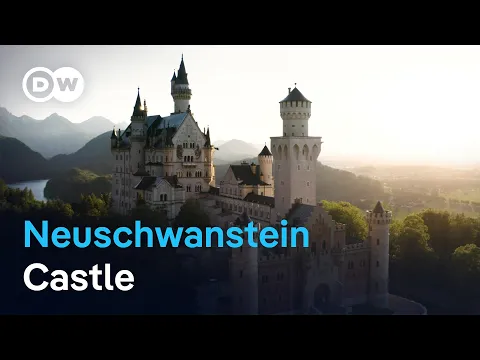

Neuschwanstein is often described as a paradox between architectural feat and decorative excess.
While the structure and implantation reveal a sophisticated mastery of technique and planning, the treatment of forms, volumes, and interiors brings the castle closer to an imaginary that many consider kitsch, laden with idealizations and a late romanticism.
This ambiguity is central to the reading of the building.
The fairy tale castle was consciously designed to appear older than it really is, operating as a kind of staged medievalism, in which History is rewritten to satisfy the aesthetic and emotional expectations of Ludwig II.
The deliberate historicization transforms architecture into a stage and the landscape into a set, dissolving boundaries between reality and representation.
At the same time, this combination of technical rigor and ornamental excess contributed to making Neuschwanstein a symbol of German identity.
The building crystallizes, in stone, a set of founding myths, images of heroism, and folklore narratives that helped establish, in the collective imagination, a certain idea of romantic, mountainous, musical Germany that is deeply connected to its legends.
The Progressive Isolation Of The Monarch And The Weight Of The Castle Itself
As the project advanced, Ludwig II of Bavaria isolated himself more and more.
The castle, conceived as a refuge, began to function as a mirror of the king’s physical and psychological distancing, who sought in architecture a way to control what he could no longer manage in the political arena.
Neuschwanstein condensed this retraction process.
The obsessive control over plans, decorative details, and design decisions widened the distance between the monarch and the outside world.
The fairy tale castle, which was meant to guarantee protection and symbolic comfort, ended up reinforcing a cycle of isolation, in which the sovereign closed himself off in his own universe, while the reality of the monarchy transformed around him.
Tragic Fate Of Ludwig II And Permanent Legacy Of Neuschwanstein
The biography of Ludwig II, marked by the years 1845 to 1886, is inseparably linked to Neuschwanstein.
The image of the “fairy tale king” became attached to the castle, which came to be read as a material monument of a tragic fate and an extreme relationship between power, art, and escape from reality.
After the monarch’s death, the building ceased to be merely a private refuge to become the ultimate icon of tourist Germany, attracting interested gazes both in its aesthetics and in the history of excess, isolation, and rupture that originated it.
The fairy tale castle continued to operate as a symbol, now less of Ludwig II’s sovereignty and more of the capacity of an architectural project to shape the imagination of an entire country.
The legacy of Neuschwanstein remains anchored in this contrast: on one side, the genius of a project that dominates a cliff and synthesizes national myths; on the other, the perception that grand dreams may carry the contours of an irreversible escape from the tensions of the real world.
For you, does the fairy tale castle of Neuschwanstein represent another work of artistic genius or a warning about the risks of turning fantasy into the sole strategy of power?








-

Uma pessoa reagiu a isso.