





 Portuguese
  English
  Spanish
  3 min of reading
  7 comments


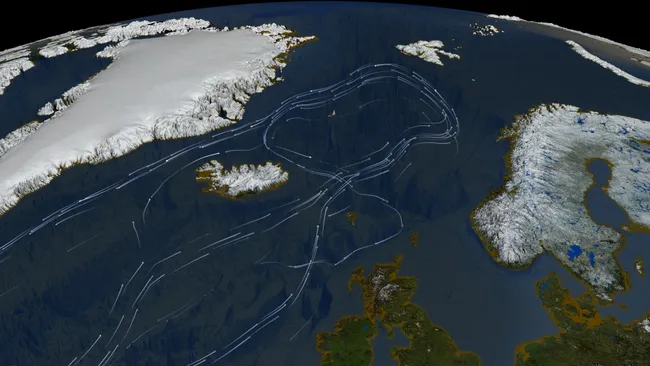


Discover the Amazing Waterfall of the Strait of Denmark, a Giant and Unique Submarine Waterfall, Very Different from the Ones We Know on Land.
The largest waterfall in the world cannot be seen with the naked eye. Hidden beneath the icy waters of the Strait of Denmark, between Iceland and Greenland, this underwater formation surprises with its grandeur and environmental impact.
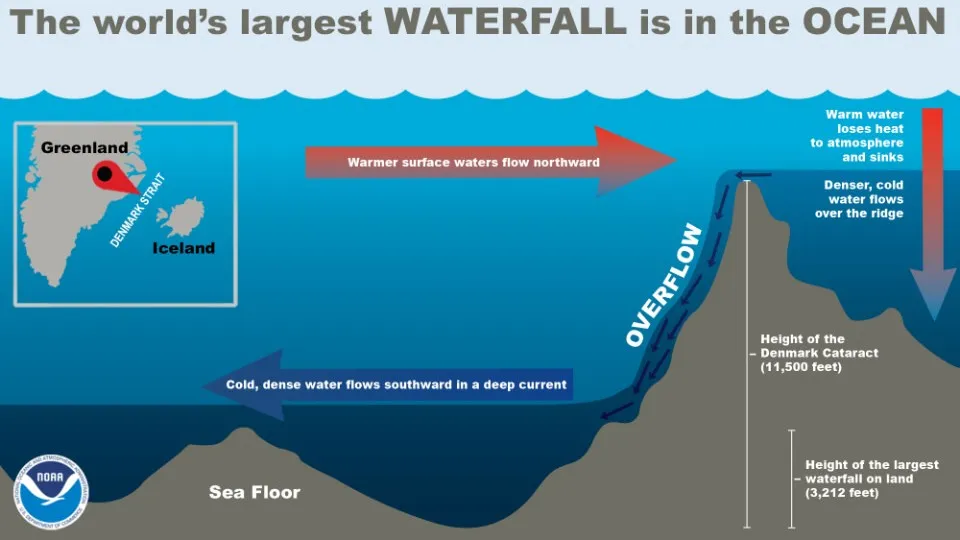
Its waters fall 11,500 feet (3.51 km), making it the highest ever recorded, even though its presence is completely invisible at the surface.
A Submerged Giant
With a main drop of about 6,600 feet (approx. 2 km), the waterfall of the Strait of Denmark is twice as high as Angel Falls in Venezuela, the tallest waterfall on land.
-
While the world looks at oil, the war with Iran is already disrupting helium supply from Qatar, affecting car and iPhone chips, threatening AI expansion, and putting pressure on aluminum packaging at the highest value in four years.

-
Global warming will expose a treasure hidden under the ice of Antarctica and may spark an international dispute over gold and valuable minerals.

-
A street vendor from Praia Grande built a robot made of scrap from scooters and washing machines that pulls his popcorn cart on the beach, emits sounds, and interacts with customers, becoming an attraction on the coast of São Paulo.

-
The specifications of the Xiaomi 18 Pro Max have been leaked, and the highlight is a dual 200 MP camera with a new 22-nanometer technology that promises to consume less energy and capture details in shadows and bright areas using LOFIC HDR.


However, it does not have the same visual impact. Being submerged, the waters flow slowly, at a speed of 1.6 feet per second (0.5 meters per second). This rate is well below the 100 feet per second (30.5 m/s) of the famous Niagara Falls.
Historical Formation and Unique Characteristics
The formation of the waterfall dates back to the last Ice Age, between 17,500 and 11,500 years ago, when glaciers sculpted the seafloor landscape.
It crosses the Arctic Circle, channeling waters from the seas of Greenland, Norway, and Iceland into the Irminger Sea in the North Atlantic. This process is crucial for thermohaline circulation, a global system of ocean currents that helps regulate the planet’s climate.
The waters north of the waterfall reach about 1,300 feet (0.4 km) in depth, but only the lower 660 feet (200 meters) flow in the cascade.
The upper layer remains at the surface and mixes with currents that flow northward. After exiting the Strait of Denmark, the waters of the lower layer head south, reaching Antarctica.
The Invisible Below the Waves
Despite its magnitude, the waterfall of the Strait of Denmark is completely invisible at the surface. Anna Sanchez Vidal, a marine sciences professor at the University of Barcelona, led an expedition to the region in 2023 and highlighted that, above the waters, the conditions are typical of the Arctic.
Only through measurements of temperature and salinity is it possible to detect the presence of the waterfall.
With about 480 kilometers wide and extending 500 to 600 kilometers along the seafloor, its colossal structure contrasts with its invisibility to those observing from above.
A Comparison with Other Submarine Waterfalls
The waterfall of the Strait of Denmark is not alone. Mike Clare, a specialist in marine geosystems at the National Oceanography Centre in the UK, explains that there are other known underwater cascades, although none compare to it in size.
Some formations called “knickpoints” have similarities to terrestrial waterfalls, but are small compared to the submerged giant.
The vastness of the waterfall of the Strait of Denmark highlights the hidden wonders at the ocean floor that, although invisible, play crucial roles in the environmental and climatic balance of the planet.








Que **** de notícia,aff,oque tem a ver uma cachoeira submersa,sem nexo totalmente essa matéria!
Como pode alguém chegar a tal nível de ignorância? É inconcebível que um artigo tão interessante, revelando uma das principais maravilhas escondidas nos oceanos, seja rejeitado com tal desprezo e indiferença. A Catarata do Estreito da Dinamarca, uma entidade majestosa que desafia comparações com qualquer outra cachoeira, é rebateida com insensibilidade. Isso quebra qualquer sentido de respeito pela natureza e pela científica descoberta no interior de nossos mares, os verdadeiros exploradores da humanidade.
Cataratas??? É só o movimento das águas no fundo do oceano. Jornalismo desesperado.
Sim, poderia haver links pra se saber mais. Muito interessante a matéria e da próxima vez poderemos ter essa motivação desejada pela autora pra assinar e receber outras matérias…. Né?