





 Portuguese
  English
  Spanish
  5 min of reading
  3 comments


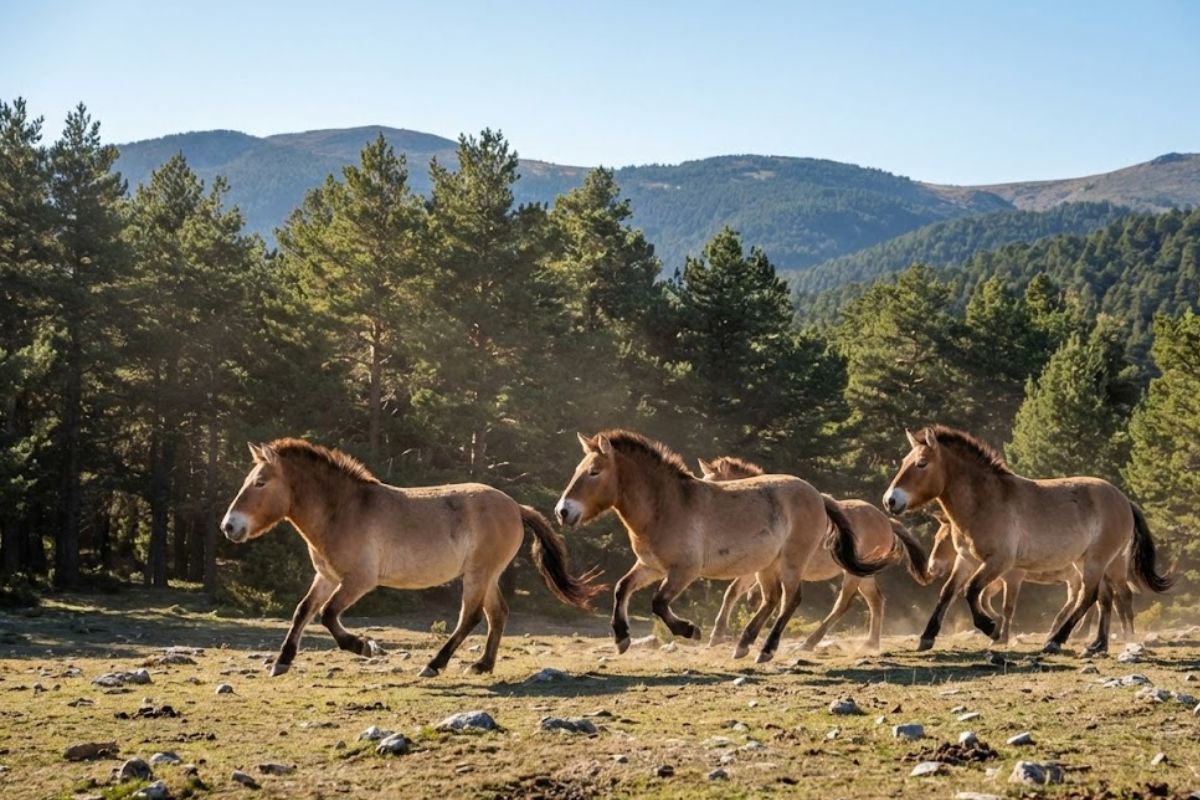


Wild Przewalski Horses Were Released in Alto Tajo Natural Park, in the Iberian Plateau, Spain, in a Protected Area with GPS Monitoring, Research, Conservation, and Ecological Recovery.
In the Iberian Plateau, in Spain, wild horses are back roaming freely in a protected area for the first time, in a release considered historic at Alto Tajo Natural Park. A herd of six Przewalski horses was released to restore the natural grazing that shaped the local ecosystem.
The wild horses have a direct and transformative mission: to open habitats, stimulate biodiversity, and help reduce the risk of devastating wildfires, while also reinforcing the conservation of a rare subspecies, with a global population estimated at around 2,000 individuals.
The release took place in Alto Tajo Natural Park, in Spain, within the restoration landscape of the Iberian Plateau.
-
NASA issues a warning for the feared Godzilla El Niño that could change the planet’s climate in 2026 with extreme warming of the Pacific capable of causing devastating droughts in some regions and historic floods in others simultaneously.

-
Archaeologists discover a 100-meter ship graveyard in a submerged Greek city, and what has appeared on the seabed of Libya could change what was known about this ancient port.

-
You buy the refrigerator and still have to see ads: Samsung starts displaying advertising on appliances and generates negative reactions among consumers.

-
What can really trigger large volcanic eruptions? Research suggests that gas returning to the magma may be more dangerous than gas escaping from it.




The released group consists of six individuals and marks the first time that natural grazing is actively promoted within a protected area of the Iberian Plateau.
Although the Rewilding Spain initiative has already introduced Przewalski horses at other points in the region since 2023, the step taken in Alto Tajo is described as a milestone, as it consolidates the return of large herbivores in a formal context of protection and conservation objectives of the park.
Who Are the Wild Przewalski Horses and Why Are They Different

Przewalski horses are described as the last truly wild horses in the world, known for their endurance and resilience.
The natural behavior of the group and their grazing patterns function as an ecological engine: as they move and feed, they reshape vegetation, create habitat mosaics, and favor a more dynamic landscape.
The release in the park also has a direct impact on the conservation of the subspecies.
With a global population of only about 2,000 individuals, each new suitable and monitored territory helps to strengthen the future of these wild horses, expanding security and knowledge about the species.
Where the Herd Was Released and What Kind of Landscape It Will Shape

The wild horses were released on the La Campana property, in the village of Checa, within the context of Alto Tajo Natural Park, in the Iberian Plateau, Spain.
The region is described as a territory of deep canyons, extensive pine forests, and some of the wildest terrain in the country, offering a combination of open areas and forested zones.
The La Campana property covers 1,000 hectares and was acquired by the regional government last year for conservation and research purposes.
The site was identified as ideal for thriving, with open pastures, shaded pine groves, and enough space for free movement, which is central for natural grazing to occur without relying on intensive management.
The Composition of the Herd and What GPS Will Reveal About the Wild Horses
The herd released in Alto Tajo consists of four females, one young male, and one adult stallion.
The group is being monitored by GPS, which allows for precise tracking of how the wild horses move, where they graze, which areas they use most frequently, and how their presence transforms the surrounding environment.
GPS monitoring is a key component of the project, as it connects the release to applied research.
The team involved has modernized the infrastructure of La Campana Farm and will continue studying the impact of the animals on the local landscape, reinforcing the goal of understanding, measuring, and adjusting ecological restoration actions.
Collaboration in Spain and the Logistics of Taking the Animals to Alto Tajo
The arrival of the wild horses is the result of collaboration between Rewilding Spain and the regional government of Castilla-La Mancha.
Prior to the release, there were months of careful observation and testing with other horses to confirm the suitability of the habitat, reducing risks and increasing chances of adaptation.
The animals traveled from France with the support of the TAKH Association, specialized in the conservation of the Przewalski horse and part of the European Ecological Reintroduction Network linked to Rewilding Europe.
The logistics and preliminary tests were treated as decisive steps, as the success of the reintroduction depends on environmental compatibility and a transition with minimal stress.
The Expected Ecological Effect in the Iberian Plateau: Biodiversity and Wildfires
The central ecological goal is to restore natural grazing, which historically shaped the ecosystem. By opening areas, creating clearings, and influencing vegetation structure, the wild horses tend to favor a greater diversity of microhabitats, which can enhance local biodiversity.
Another strategic point is the risk of wildfires.
The presence of wild horses reduces biomass in certain areas and alters the continuity of combustible material, which helps to decrease the likelihood of devastating events.
The proposal is not to “control” nature, but to reactivate natural processes that make the landscape more balanced and resilient.
An Already Rich Ecosystem and the Role of Large Herbivores in Alto Tajo
The La Campana property itself is described as a treasure of biodiversity, with mountain pine forests and species such as linden trees, ashes, holly, and yews.
In the sky, griffon vultures, Egyptian vultures, and golden eagles appear, while on the ground, there is a community of herbivores and mammals such as Iberian ibex, wild boars, fallow deer, red deer, and roe deer.
In this scenario, the return of natural large herbivores like the wild horses brings Alto Tajo closer to a “wilder future”, strengthening the set of ecological interactions that depend on grazing, movement, and natural disturbance of the landscape.
Nature Tourism and Local Economic Impact in Alto Tajo
In addition to the ecological impact, the introduction of wild horses is presented as an opportunity to boost nature tourism and generate economic reinforcement in a region that needs new sources of income.
Rare and charismatic animals tend to attract tourists and wildlife enthusiasts, increasing the visibility of Alto Tajo and the entire landscape of the Iberian Plateau.
The proposal includes working with local entrepreneurs and small businesses to create opportunities related to wildlife observation and ecosystem restoration, following a model already occurring in other areas of the Iberian Plateau.
Why the Iberian Plateau Makes Sense for Wild Horses Today
The Iberian Peninsula was once inhabited by wild horses with physical characteristics similar to those of Przewalski horses, as indicated by engravings and cave paintings, including Altamira.
These horses disappeared about 4,000 years ago, creating an ecological void that is now being discussed in the context of renaturalization.
With the significant decrease in the number of domestic animals in parts of the Iberian Plateau, Przewalski horses take on an ecological role similar to that of the extinct Iberian wild horse and what has been partially executed in recent periods by domestic herbivores.
Rewilding Spain also works with Spanish breeds of semi-wild horses in other regions and has already released herds of Tauro cattle to reinforce natural grazing.
Do you think the return of wild horses in protected parks should become a priority in other regions of Europe, or should this kind of reintroduction be more cautious and limited?







Si no es nativo no deberia llamarse reintroduccion/rewilding, si realmente no hay posibilidad de conseguir la raza nativa y estudios serios confirman que otra raza con caracteristicas iguales cumple con el vacio ambiental que dejó la especie desaparecida podria servir
NO SON caballos salvajes. La prestigiosa revista Nature ta publicó resultados genéticos desmintiendo está teoría. Sin caballos asilvestrados ( como los Mustang en EEUU ) Deberíamos plantearnos la cagada ecológica que estamos haciendo introduciendo está raza foránea cuando en España TENEMOS un caballo feral autóctono propio y primitivo y reconocido por Europa ( con menos de 400 ejemplares vivos) El asturcón, Potokka, caballo Losino…. No valoramos lo que tenemos, nada nuevo….
NO SON caballos salvajes, son caballos asilvestrados ( al igual que los Mustang en EEUU) . Hay estudios genéticos publicados en la prestigiosa revista Nature que corroboran que esta raza de caballos fue domesticada hace unos tres mil años ( probablemente por la cultura Botai en el Este de Europa).
Ecológicamente deberíamos plantearnos la cagada que estamos haciendo introduciendo una raza caballar doméstica y exógena a nuestros ecosistemas cuando en la península ibérica TENEMOS una raza de caballo primitiva y autóctona que no supera los 400 ejemplares y podríamos estar introduciendo en nuestros paisajes ya que es el verdadero heredero de estas tierras. El caballo Cantábrico Feral. Asturcón, Pottokas, caballo Losino….