





 Portuguese
  English
  Spanish
  8 min of reading
  12 comments


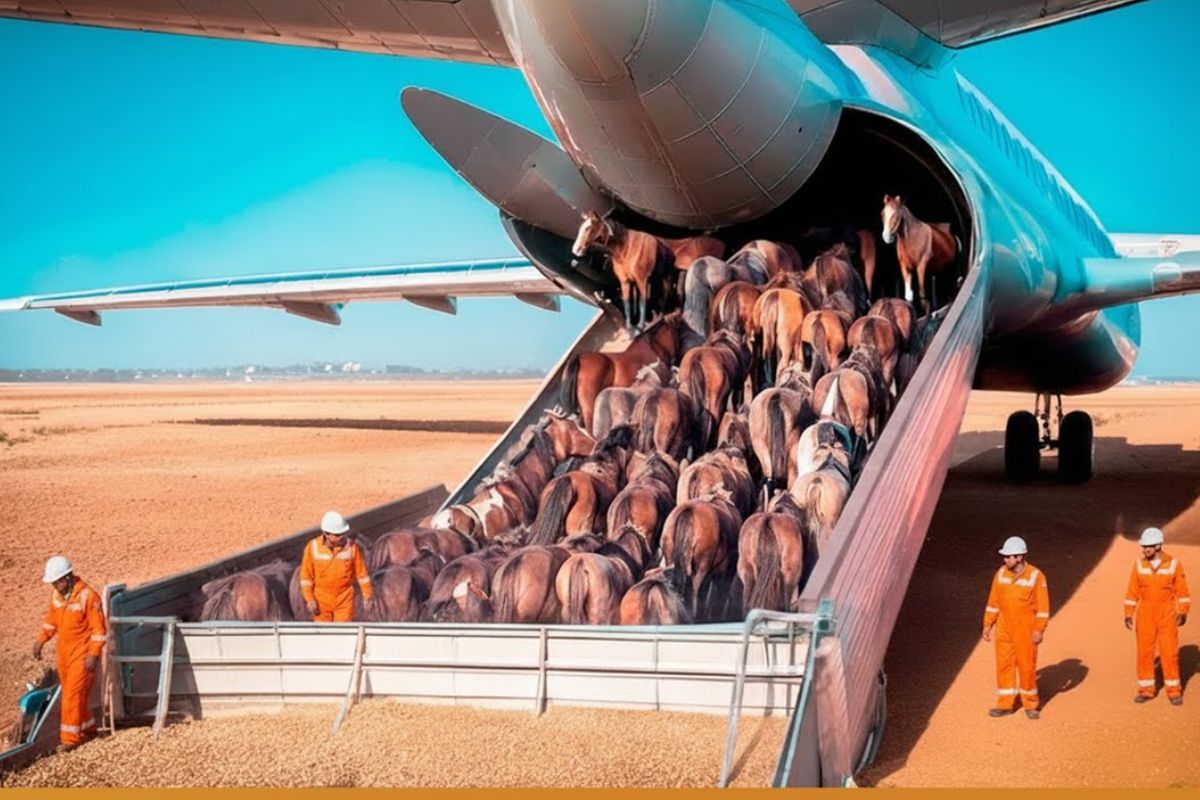


After Decades Of Desertification In Northern China And Xinjiang, Przewalski Wild Horses Returned To The Junggar Basin: Species Declared Extinct In The Wild After 1969. Reintroduced From 1986, They Move 5 To 15 Km Per Day, Reactivating The Soil, Dispersing Seeds And Accelerating Local Recovery.
The ecological erosion described in northern China and Xinjiang is not just an advance of sand: in three decades, more than 350,000 km² turned into continuous wounds of cracked land, invasive dunes, and dry rivers. To react, China planted 66 billion trees, but the loss of the living roots of the grasslands left the soil without biological support, and the wild horses returned to the center of the debate.
The turnaround begins with a species that was declared extinct in the wild. The Przewalski horse, the only truly wild horse that has never been domesticated, returns to the deserts of China in a process that combines genetics, management, and ecology: five years after reintroduction, the “regeneration machine” appears as a mobile force that reactivates the soil, spreads seeds, and confronts desertification where trees alone cannot solve.
Accelerated Desertification And The Limit Of 66 Billion Trees

The report describes a rapid transformation of the territory: in just three decades, more than 350,000 square kilometers of land in northern China and Xinjiang have turned into areas of cracked soil, advancing sand, and dried waterways.
-
A forgotten cord on the floor of a basement in Vienna leads a plumber to a box containing 30 kilograms of gold with Mozart’s face, hidden before World War II. The treasure, worth 2.3 million euros, was just centimeters away from a worker who ignored the sign a day earlier.

-
A couple buys an old chalet, breaks the kitchen floor for renovation, and finds over a thousand coins of gold and silver hidden since the English Civil War over 4 centuries ago.

-
Rigid bags with their days numbered: new trend prioritizes comfort in 2026.

-
YouTuber creates an excavator equipped with a giant 4.5-meter sword to challenge his brother to a rematch, and the invention quickly goes viral on social media.

The central point is not presented as isolated degradation, but as collapse of a living system that would have functioned with stability for thousands of years.
The state response comes at scale: China planted 66 billion trees to try to contain the advance of deserts.
Still, the diagnosis is that the roots of the grasslands had already disappeared and, to save an ecosystem, trees are not always sufficient.
The logic described is straightforward: trees remain stationary; in a desert, the lack of biological movement leaves the soil unreplenished.
Who Are The Przewalski Wild Horses And Why Do They Matter

The Przewalski horse is described as the only truly wild horse species on Earth, never domesticated.
Robust body, powerful legs, short and upright mane and alert eyes appear as a result of hundreds of thousands of years of evolution in the harsh climates of Central Asia.
There is a highlighted anatomical adaptation: dental structure and jaw muscles adjusted to low, dry, and nutrient-poor grasses, vegetation that modern livestock largely ignores.
This adaptation is presented as the reason why wild horses function as a “regeneration machine” in grasslands: it is not an ornamental metaphor, it is ecological function.
Movement In Fractal Pattern And The Grazing Pressure That Rebuilds The Soil

In the wild, herds continuously move in a pattern that ecologists describe as fractal pattern.
The result is repeated bands of grazing pressure at multiple scales, from a few meters to several kilometers.
The described mechanism has three main effects. First, horizontal grazing encourages grasses to regrow denser.
Second, this plant recomposition helps retain carbon in the soil more effectively than grazing by animals that pull plants out by the roots.
Third, movement creates mosaics that distribute pressure and allow for recovery, something critical in desert regions where the margin for error is minimal.
Manure, Urine And Microorganisms: The Layer That Technology Cannot Copy
The report states that the most critical link in the ecosystem is invisible.
The manure and urine of wild horses carry natural nitrogen and phosphorus, creating an environment for soil microorganisms, described as the most important link that humans cannot reproduce with technology.
In this reading, soil is not just physical support.
It is a network between grass roots, microorganisms, moisture, herbivores, and predators.
When the roots disappear, the soil loses its ability to retain water.
When the soil does not retain water, plants fail.
When there is no vegetation, herbivores disappear; when they vanish, predators move away; and the soil microbiome collapses before being perceived at the surface.
From The End Of The 19th Century To 1969: Hunting, Overgrazing And Fragmentation
The trajectory to extinction in the wild is presented as a sum of threats.
At the end of the 19th century and the first half of the 20th century, periods of famine led to hunting as a means of survival for nomadic communities. Wild horses in open plains became easy targets.
At the same time, overgrazing by livestock, agricultural expansion, removal of shrubs for firewood, and depletion of groundwater formed a feedback cycle: roots vanished, winds became stronger, sand spread, water ceased to be retained, and the land continued to degrade.
Hybridization with domestic horses is cited as a factor that reduced genetic purity and removed traits necessary for survival.
The final factor described as most dangerous is habitat fragmentation.
In a few decades, migration routes of several kilometers were cut by fences, roads, and plowed fields. Large herds became small groups with few individuals.
With low genetic diversity, juvenile mortality increased and resistance to diseases dropped to almost zero.
Records, Extinction In The Wild And The Silence After 1969
According to records compiled in the IUCN Red List and the Przewalski’s Horse International Studbook, the last reliable observation occurred in 1969.
What remained were weak tracks and some strands of hair caught in grasses pulled by the wind.
The next expedition returned with a direct conclusion: the Przewalski horse was extinct in the wild.
The report treats this moment as an ecological silence.
And, with the absence of wild horses, the ecosystem loses the force of movement that sustained the continuous regeneration of the soil.
Captivity, Fewer Than 12 Breeders And The Role Of The Studbook From 1959
When the species became confined to zoos, scientists identified a severe bottleneck: fewer than 12 individuals with reproductive potential were left.
The rate of inbreeding was extremely high and each birth had to be tracked in detailed pedigrees.
The Przewalski’s Horse Studbook, established in 1959, appears as a critical genetic record for survival.
Scientists designed pairings with algorithmic selection to maximize genetic diversity.
Many individuals were excluded from the program because their levels of inbreeding were severe.
The report describes these decisions as painful but necessary, because releasing animals with weakened genetics would mean death in the first winter.
1986: The Decision Of China And The Test In The Junggar Basin
In 1986, China decided to attempt what no other country would dare: to restore the species in the heart of one of the harshest environments on Earth, the Junggar Basin, in Xinjiang.
The region is described as the former homeland of wild horses, but also as an area of accelerated desertification.
The risk was total. If the project failed, the collective efforts of the whole world could disappear. From Germany, the UK, and the USA, 18 individuals were taken to Xinjiang.
There, they lived in large semi-wild enclosures to relearn water routes, withstand sand-laden winds, and survive winters when temperatures could drop below -40°C.
Junggar Herd 1: Genetics, Physical Strength And Constant Monitoring
The first group is named Junggar Herd 1.
It is described as a small collection of carefully selected mares and stallions, with sufficient genetic diversity and physical strength for the first reintroduction.
In the report, names like 6H013 and 5F122 become operational symbols: every step and every breath were monitored.
For the first time in more than 30 years, wild horses returned to tread on natural land.
When the group ran away, they carried something that humans do not provide: biological moment, daily movement that reorganizes the soil.
5 To 15 Km Per Day: Seeds Dispersed And Bottom-Up Restoration
The centerpiece is movement.
The wild horses travel 5 to 15 kilometers per day and, in doing so, disperse thousands of seeds.
Later analyses cited in the report indicate that the manure contained more than 20 species of native plant seeds, many of which do not disperse without large herbivores.
The chain is described as bottom-up restoration: with the return of grass, soil microorganisms recover; when the soil retains water again, insects return; with the food base restored, birds and rodents increase.
The desert, in this view, does not return by decree of trees, but by reactivating the soil.
Why Trees Do Not Replace Movement In Semi-Arid Ecosystems
The report insists on a structural difference: trees stay still; wild horses move. This movement creates pasturing mosaics, distributes seeds, and recycles nutrients.
It is a dynamic that would have been lacking for decades and that trees cannot reproduce.
In “greening” projects in the deserts of China, the reading presented is that trees only survive in the long term when placed in a functional ecosystem, where the soil still contains microorganisms, nutrients, and regenerative cycles.
Therefore, planting trees would not be the first step, but the next step, after the return of the biological moment of the grasslands.
Comparisons: Wolves, Beavers And The Unique Role In The Desert
The report contrasts reintroduction mechanisms.
Famous models such as gray wolves in Yellowstone or beavers in Europe operate through changes in behavior of other species or water regulation.
Przewalski wild horses, however, act in another way: they regenerate the soil in nutrient-poor environments where trees do not survive, wolves do not impact, and beavers cannot exist.
The story places wild horses alongside other large herbivores cited as restorers, such as European bison in degraded forests and Konik horses in temperate pastures.
The uniqueness here is the semi-desert: the species is presented as one of the few capable of rescuing areas close to a “dead soil” state.
Expansion Of The Model: Mongolia, Kazakhstan And Chernobyl
The success described in China would have spread to Mongolia, Kazakhstan, and even Chernobyl, places treated as lands once considered “dead”.
In Chernobyl, the population of wild horses is believed to have grown from 31 to nearly 300 individuals, despite the absence of human intervention.
In Kazakhstan, newly launched reintroduction projects are cited as hope for restoring entire ecosystems of semi-arid steppe.
The message is that a reintroduced species does not bring life just for itself, but for the surrounding system, mainly through the reconstruction of the soil.
Projections Until 2040 And 2050: Growth And Slowing Of The Desert Edge
The report includes projections based on predictive models from Central Asian ecologists.
If populations continue to grow at 8% to 10% per year, by 2040, a naturally stable population of 3,000 to 5,000 individuals could be reached, sufficient to influence vast areas of the Junggar Basin and the Gobi Desert.
By 2050, models suggest that the expansion of the desert edge could slow by 20% to 40% due to the biological moment generated by large herbivores.
The most compelling point is the reversal of areas once considered beyond recovery, where soil microorganisms had disappeared and grass roots had died.
The return of Przewalski wild horses to the deserts of China is described as a measurable ecological tool: daily movement, compatible grazing, dispersed seeds, and reactivation of the soil.
In a scenario where China plants 66 billion trees and still faces desertification in 350,000 km², the narrative points out that restoring the missing link may be the difference between holding back sand or rebuilding a living system.
Among the species we are losing today, which one do you think could transform an entire desert if it returned to occupy its natural place?









Here in America, in 2010, Obama put into law to kill off all the Wild Mustangs ( an American Treasure) off the Western Plains of America, all to satisfy the Tax Paying Big Cattle Ranchers. These Once Nationaly Protected Mustang & donkeys have been taken off of National Protected Lands & demonically destroyed by our Governments BLM division!
It is disgusting and you can view it in full on YOUTUBE.
The government could have taken the slaughter/butchering monies & started spaying/neutering the horses to off set their claim of over population. There is No OVER POPULATION, for the horses are nearly extinct now. Disgusting!
You are clueless. No science. All emotion. We need to start harvesting the overpopulation of horses out West and use the meat to feed the poor. Along with harvesting all feral cats and dogs, they could use the meat in North Korea and Africa for starving children.
What an achievement, after a time of total extinction, except for zoo animals this project is not only fascinating but very positive for the future of some creatures close to extinction. It takes time and patience……..
Excelente forma de crear desde el caos climático y la resiliencia de las especies que solo el hombre desde el conocimiento científico puede contribuir a restablecer