





 Portuguese
  English
  Spanish
  4 min of reading
  6 comments


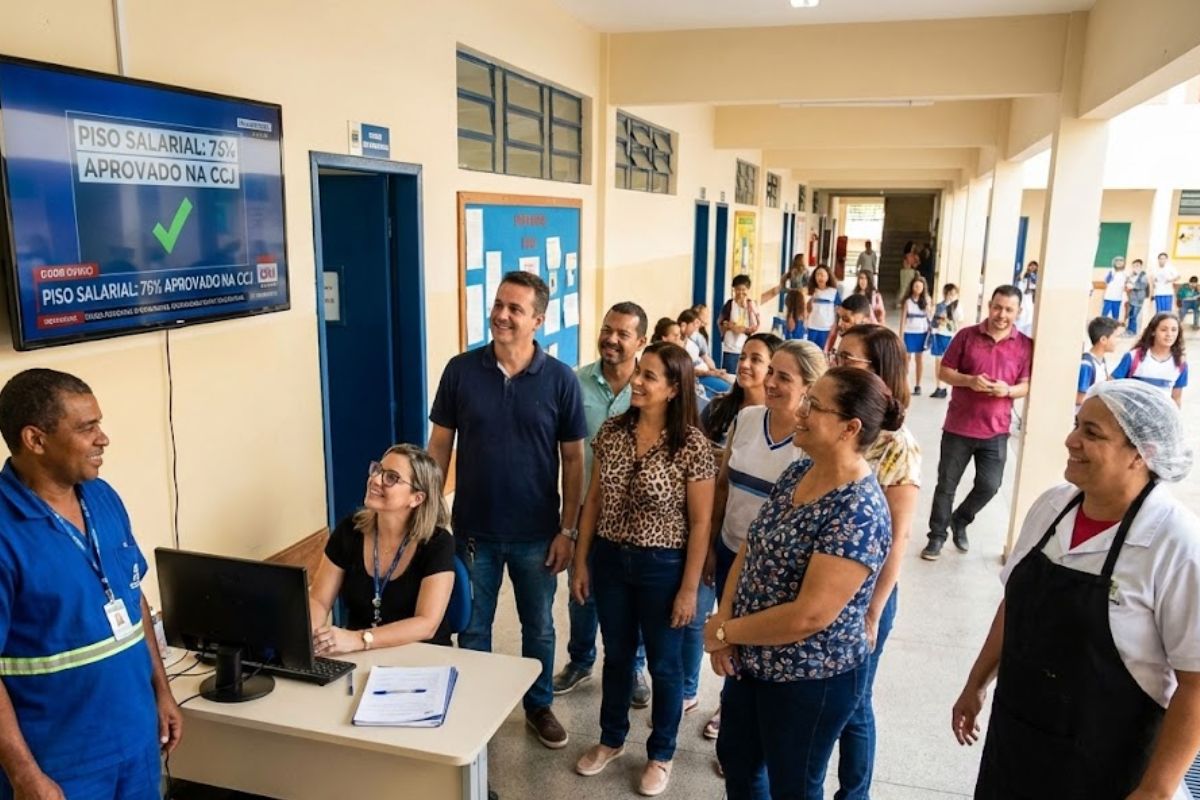


Technical, Operational, and Administrative Professionals in Public Basic Education Saw the CCJ of the Chamber Approve National Minimum Wage Equivalent to 75% of the Teachers’ Minimum Wage, Conclusively Opening the Way for a Dignified Minimum Wage, While the Text Proceeds for Senate Review in 2025, This Same Tuesday, December 9.
Technical, operational, and administrative staff from public basic education celebrated this Tuesday, December 9, 2025, the approval of the national minimum wage by the Constitution and Justice and Citizenship Commission (CCJ) of the Chamber of Deputies. Conclusively, the parliamentarians validated the text that guarantees a minimum wage equivalent to 75% of the teachers’ minimum wage for this group of workers.
The new level was established in the substitute from the Education Commission for Bill 2531/21, reported by Deputy Danilo Forte (União CE). The proposal will move to the Senate, unless there is a request for a vote in the Chamber’s Plenary, keeping the debate on minimum wage and valuing the team that sustains the day-to-day operations of public schools across the country alive.
Who Will Benefit from the New Minimum Wage
The approved text in the CCJ establishes a national minimum wage specifically for professionals in the technical, operational, and administrative areas of public basic education.
-
Brazilian city bets on the business environment to generate jobs and attract investments in the energy sector — secretary reveals strategy at Macaé Energy 2026.

-
50 viaducts, 4 tunnels, 28 bridges, and 40 kilometers of bike paths: BR-262 in Espírito Santo will receive 8.6 billion reais for the largest engineering project in the state’s history, inspired by the Immigrant Highway in São Paulo.

-
Brazil produces too much clean energy and doesn’t know what to do with it: over 20% of solar and wind capacity was wasted in 2025 while investors flee and 509 renewable generation projects were abandoned in the last year.

-
Piauí will produce a new fuel that replaces diesel without needing to change anything in the truck’s engine and reduces pollutant gas emissions by half: truck drivers from all over the Northeast are already celebrating the news that will arrive later this decade.


This group includes staff who do not work directly in the classroom but are considered essential for the functioning of education networks.
In practice, these workers will be entitled to an initial minimum wage equal to 75% of the teachers’ minimum wage in basic education.
The measure does not define all other components of compensation but ensures a starting level for the group of employees working in support, management, and service functions in Brazilian public schools.
By linking the value to the teachers’ minimum wage, the project aims to bring the minimum wage of these professionals closer to the reality of teachers, recognizing that behind-the-scenes work is also crucial for the quality of education offered to students.
What the Reporter Says About Valuation and Autonomy
The approved opinion followed entirely the analysis of the reporter, Deputy Danilo Forte. According to him, “the measure aims to value an essential segment for the functioning of education networks, without removing autonomy from federated entities”.
In the parliamentarian’s assessment, the text merely establishes a national minimum initial wage, leaving it to States, the Federal District, and Municipalities the responsibility to define career structures and other benefits.
This means that, above the national minimum wage, each federative entity remains free to create bonuses, supplements, and career plans compatible with its financial and administrative reality.
With this framework, the proposal seeks to balance two objectives: to guarantee a dignified minimum wage for the base of the school team and, at the same time, to preserve the local decision-making space on how to organize and compensate careers in public basic education.
Details of the Proceedings and Changes Regarding Adjustments
The approval in the CCJ occurred in a conclusive manner, a stage that typically concludes the merit analysis in the Chamber of Deputies.
However, it is still possible for there to be a request to bring the topic to the Plenary, which would extend the debate among parliamentarians before sending it to the Senate.
An important point of the final text is that a sub-amendment from the Finance and Taxation Commission removed the article that provided for annual updates of the minimum wage, which would be based on the same adjustment index used for public basic education professionals.
With this change, the project maintains the definition of a national minimum wage of 75% of the teachers’ minimum wage, but leaves the future adjustment rule open, which may be defined in a new legislative discussion or by specific norms of each sphere of government.
Still, the approval is seen as a significant step towards securing a fairer minimum wage for the workers who keep schools running every day.
Next Steps in Congress and Impact on Schools
If there is no request for the Plenary, the proposal will proceed directly to the Federal Senate, where senators may confirm, amend, or reject the text approved by the deputies. Only after being approved in both Houses and sanctioned will the new minimum wage take effect as law throughout the national territory.
Until then, state and municipal networks are closely monitoring the proceedings, as the creation of a national minimum wage for technical, operational, and administrative staff impacts the payroll of States, the Federal District, and Municipalities.
The reporter himself highlighted that the project was developed to not infringe upon the autonomy of federated entities, allowing each government to adjust its careers and benefits above the established minimum.
For basic education workers, however, the message from the CCJ vote is clear: Congress acknowledges that without a valued support team, there is no quality public school.
And you, do you think that this minimum wage of 75% of the teachers’ minimum wage is sufficient to value those who keep public schools running every day?









Sim,as merendeiras merecem, trabalhamos com amor e dedicação.
E os professores do ensino médio? Do RSG
E os aposentados do RSG
E os professores do ensino médio? Do RSG
E os aposentados do RSG